

M23 rebels battling Congo’s army close in on Goma as panic spreads among city’s 2 million people

1 / 3
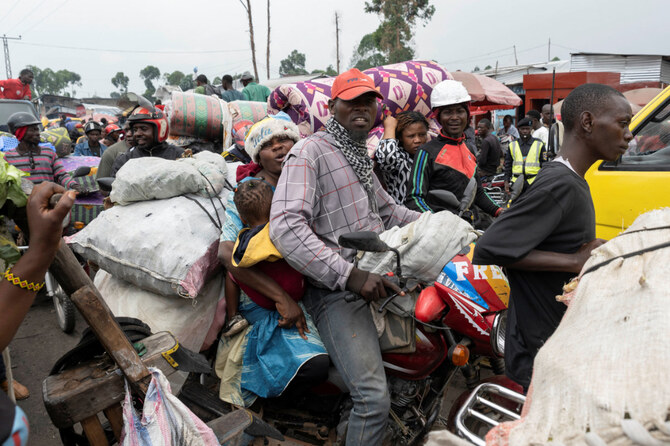
Civilians carry their belongings as they flee from the Nzulo camp for the internally displaced to Goma, as fighting intensifies between the M23 rebels and government forces. (REUTERS)
2 / 3
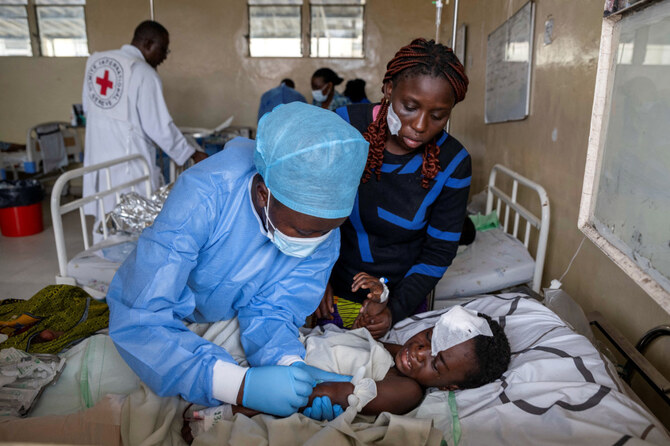
A health worker attends to a newly admitted patient at the CBCA Ndosho hospital in the town of Sake, near Goma, eastern DR Congo, amid fighting between M23 rebels and government forces. (Reuters)
3 / 3
Uruguayan soldiers of the United Nations peacekeeping force in DR Congo stand along the road leading to the entrance of the town of Sake, 25 km north-west of Goma, on January 23, 2025. (AFP)
Short Url
Updated 24 January 2025
Follow

M23 rebels battling Congo’s army close in on Goma as panic spreads among city’s 2 million people

  • The rebel group has advanced significantly in recent weeks, closing in on Goma, which has around 2 million people
  • M23 is one of about 100 armed groups that have been vying for a foothold in mineral-rich eastern Congo, along the border with Rwanda

GOMA, Congo: Panic spread in eastern Congo’s main city on Thursday, with M23 rebels steadily inching closer to Goma and seizing a nearby town as they battle the Congolese army. Bombs were heard going off in the city’s distant outskirts and hundreds of wounded civilians were brought in to the main hospital from the area of the fighting.
The rebel group has advanced significantly in recent weeks, closing in on Goma, which has around 2 million people and is a regional hub for security and humanitarian efforts. On Thursday, the rebels took Sake, a town only 27 kilometers (16 miles) from Goma and one of the last main routes into the provincial capital still under government control, according to the UN chief.
M23 is one of about 100 armed groups that have been vying for a foothold in mineral-rich eastern Congo, along the border with Rwanda, in a decadeslong conflict that has created one of the world’s largest humanitarian crises.
More than 7 million people have been displaced by the fighting. Earlier this month, M23 captured the towns of Minova, Katale and Masisi, west of Goma.
“The people of Goma have suffered greatly, like other Congolese,” an M23 spokesperson, Lawrence Kanyuka, said on X. “M23 is on its way to liberate them, and they must prepare to welcome this liberation.”
M23 seized Goma in 2012 and controlled it for over a week.


An armored unit of the United Nations peacekeeping force in Congo drive towards Goma on January 23, 2025, as advancing M23 rebels close in on the key city. (AFP)

As news of fighting spread, schools in Goma sent students home on Thursday morning.
“We are told that the enemy wants to enter the city. That’s why we are told to go home,” Hassan Kambale, a 19-year-old high school student, said. “We are constantly waiting for the bombs.”
Congo, the United States and UN experts accuse Rwanda of backing the M23, mainly composed of ethnic Tutsis who broke away from the Congolese army over a decade ago.
Rwanda’s government denies the claim but last year admitted that it has troops and missile systems in eastern Congo to safeguard its security, pointing to a buildup of Congolese forces near the border. UN experts estimate there are up to 4,000 Rwandan forces in Congo.
On Wednesday, Congo’s minister of communication, Patrick Muyaya, told French broadcaster France 24 that war with Rwanda is an “option to consider.”
Late Thursday, UN Secretary-General António Guterres condemned “in the strongest terms, the renewed offensive launched by the 23 March Movement (M23),” including the “seizure of Sake.”
“This offensive has a devastating toll on the civilian population and heightened the risk of a broader regional war,” Guterres’ statement read. He also urged “all parties to uphold human rights and international humanitarian law.”
Earlier in the day, Congolese authorities claimed that the military pushed back an attack from the “Rwandan army” on Sake. The Associated Press was unable to verify if Rwanda’s army took part in the offensive.
“The population is in panic. The M23 now control large parts of the town,” said Léopold Mwisha, the president of civil society of the area of Sake.


Villagers fleeing fighting in  the town of Minova arrive in Nzulo camp, North Kivu, DR Congo, on 21 January 2025. (EPA)

Guterres said he was “deeply troubled” by the most recent reports about the “presence of Rwandan troops on Congolese soil and continued support to the M23.”
The US Embassy in Congo’s capital, Kinshasa, in a notice warned of “an increase in the severity of armed conflict near Sake” and advised US nationals in North Kivu province, which includes Goma, to be on the alert in case they need to leave their homes on short notice.
The United Kingdom also issued a travel advisory that said M23 now controls Sake and urged British nationals to leave Goma while roads remain open.
Many Sake residents have joined the more than 178,000 people who have fled the M23 advance in the last two weeks.
The CBCA Ndosho Hospital in Goma was stretched to the limit, with hundreds of newly wounded on Thursday.
Thousands escaped the fighting by boat on Wednesday, making their way north across Lake Kivu and spilling out of packed wooden boats in Goma, some with bundles of their belongings strapped around their foreheads.
Neema Matondo said she fled Sake during the night, when the first explosions started to go off. She recounted seeing people around her torn to pieces and killed.
“We escaped, but unfortunately” others did not, Matondo told the AP.
Mariam Nasibu, who fled Sake with her three children, was in tears — one of her children lost a leg, blown off in the relentless shelling.
“As I continued to flee, another bomb fell in front of me, hitting my child,” she said, crying.


Nobel laureate Machado says US helped her leave Venezuela, vows return

Updated 6 sec ago
Follow

Nobel laureate Machado says US helped her leave Venezuela, vows return

  • Machado emerged on a hotel balcony in Oslo to cheering supporters early Thursday
  • “We did get support from the United States government to get here,” Machado said

OSLO: Nobel Peace laureate Maria Corina Machado said on Thursday that the United States helped her get to Norway from hiding in Venezuela, expressing support for US military action against her country and vowing to return home.
Machado, who vanished in January after challenging the rule of President Nicolas Maduro, emerged on a hotel balcony in Oslo to cheering supporters early Thursday after several days of confusion over her whereabouts.
“We did get support from the United States government to get here,” Machado told a press conference when asked by AFP about whether Washington had helped.
The Wall Street Journal reported that she wore a wig and a disguise on the high-risk journey, leaving her hide-out in a Caracas suburb on Monday for a coastal fishing village, where she took a fishing skiff across the Caribbean Sea to Curacao.
The newspaper said the US military was informed to avoid the boat being targeted by airstrikes. Once on the island, she took a private jet to Oslo early on Wednesday.
Machado thanked those who “risked their lives” to get her to Norway but it was not immediately clear how or when she will return to Venezuela, which has said it would consider her a fugitive if she left.
“Of course, the risk of going back, perhaps it’s higher, but it’s always worthwhile. And I’ll be back in Venezuela, I have no doubt,” she added.
Machado has been hailed for her fight for democracy but also criticized for aligning herself with US President Donald Trump, to whom she has dedicated her Nobel, and for inviting foreign intervention in her country.

- Military build-up -

The United States has launched a military build-up in the Caribbean in recent weeks and deadly strikes on what Washington says are drug-smuggling boats.
“I believe every country has the right to defend themselves,” Machado told reporters Thursday.
“I believe that President Trump’s actions have been decisive to reach the point where we are right now, in which the regime is weaker than ever, because the regime previously thought that they could do anything,” she continued.
Late Wednesday, Trump said the United States had seized a “very large” oil tanker near Venezuela, which Caracas denounced as “blatant theft.”
Maduro maintains that US operations are aimed at toppling his government and seizing Venezuela’s oil reserves.
Machado first appeared on a balcony of the Grand Hotel in the middle of the night, waving and blowing kisses to supporters chanting “libertad” (“freedom“) below.
On the ground, she climbed over metal barriers to get closer to her supporters, many of whom hugged her and presented her with rosaries.
She said she has missed much of her children’s lives while hiding, including graduations and weddings.

- ‘ Political risk’ -

Machado won the Peace Prize for “her struggle to achieve a just and peaceful transition from dictatorship to democracy.”
She has accused Maduro of stealing Venezuela’s July 2024 election, from which she was banned — a claim backed by much of the international community.
She last appeared in public on January 9 in Caracas, where she protested Maduro’s inauguration for his third term.
The decision to leave Venezuela and join the Nobel festivities in Oslo comes at both personal and political risk.
“She risks being arrested if she returns even if the authorities have shown more restraint with her than with many others, because arresting her would have a very strong symbolic value,” said Benedicte Bull, a professor specializing in Latin America at the University of Oslo.
While Machado is the ” undisputed” leader of the opposition, “if she were to stay away in exile for a long time, I think that would change and she would gradually lose political influence,” Bull said.
In her acceptance speech read by one of her daughters Wednesday, Machado denounced kidnappings and torture under Maduro’s tenure, calling them “crimes against humanity” and “state terrorism, deployed to bury the will of the people.”