

Winter treasures: Truffle hunting in Northern Borders desert

1 / 4
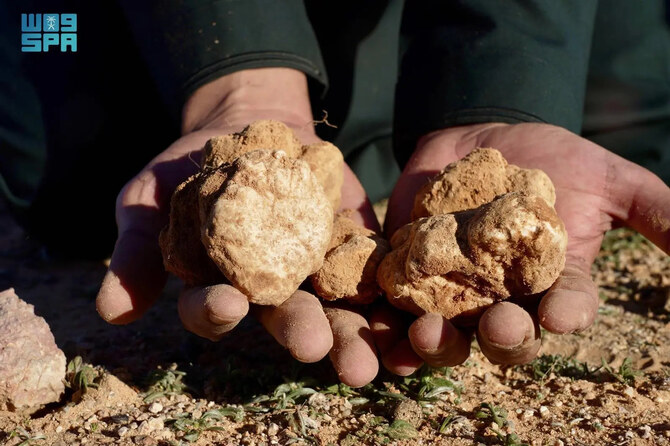
The truffle hunting season is not just a quest for food; it is a celebration of nature and heritage. (SPA)
2 / 4
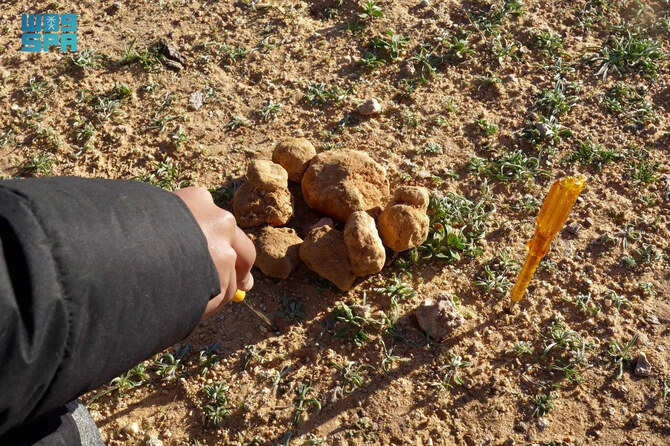
The truffle hunting season is not just a quest for food; it is a celebration of nature and heritage. (SPA)
3 / 4
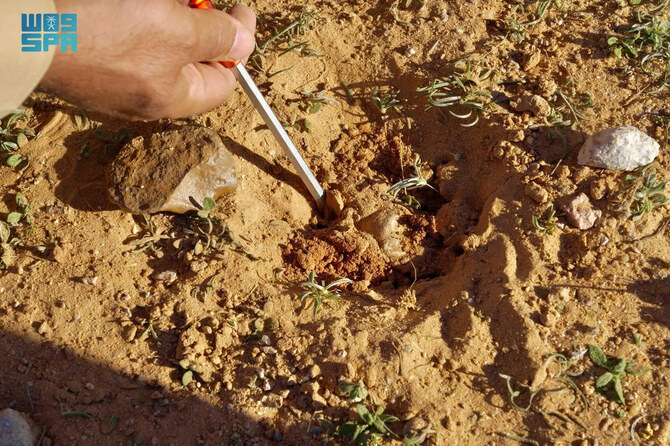
The truffle hunting season is not just a quest for food; it is a celebration of nature and heritage. (SPA)
4 / 4
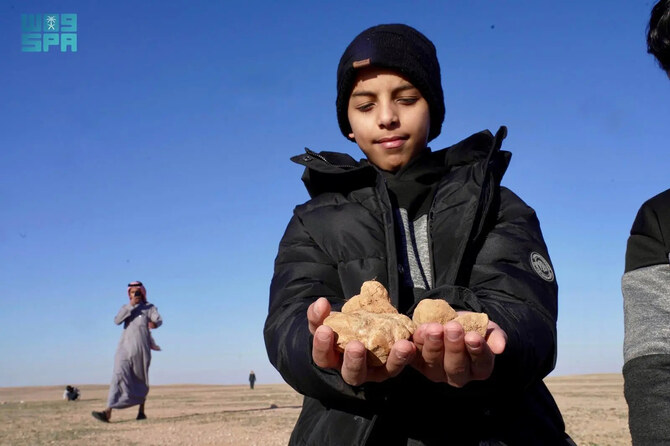
The truffle hunting season is not just a quest for food; it is a celebration of nature and heritage. (SPA)
Short Url
Updated 26 January 2025
Follow

Winter treasures: Truffle hunting in Northern Borders desert

  • Truffle season coincides with the rainy period from late winter to early spring
  • Truffles’ unique flavor enhances the taste of dishes

RAFHA: Truffle hunting in the Northern Borders region is an annual activity that combines the thrill of discovery with the beauty of heritage, attracting nature and heritage enthusiasts who embark on sunrise journeys in search of these prized delicacies.

The Saudi Press Agency accompanied a group of enthusiasts in Al-Sahin area, where they gathered truffles in a tranquil desert setting, enjoying the scent of rain mingling with the earth and flora. This experience highlights the deep connection between natural heritage and local culture.


The truffle hunting season is not just a quest for food; it is a celebration of nature and heritage. (SPA)

Enthusiasts use traditional knowledge to interpret soil and plant indicators, identifying potential truffle sites. Using simple tools that reflect humanity’s connection to the environment, they employ long sticks to shift the soil and uncover hidden treasures.

Others use their hands to gently remove the surface layer without damaging the truffles, while bags and baskets are prepared for collection.

Types of trufflesin KSA

Zubaidi - stands out for its round shape

Khalasi - the smallest and has an irregular shape

Jabbi - small and round

Hooper - the most irregular in shape

The truffle season coincides with the rainy period from late winter to early spring, usually beginning in January and lasting until the end of March. During the rainy season in Saudi Arabia, the rainfall enriches the soil and activates truffle seeds, with growth rates varying. Some truffles require 50 to 70 days of rain, while others take less time.

Truffles are wild fungi that grow beneath the surface at different depths, depending on the complex interaction of soil, moisture, and surrounding plants.

They thrive in well-ventilated sandy or clay soil, exhibiting signs such as slight cracks or small lumps when ripe.

Among the various types, the zubaidi stands out for its round shape, while the irregularly shaped khalasi is the smallest. The jabbi is small and round, while the tiny hooper is the most irregular in shape.


he truffle hunting season is not just a quest for food; it is a celebration of nature and heritage. (SPA)

Truffles are celebrated for their unique flavor that enhances the taste of dishes. The truffle hunting season is not just a quest for food; it is a celebration of nature and heritage, fostering social bonds and revitalizing an age-old tradition passed down through generations.

As interest in this heritage activity grows, there is an increasing recognition of the need to educate future generations on preserving the environment and the desert landscapes, which are integral to this land’s cultural heritage. The truffle season is a testament to the splendor of nature and the importance of heritage.


Saudi Arabia, Estonia strengthen cyber defense cooperation

Updated 5 sec ago
Follow

Saudi Arabia, Estonia strengthen cyber defense cooperation

  • Renowned for its leadership in digital governance, Estonia sees cybersecurity as central to its partnership potential with Saudi Arabia, building on years of regional engagement through its technology firms

RIYADH: Estonia aims to deepen defense, cybersecurity, and artificial intelligence cooperation with Saudi Arabia as both nations look to advance technology‑driven defense and cybersecurity capabilities.

Hanno Pevkur, Estonia’s minister of defense, told Arab News at the World Defense Show in Riyadh on Monday that Estonia’s defense industry is eager to contribute to the Kingdom’s fast‑growing defense ecosystem.

“In the modern world, cooperation built on trust and technology is the best defense,” he said. “It is important for us to be here because we clearly see there is a possibility to increase cooperation, not only bilaterally between Saudi Arabia and Estonia, but across the region.”

At Estonia’s pavilion, a cooperation agreement was signed between an Estonian company and a Saudi firm during the show, he noted.

Pevkur also said Estonia’s defense sector has expanded rapidly in recent years, driven by technological innovation and partnership.

“Our defense industry is growing very rapidly, and we continue to see strong momentum,” he said.

He said Estonia’s strengths lie in digital and smart‑system integration rather than large‑scale weapons production.

“We will not build airplanes or tanks, but what we can do is integrate robotics, automation and drones to make existing systems smarter,” he said.

The minister said effective defense collaboration must link businesses and governments to achieve meaningful results.

“When we want to have real cooperation, we need it on all levels,” he said. “The biggest client for any defense company is the government, so we must treat this as one ecosystem where the public and private sectors work hand in hand.”

Renowned for its leadership in digital governance, Estonia sees cybersecurity as central to its partnership potential with Saudi Arabia, building on years of regional engagement through its technology firms.

Pevkur said several Estonian companies, including Nortal, have already assisted Gulf governments in developing open IT and digital‑service systems.

“As the most digitalized nation in the world, almost every service in Estonia can be done online, except getting married,” he said. “But with such digitalization, we also need strong cyberdefense.”

He said data protection and digital resilience are treated as matters of national sovereignty in Tallinn, the capital of Estonia.

“Data is what we own. When someone steals that data, it becomes a serious threat,” he added. “That is why cyberdefense is not just about technology, it is about trust, sovereignty and protection.”

Pevkur said Saudi Arabia’s advances in AI offer promising opportunities for collaboration.

“I know that Saudi Arabia is doing great work when it comes to AI,” he said. “For us, as a small country with limited human resources, AI is essential not just for defense but for everyday life.”

Pevkur added that Estonia has launched a national AI strategy to promote responsible development and closer coordination between government and industry. One Estonian company, he said, has developed a system that allows a single operator to control hundreds of drones through AI.

“It is quite easy to put a weapon into the hands of a robot, but we also need to define who is accountable for its actions,” he said.

“The big question for the future is whether we can allow a war to be fought entirely by AI, or if humans must always make the final ethical decisions.”

He said in his conclusion that governments must reach a common understanding on how AI will be used and regulated on the battlefield.