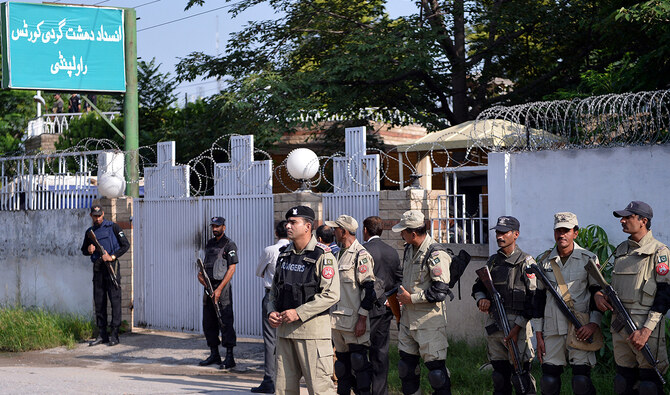
MULTAN: A Pakistani court Saturday sentenced four people to death for blasphemy, allegedly because they posted sacrilegious material on social media about Islamic religious figures and the Holy Qur’an. Their lawyer said appeal preparations are underway.
Under the country’s blasphemy laws, anyone found guilty of insulting Islam or its religious figures can be sentenced to death. Authorities have yet to carry out such a penalty, although the accusation of blasphemy and opposition to the law can incite mob violence or reprisals.
Judge Tariq Ayub in the city of Rawalpindi declared that blasphemy, disrespect to holy figures, and desecration of the Holy Qur’an were unforgivable offenses and left no room for leniency.
Along with the death sentences, the judge imposed collective fines of 4.6 million rupees (around $16,500) and handed down jail terms to each of the four should a higher court overturn their death sentences.
The men’s lawyer, Manzoor Rahmani, criticized the court’s decision and investigating authorities’ lack of evidence.
“The doubts and uncertainties that arise in such cases are ignored by the courts, likely due to the fear of religious backlash and potential mob violence against the judge if the accused is acquitted,” said Rahmani.
“We are preparing our appeals against the decision and will go to the High Court.”
Anti-blasphemy measures introduced in Pakistan in the 1980s made it illegal to insult Islam.
Since then, people have been accused of insulting the religion, desecrating its texts, or writing offensive remarks on the walls of mosques. Critics of the law say it is used to settle personal disputes.

Pakistani court sentences four people to death for blasphemy
https://arab.news/6h5js
Pakistani court sentences four people to death for blasphemy
- Under Pakistan’s laws, anyone found guilty of insulting Islam or its figures can be sentenced to death
- Authorities have yet to carry out such a penalty, although opposition to the law can incite reprisals
Pakistan, China to sign multiple MoUs at major agriculture investment conference today
- Hundreds of Chinese and Pakistani firms to attend Islamabad event
- Conference seen as part of expanding CPEC ties into agriculture, trade
KARACHI: Islamabad and Beijing are set to sign multiple memorandums of understanding (MoUs) to boost agricultural investment and cooperation at a major conference taking place in the capital today, Monday, with hundreds of Chinese and Pakistani companies expected to participate.
The conference is being billed by Pakistan’s Ministry of National Food Security and Research as a platform for deepening bilateral agricultural ties and supporting broader economic engagement between the two countries.
“Multiple memorandums of understanding will be signed at the Pakistan–China Agricultural Conference,” the Ministry of National Food Security said in a statement. “115 Chinese and 165 Pakistani companies will participate.”
The conference reflects a growing emphasis on expanding Pakistan-China economic cooperation beyond the transport and energy foundations of the flagship China-Pakistan Economic Corridor (CPEC) into agriculture, industry and technology.
Under its first phase launched in 2015, CPEC, a core component of China’s Belt and Road Initiative, focused primarily on transportation infrastructure, energy generation and connectivity projects linking western China to the Arabian Sea via Pakistan. That phase included motorways, power plants and the development of the Gwadar Port in the country's southwest, aimed at helping Pakistan address chronic power shortages and enhance transport connectivity.
In recent years, both governments have formally moved toward a “CPEC 2.0” phase aimed at diversifying the corridor’s impact into areas such as special economic zones, innovation, digital cooperation and agriculture. Second-phase discussions have highlighted Pakistan’s goal of modernizing its agricultural sector, attracting Chinese technology and investment, and boosting export potential, with high-level talks taking place between planning officials and investors in Beijing.
Agri-sector cooperation has also seen practical collaboration, with joint initiatives examining technology transfer, export protocols and value-chain development, including partnerships in livestock, mechanization and horticulture.
Organizers say the Islamabad conference will bring together government policymakers, private sector investors, industry associations and multinational agribusiness firms from both nations. Discussions will center on investment opportunities, technology adoption, export expansion and building linkages with global buyers within the framework of Pakistan-China economic cooperation.


