

Pakistan province orders comprehensive probe into alleged police harassment of Chinese nationals

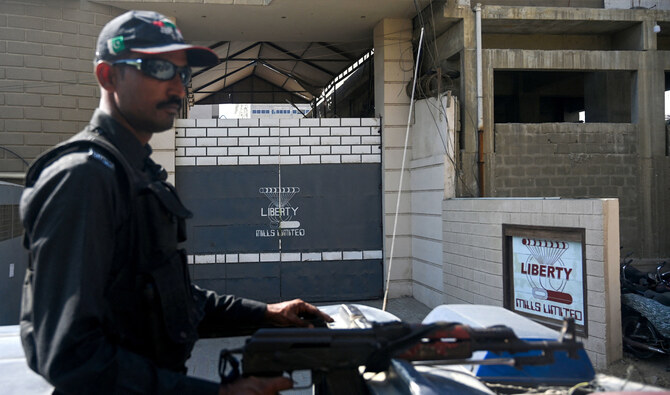
A police officer stand guard outside a factory where, according to police, two Chinese nationals were shot and injured, in Karachi, Pakistan on November 5, 2024. (AFP/File)
Short Url
Updated 25 January 2025
Follow

Pakistan province orders comprehensive probe into alleged police harassment of Chinese nationals

  • Group of Chinese nationals filed petition in high court accusing Sindh Police of extorting, imposing unlawful restrictions on them
  • Sindh official says it si necessary for police to take measures to address potential security gaps to ensure Chinese nationals’ security

KARACHI: The home minister of Pakistan’s southern Sindh province on Saturday took notice of police harassment and extortion allegations leveled by Chinese nationals, directing authorities to launch a “comprehensive investigation” into the matter. 

Twelve Chinese nationals filed a petition in the Sindh High Court (SHC) December 2024 alleging they are being forced to pay bribes to police officers ranging from Rs20,000 ($71) to Rs50,000 ($179) for permission to leave their homes. It demanded a high-level inquiry into the involvement of police officers in their mistreatment. The SHC issued notices to the Sindh government, Pakistani foreign ministry and China’s missions in Pakistan on Friday, seeking their response within four weeks. 

A significant number of private Chinese investors have arrived and established businesses with local partners in Pakistan since the China-Pakistan Economic Corridor, a multi-billion-dollar infrastructure network of roads, energy and railways projects, was launched in 2013. 

In Sindh, the provincial government has established a Special Protection Unit (SPU) within the provincial police force to ensure the security of Chinese nationals, who have been under threat from separatist groups operating in neighboring Balochistan province. These groups have also carried out attacks on Chinese interests and citizens in Karachi, the capital of Sindh and commercial hub of the country.

“Sindh Home Minister Zia-ul-Hassan Lanjar has taken notice of the Chinese investors’ decision to approach the Sindh High Court, issuing instructions to the IGP Sindh to immediately appoint a senior inquiry officer for a comprehensive investigation into the matter,” the Sindh home ministry said in a statement. 

As per the statement, Lanjar said the provincial government is committed to ensuring the security of Chinese nationals according to the set standard operating procedures. 

“Therefore, it must be ensured that at the provincial level, the “foolproof security” of Chinese nationals involved in both CPEC and non-CPEC projects is a joint responsibility of the Sindh government, Sindh Police and local sponsors or hosts,” the statement said. 

This is aimed at further strengthening the unwavering trust of Chinese investors in the Sindh government and Sindh Police.

Lanjar stressed that it is the Sindh government and provincial police’s goal to facilitate and provide security to Chinese investors through mutual cooperation. He admitted, however, that it is also important that sponsors and SPU officers take steps to monitor security measures. 

“Additionally, it is necessary to address any potential gaps, shortcomings, or deficiencies in the security measures for Chinese nationals,” the statement said. “Implementing the measures outlined by law and SOPs is critical to eliminating any security gaps.”

Lanjar said that if Chinese nationals face security-related complaints, senior officers must not only review the situation but also ensure “a prompt resolution, as Chinese citizens turn to the Sindh Police for assistance regarding security concerns.”

Amid the surge in attacks on Chinese nationals in Pakistan, Beijing has repeatedly urged Islamabad to ensure protection for its citizens living and working in the South Asian country.

A suicide blast claimed by the separatist Balochistan Liberation Army (BLA) killed two Chinese nationals in Karachi in October, while five Chinese workers were killed in a suicide bombing in March 2024 in northwest Pakistan.

Pakistan says attacks on Chinese nationals are an international conspiracy to harm friendly ties between Pakistan and China.


Pakistan terms climate change, demographic pressures as ‘pressing existential risks’

Updated 4 sec ago
Follow

Pakistan terms climate change, demographic pressures as ‘pressing existential risks’

  • Pakistan has suffered frequent climate change-induced disasters, including floods this year that killed over 1,000
  • Pakistan finmin highlights stabilization measures at Doha Forum, discusses economic cooperation with Qatar 

ISLAMABAD: Pakistan’s Finance Minister Muhammad Aurangzeb on Saturday described climate change and demographic pressures as “pressing existential risks” facing the country, calling for urgent climate financing. 

The finance minister was speaking as a member of a high-level panel at the 23rd edition of the Doha Forum, which is being held from Dec. 6–7 in the Qatari capital. Aurangzeb was invited as a speaker on the discussion titled: ‘Global Trade Tensions: Economic Impact and Policy Responses in MENA.’

“He reaffirmed that while Pakistan remained vigilant in the face of geopolitical uncertainty, the more pressing existential risks were climate change and demographic pressures,” the Finance Division said. 

Pakistan has suffered repeated climate disasters in recent years, most notably the 2022 super-floods that submerged one-third of the country, displaced millions and caused an estimated $30 billion in losses. 

This year’s floods killed over 1,000 people and caused at least $2.9 billion in damages to agriculture and infrastructure. Scientists say Pakistan remains among the world’s most climate-vulnerable nations despite contributing less than 1 percent of global greenhouse-gas emissions.

Aurangzeb has previously said climate change and Pakistan’s fast-rising population are the only two factors that can hinder the South Asian country’s efforts to become a $3 trillion economy in the future. 

The finance minister noted that this year’s floods in Pakistan had shaved at least 0.5 percent off GDP growth, calling for urgent climate financing and investment in resilient infrastructure. 

When asked about Pakistan’s fiscal resilience and capability to absorb external shocks, Aurangzeb said Islamabad had rebuilt fiscal buffers. He pointed out that both the primary fiscal balance and current account had returned to surplus, supported significantly by strong remittance inflows of $18–20 billion annually from the Middle East and North Africa (MENA) and Gulf Cooperation Council (GCC) regions. 

Separately, Aurangzeb met his Qatari counterpart Ali Bin Ahmed Al Kuwari to discuss bilateral cooperation. 

“Both sides reaffirmed their commitment to strengthening economic ties, particularly by maximizing opportunities created through the newly concluded GCC–Pakistan Free Trade Agreement, expanding trade flows, and deepening energy cooperation, including long-term LNG collaboration,” the finance ministry said. 

The two also discussed collaboration on digital infrastructure, skills development and regulatory reform. They agreed to establish structured mechanisms to continue joint work in trade diversification, technology, climate resilience, and investment facilitation, the finance ministry said.