

Pakistan police say bound to follow SOPs to protect Chinese nationals amid harassment allegations

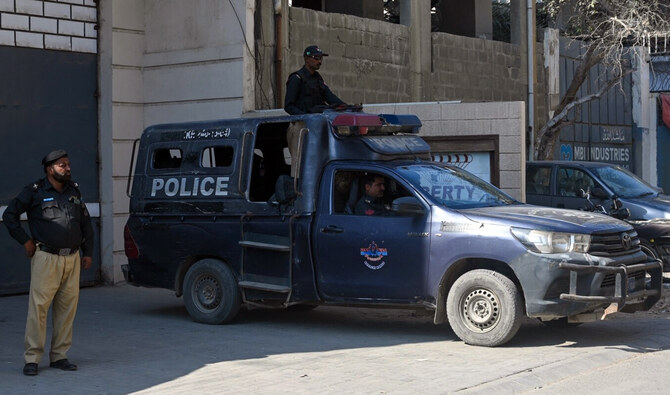
Police officers stand guard outside a factory where, according to police, two Chinese nationals were shot and injured, in Karachi, Pakistan on November 5, 2024. (AFP/File)
Short Url
Updated 25 January 2025
Follow

Pakistan police say bound to follow SOPs to protect Chinese nationals amid harassment allegations

  • Group of Chinese nationals filed petition in high court accusing Sindh Police of extorting, imposing unlawful restrictions on them
  • Chinese nationals, under threat from separatist groups in neighboring Balochistan, have suffered attacks in Karachi in recent past

KARACHI: The police in Pakistan’s southern Sindh province this week said they are bound to follow the federal and provincial governments’ instructions to ensure protection for Chinese nationals, responding to a group of Chinese citizens who filed a petition against alleged police harassment and extortion. 

The Sindh High Court (SHC) on Friday sought a response from Pakistani authorities over alleged harassment, extortion and unlawful restrictions on Chinese nationals imposed by police in Sindh, after a group of 12 Chinese nationals filed a petition in December alleging their families were confined to their residences for nearly a week, forcing them to pay police hefty bribes. 

A significant number of private Chinese investors have arrived and established businesses with local partners in Pakistan since both countries initiated the multi-billion-dollar infrastructure China-Pakistan Economic Corridor (CPEC) in 2015. 

In Sindh, the provincial government has established a Special Protection Unit (SPU) within the provincial police force to ensure security for Chinese nationals, under threat from separatist groups operating in neighboring Balochistan province which have also carried out attacks on Chinese interests and citizens in Karachi, the commercial hub of the country.

“Sindh Police is bound to implement at any cost the instructions/SOPs issued by the Government of Pakistan and the Sindh government in the context of the safety of Chinese guests,” a statement from the Sindh Police’s Public Relations officer said on Friday. 

It said the provincial police aims to provide convenience and security to Chinese investors, and is ensuring all possible measures for their “foolproof security measures.”

“The responsibility of the security of Chinese citizens associated with non-CPEC projects lies with Sindh Police and local sponsors,” the statement said, adding that security lapses and gaps are regularly checked to ensure security for Chinese nationals. 

The provincial police said In case of any security complaints by Chinese investors, senior officers immediately check and resolve it.

“Sindh Police will ensure the implementation of instructions issued by the Government of Pakistan and the Government of Sindh regarding the safety of Chinese citizens so that a safe environment can be provided to Chinese investors,” it concluded. 

China has repeatedly urged Pakistani authorities to ensure protection for its citizens living and working in the South Asian country. 

A suicide blast claimed by the separatist Balochistan Liberation Army (BLA) killed two Chinese nationals in Karachi in October, while five Chinese workers were killed in a suicide bombing in March 2024 in northwest Pakistan.


Pakistan Air Force conducts ‘Exercise Golden Eagle’ to test combat readiness, agility

Updated 10 February 2026
Follow

Pakistan Air Force conducts ‘Exercise Golden Eagle’ to test combat readiness, agility

  • The exercise follows an intense, four-day Pakistan-India military conflict in May 2025
  • It focused on AI-enabled operations integrating disruptive technologies, military says

ISLAMABAD: The Pakistan Air Force (PAF) has conducted “Exercise Golden Eagle” that successfully validated its combat readiness and operational agility through synchronized employment of the PAF’s complete combat potential, the Pakistani military said on Tuesday.

It comes months after Pakistan’s four-day military conflict with India in May, with Islamabad claiming victory in the standoff after the PAF claimed to have shot down at least six Indian fighter aircraft, including the French-made Rafale. New Delhi acknowledged some losses but did not specify a number.

The exercise was conducted on a Two-Force construct, focusing on AI-enabled, net-centric operations while integrating indigenous niche, disruptive and smart technologies in line with evolving regional security dynamics, according to the Inter-Services Public Relations (ISPR), the Pakistani military’s media wing.

Operating within a robust Integrated Air Defense System, friendly forces shaped the battlespace through seamless fusion of kinetic operations with cyber, space and electro-magnetic spectrum operations.

“The kinetic phase featured First-Shoot, First-Kill swing-role combat aircraft equipped with long-range BVR air-to-air missiles, extended-range stand-off weapons and precision strike capabilities, supported by Airborne Early Warning & Control platforms and Air-to-Air Refuelers,” the ISPR said in a statement.

“A key highlight of the exercise was Manned–Unmanned Teaming, with deep-reach killer drones and loitering munitions operating in a highly contested, congested and degraded environment, validating PAF’s capability to conduct high-tempo operations in modern warfare.”

In recent months, many countries have stepped up defense engagement with Pakistan, while delegations from multiple nations have proposed learning from the PAF’s multi-domain air warfare capabilities that officials say were successfully employed during the May conflict.

“The successful conduct of Exercise Golden Eagle reaffirms Pakistan Air Force’s unwavering commitment to maintaining a high state of operational preparedness, leveraging indigenous innovation and effectively countering emerging and future security challenges,” the ISPR added.