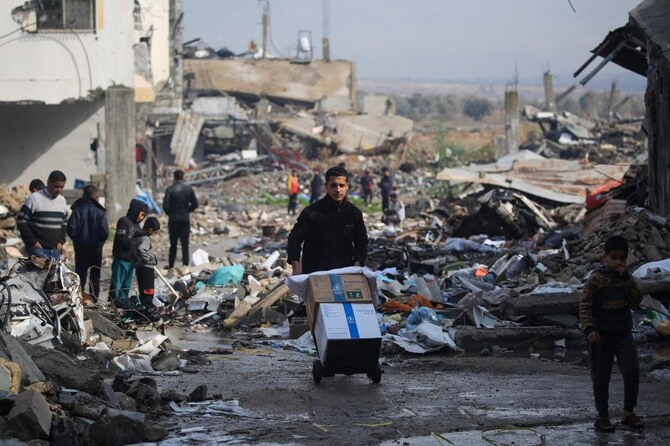
JERUSALEM: Hundreds of truckloads of aid have entered Gaza since the Israel-Hamas ceasefire began last weekend, but its distribution inside the devastated territory remains an enormous challenge.
The destruction of the infrastructure that previously processed deliveries and the collapse of the structures that used to maintain law and order make the safe delivery of aid to the territory’s 2.4 million people a logistical and security nightmare.
In the final months before the ceasefire, the few aid convoys that managed to reach central and northern Gaza were routinely looted, either by desperate civilians or by criminal gangs.
Over the past week, UN officials have reported “minor incidents of looting” but they say they are hopeful that these will cease once the aid surge has worked its way through.
In Rafah, in the far south of Gaza, an AFP cameraman filmed two aid trucks passing down a dirt road lined with bombed out buildings.
At the first sight of the dust cloud kicked up by the convoy, residents began running after it.
Some jumped onto the truck’s rear platforms and cut through the packaging to reach the food parcels inside.
UN humanitarian coordinator for the Middle East Muhannad Hadi said: “It’s not organized crime. Some kids jump on some trucks trying to take food baskets.
“Hopefully, within a few days, this will all disappear, once the people of Gaza realize that we will have aid enough for everybody.”
central Gaza, residents said the aid surge was beginning to have an effect.
“Prices are affordable now,” said Hani Abu Al-Qambaz, a shopkeeper in Deir el-Balah. For 10 shekels ($2.80), “I can buy a bag of food for my son and I’m happy.”
The Gaza spokesperson of the Fatah movement of Palestinian president Mahmud Abbas said that while the humanitarian situation remained “alarming,” some food items had become available again.
The needs are enormous, though, particularly in the north, and it may take longer for the aid surge to have an impact in all parts of the territory.
In the hunger-stricken makeshift shelters set up in former schools, bombed-out houses and cemeteries, hundreds of thousands lack even plastic sheeting to protect themselves from winter rains and biting winds, aid workers say.
In northern Gaza, where Israel kept up a major operation right up to the eve of the ceasefire, tens of thousands had had no access to deliveries of food or drinking water for weeks before the ceasefire.
With Hamas’s leadership largely eliminated by Israel during the war, Gaza also lacks any political authority for aid agencies to work with.
In recent days, Hamas fighters have begun to resurface on Gaza’s streets. But the authority of the Islamist group which ruled the territory for nearly two decades has been severely dented, and no alternative administration is waiting in the wings.
That problem is likely to get worse over the coming week, as Israeli legislation targeting the lead UN aid agency in Gaza takes effect.
Despite repeated pleas from the international community for a rethink, the UN Relief and Works Agency for Palestine Refugees (UNRWA), which has been coordinating aid deliveries into Gaza for decades, will be effectively barred from operating from Tuesday.
UNRWA spokesman Jonathan Fowler warned the effect would be “catastrophic” as other UN agencies lacked the staff and experience on the ground to replace it.
British Foreign Secretary David Lammy warned last week that the Israeli legislation risked undermining the fledgling ceasefire.
Brussels-based think tank the International Crisis Group said the Israeli legislation amounted to “robbing Gaza’s residents of their most capable aid provider, with no clear alternative.”
Israel claims that a dozen UNRWA employees were involved in the October 2023 attack by Hamas gunmen, which started the Gaza war.
A series of probes, including one led by France’s former foreign minister Catherine Colonna, found some “neutrality related issues” at UNRWA but stressed Israel had not provided evidence for its chief allegations.

Gaza aid surge having an impact but challenges remain
Short Url
https://arab.news/4x8sw
Gaza aid surge having an impact but challenges remain
- In final months before ceasefire, aid convoys were routinely looted by gangs, residents
- In central Gaza, residents say flow of aid has begun to take effect as prices normalize
Trump, Erdogan discuss Syria and Gaza in call
WASHINGTON/ ANKARA: Turkish President Tayyip Erdogan discussed developments in Syria and Gaza with US counterpart Donald Trump in a telephone call on Tuesday as Syria’s Turkiye-backed government announced a ceasefire with US-allied Kurdish forces after days of clashes.
Turkiye separately weighed if Erdogan should join the US leader’s “Board of Peace” initiative.
“President Erdogan stated that Turkiye was closely following developments in Syria, that Syria’s unity, harmony and territorial integrity were important for Turkiye,” the Turkish presidency said in a statement.
Earlier Trump said he had a “very good call” with Erdogan, without elaborating.
Syria’s government seized swathes of territory in the northeast this week, and gave the Kurdish-led Syrian Democratic Forces four days to agree on integrating into the central state.
The SDF’s main ally, the United States, said the partnership with the group had changed nature after Syria’s new government emerged.
The Turkish presidency added that Erdogan and Trump also discussed the fight against the Islamic State militant group and the “situation” of its prisoners in Syrian jails.
Turkiye deems the SDF a terrorist organization linked with the outlawed Kurdistan Workers Party (PKK), which has mounted a four-decade insurgency against the Turkish state.
In its peace process with the PKK, Ankara has called for the group and its affilites to disband and disarm.
Ankara, the main foreign backer of Syria’s new government, has praised Damascus’ advances against the SDF and repeatedly called for it to integrate with the Syrian state apparatus.
ERDOGAN THANKS TRUMP FOR ‘BOARD OF PEACE’ INVITE
Erdogan told Trump Turkiye would continue to coordinate with Washington on Gaza, the Turkish presidency said.
“President Erdogan thanked US President Trump for the invitation to the Gaza Board of Peace,” it added.
A UN Security Council resolution, adopted in mid-November, authorized the “Board of Peace” and countries working with it to establish an international stabilization force in Gaza.
In October, a fragile ceasefire began in Gaza under a Trump plan on which Israel and Palestinian militant group Hamas had signed off.
Earlier on Tuesday, Turkiye said Erdogan would decide soon on joining the initiative. Turkiye has been critical of Israel’s assault on Gaza, casting it as genocide, while Israel has repeatedly opposed a Turkish role in Gaza.
More than 460 Palestinians, more than 100 of them children, and three Israeli soldiers have been reported killed since the Gaza truce began.
Under Trump’s Gaza plan, the board was meant to supervise Gaza’s temporary governance. Later Trump said it would be expanded to tackle conflicts around the world.
Many rights experts say that Trump’s chairing of a board to supervise a foreign territory’s affairs would resemble a colonial structure.
Diplomats fear such a board for global issues could harm the work of the United Nations.
Among those the White House has named to the board are Secretary of State Marco Rubio, Britain’s former Prime Minister Tony Blair, and Trump’s son-in-law, Jared Kushner.
Turkiye separately weighed if Erdogan should join the US leader’s “Board of Peace” initiative.
“President Erdogan stated that Turkiye was closely following developments in Syria, that Syria’s unity, harmony and territorial integrity were important for Turkiye,” the Turkish presidency said in a statement.
Earlier Trump said he had a “very good call” with Erdogan, without elaborating.
Syria’s government seized swathes of territory in the northeast this week, and gave the Kurdish-led Syrian Democratic Forces four days to agree on integrating into the central state.
The SDF’s main ally, the United States, said the partnership with the group had changed nature after Syria’s new government emerged.
The Turkish presidency added that Erdogan and Trump also discussed the fight against the Islamic State militant group and the “situation” of its prisoners in Syrian jails.
Turkiye deems the SDF a terrorist organization linked with the outlawed Kurdistan Workers Party (PKK), which has mounted a four-decade insurgency against the Turkish state.
In its peace process with the PKK, Ankara has called for the group and its affilites to disband and disarm.
Ankara, the main foreign backer of Syria’s new government, has praised Damascus’ advances against the SDF and repeatedly called for it to integrate with the Syrian state apparatus.
ERDOGAN THANKS TRUMP FOR ‘BOARD OF PEACE’ INVITE
Erdogan told Trump Turkiye would continue to coordinate with Washington on Gaza, the Turkish presidency said.
“President Erdogan thanked US President Trump for the invitation to the Gaza Board of Peace,” it added.
A UN Security Council resolution, adopted in mid-November, authorized the “Board of Peace” and countries working with it to establish an international stabilization force in Gaza.
In October, a fragile ceasefire began in Gaza under a Trump plan on which Israel and Palestinian militant group Hamas had signed off.
Earlier on Tuesday, Turkiye said Erdogan would decide soon on joining the initiative. Turkiye has been critical of Israel’s assault on Gaza, casting it as genocide, while Israel has repeatedly opposed a Turkish role in Gaza.
More than 460 Palestinians, more than 100 of them children, and three Israeli soldiers have been reported killed since the Gaza truce began.
Under Trump’s Gaza plan, the board was meant to supervise Gaza’s temporary governance. Later Trump said it would be expanded to tackle conflicts around the world.
Many rights experts say that Trump’s chairing of a board to supervise a foreign territory’s affairs would resemble a colonial structure.
Diplomats fear such a board for global issues could harm the work of the United Nations.
Among those the White House has named to the board are Secretary of State Marco Rubio, Britain’s former Prime Minister Tony Blair, and Trump’s son-in-law, Jared Kushner.
© 2026 SAUDI RESEARCH & PUBLISHING COMPANY, All Rights Reserved And subject to Terms of Use Agreement.