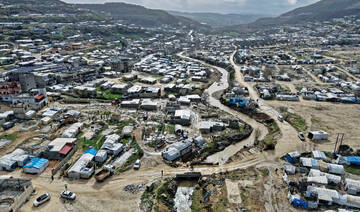
Gaza life expectancy nearly half prewar levels: Study

Israel’s war in Gaza has led to a drop in average life expectancy of 35 years in the Palestinian enclave, a new study has found. (AFP)
Short Url
Updated 24 January 2025
Follow

Gaza life expectancy nearly half prewar levels: Study

  • Data published in Lancet shows average life expectancy fell from 75.5 to 40.5 in a year
  • Figures could be worse due to collapse of Gaza’s health systems, researchers warn

LONDON: Israel’s war in Gaza has led to a drop in average life expectancy of 35 years in the Palestinian enclave, a new study has found.

The Lancet journal published data suggesting that life expectancy had dropped to 40.5 years by September 2024, having been 75.5 years before Israel began its invasion in October 2023.

Researchers for the study at the University of Pennsylvania said the true average age could be lower as only data from those killed by war injuries was considered rather than overall casualty figures, which were likely exacerbated by the collapse of Gaza’s health system.

Casualty lists from Gaza’s health authorities were cross-referenced with a UN refugee list and census data to arrive at the findings.

“Our life expectancy results show that the … war in the Gaza Strip generated a life expectancy loss of more than 30 years during the first 12 months of the war, nearly halving pre-war levels,” the study’s authors said.

Despite the logistical issues caused by the war, the UN considers the Gaza health data — which claims that 47,000 have died — accurate.

The UN Human Rights Office said it verified the identities of 8,119 people killed from November 2023 to April 2024.

It added that 44 percent were children and 26 percent were women, with the largest age bracket 5-9-year-olds, and that around 80 percent of people were killed in residential buildings.

“Our case-by-case evaluation of the Gaza Health Ministry list of killed individuals did not detect any substantial errors or signs of intentional inflation,” the researchers said.

“It is highly likely that our central estimates underestimate true losses, because they do not include individuals reported missing or under the rubble.

“Even more importantly, our results do not include the indirect effects of the war on mortality.”

A separate Lancet study published earlier this month suggests that the 47,000-casualty figure may be an underestimate by around 40 percent.


In major policy shift on Syria, UN Security Council lifts sanctions on Hayat Tahrir Al-Sham

Updated 15 min 13 sec ago
Follow

In major policy shift on Syria, UN Security Council lifts sanctions on Hayat Tahrir Al-Sham

  • Move reflects evolving Syrian political landscape in the post-Assad era, ending a global freeze on assets, travel ban and arms embargo

NEW YORK CITY: The UN Security Council on Friday removed Al-Nusra Front, the militant group that evolved into Hayat Tahrir Al-Sham, from its so-called Daesh and Al-Qaeda Sanctions List.

The move signals a major shift in international policy toward Syria’s evolving political landscape in the post-Assad era, and ends a global freeze on assets, travel ban and arms embargo that have been imposed on the group since 2014.

Al-Nusra Front and Hayat Tahrir Al-Sham were led by Ahmad Al-Sharaa, formerly Abu Mohammed Al-Julani, who is now Syria’s president and was a leading figure in the offensive that toppled the Assad regime.

The consensus decision by the Security Council’s sanctions committee was announced by the UK, which holds the presidency of the Security Council this month and was acting in the absence of the chair of the committee. It followed a request by the new Syrian authorities to delist “Al-Nusrah Front for the People of the Levant.”

The decision means measures that were applied to Hayat Tahrir Al-Sham under Security Council Resolution 2734, adopted in 2024, no longer apply. As a result, UN member states are notrequired to freeze the group’s funds, restrict the movement of its representatives, or block the supply or transfer of arms and related materiel.

Al-Nusra Front was added to the sanctions list for its ties to Al-Qaeda and involvement in the financing and execution of militant activities during the war in Syria. The UN initially continued to treat the group’s successor organization, Hayat Tahrir Al-Sham, as a listed alias.

Al-Sharaa has said the group severed all prior transnational jihadist links and is now solely focused on local Syrian matters.