Saudi foreign minister calls for ending Syria sanctions during talks in Damascus

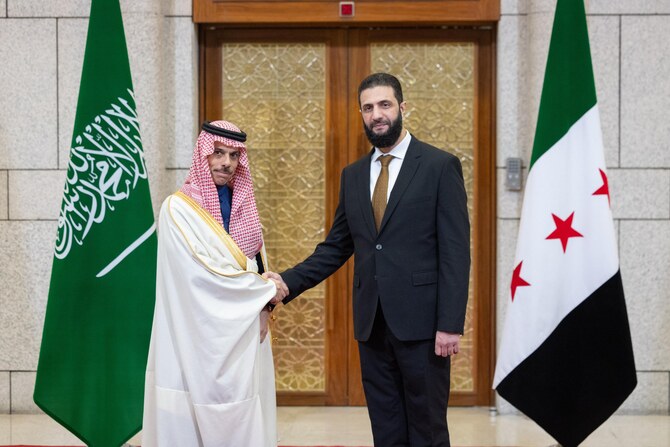
Saudi Arabia’s Foreign Minister Prince Faisal bin Farhan arrived in Syria on Friday for an official visit. (SPA)
Short Url
Updated 24 January 2025
Follow

Saudi foreign minister calls for ending Syria sanctions during talks in Damascus

  • Prince Faisal is in Syria for his first official visit there since the downfall of Bashar Assad
  • Foreign minister meets Syrian leader Ahmed Al-Sharaa and discusses support to help Syria during its transition

RIYADH: Saudi Arabia’s Foreign Minister Prince Faisal bin Farhan and Syrian leader Ahmed Al-Sharaa held talks in Damascus on Friday including the Kingdom's efforts to remove international sanctions from Syria.

Prince Faisal traveled to Syria for his first official visit there since the downfall of Bashar Assad to meet top officials in the new Syrian administration.The talks with Al-Sharaa focused on “supporting Syria's security, stability and unity,” the foreign ministry said.

“The talks also addressed efforts to support Syria's political, humanitarian, and economic aspects, emphasizing the ongoing efforts to lift the sanctions imposed on Syria and provide all forms of assistance and support to Syria during this critical phase to restore stability across its entire territory and revive its national institutions in a manner that aligns with the aspirations and hopes of the Syrian people,” the statement said.

Speaking at a press conference alongside the Syrian Foreign Minister Asaad Hassan Al-Shaibani, Prince Faisal said it was important to accelerate the “lifting and freezing of all sanctions."

He said Saudi Arabia was engaged in "active dialogue with all relevant countries, whether the United States or the European Union, and we are hearing positive messages.”

The EU and the US placed an extensive sanctions regime on Syria during the rule of Assad, who was toppled from power by Al-Sharaa’s Hayat Tahrir Al-Sham (HTS) group and its allies in December.

The US said earlier this month that it would ease sanctions on transactions with Syrian government institutions to help the flow of humanitarian assistance.

The EU is reported to be close to agreeing to ease sanctions on certain sectors.

During his meeting with Al-Sharaa, Prince Faisal passed on the greetings of King Salman and Crown Prince Mohammed bin Salman.

The new Syrian administration chose Saudi Arabia for its first foreign visit when Al-Shaibani led a delegation to Riyadh earlier this month.

The Kingdom has stepped up humanitarian aid supplies to Syria since the start of the year.

Prince Faisal arrived in Syrian after a visit to Lebanon on Thursday, where he met the new President General Joseph Aoun.


Program to combat terrorist financing ends

Updated 14 sec ago
Follow

Program to combat terrorist financing ends

RIYADH: The Islamic Military Counter Terrorism Coalition has concluded its advanced training program in Nairobi, Kenya, which was focused on combating terrorist financing and money laundering.

The five-day program was part of the Saudi-backed coalition’s capacity-building initiative, aimed at strengthening member states’ capabilities to combat financial crimes linked to terrorism.

The closing ceremony was attended by Maj. Gen. Mohamed Nour Hassan, Kenya’s deputy army commander, and several civilian and military officials, the Saudi Press Agency reported.

The program brought together specialists from the banking, financial, and security sectors, including financial compliance officers, investigators, and professionals combating money laundering and terrorist financing, as well as representatives from regulatory and supervisory authorities. It combined theoretical knowledge with practical exercises.

Sessions addressed international legislation frameworks, emerging methods of terrorist financing, money-laundering mechanisms, and the use of digital technologies for monitoring and analysis.

The program also covered leadership skills and corporate compliance management, supported by case studies and exercises to enhance participants’ ability to trace suspicious financial flows and analyze complex patterns.

The coalition said that the program reflected its commitment to helping member states build effective national systems to combat terrorist financing and financial crimes, enhance coordination with regional and international partners, and improve specialist efficiency.

These efforts contribute to integrated responses that keep pace with evolving challenges and support security and stability at national and international levels.