

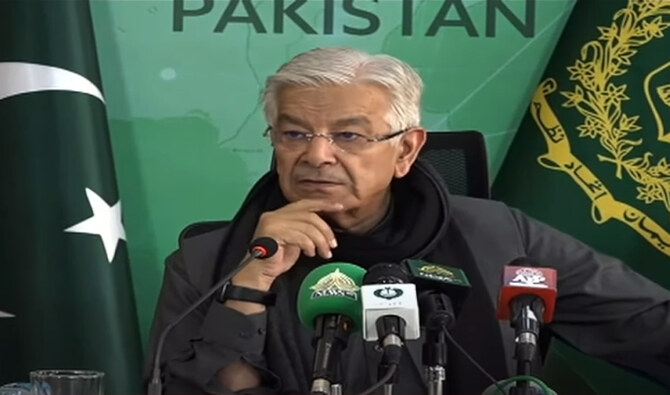

ISLAMABAD: Pakistan’s Defense Minister Khawaja Asif confirmed on Friday the government would seek the extradition from the UAE of real estate tycoon Malik Riaz Hussain who is charged in a land corruption case involving former prime minister Imran Khan, promising to bring him back to Pakistan to stand trial.
Hussain is one of Pakistan’s wealthiest and most influential businessmen and the country’s largest private employers. He is best known as the chairman of Bahria Town Limited, which claims to be Asia’s largest private real estate developer. Hussain currently lives in Dubai.
Last week, a Pakistani court sentenced ex-premier Khan to 14 years in prison and his wife, Bushra, to seven years in a case in which they are accused of receiving land as a bribe from Hussain through the Al-Qadir charitable trust during Khan’s premiership from 2018 to 2022 in exchange for illegal favors. All three deny any wrongdoing.
Khan says he and his wife were trustees and did not benefit from the land transaction. Hussain has also denied any wrongdoing related to the case.
“His [Hussain’s] extradition will also be carried out now on a state-to-state level,” Asif told reporters at a press conference. “We have an extradition treaty with the UAE. A mafia cannot be allowed to run as a parallel state.”
The defense minister said Hussain had used his immense wealth and influence to seize land from the poor and widows for his housing societies across the country, saying Bahria Town’s transactions over the past 25-30 years were “not transparent.”
“You will see flaws in the approvals of all the land bought by Hussain for his housing societies,” he added.
Earlier this week, Pakistan’s anti-corruption watchdog, the National Accountability Bureau (NAB), had cautioned people against investing in Hussain’s new real estate venture to build luxury apartments in Dubai.
“If the general public at large invests in the stated project, their actions would be tantamount to money laundering, for which they may face criminal and legal proceedings.”
Responding to NAB on X, Hussain said “fake cases, blackmailing and greed of officers” had forced him to relocate from country because he was not willing to be a “political pawn,”
AL-QADIR CASE
In 2019, Britain’s National Crime Agency (NCA) said Hussain had agreed to hand over 190 million pounds held in Britain to settle a UK investigation into whether the money was from the proceeds of crime.
The NCA said it had agreed to a settlement in which Hussain would hand over a property, 1 Hyde Park Place, valued at 50 million pounds, and cash frozen in British bank accounts.
The NCA had previously secured nine freezing orders covering 140 million pounds in the accounts on the grounds that the money may have been acquired illegally.
The agency said the assets would be passed to the government of Pakistan and the settlement with Hussain was “a civil matter, and does not represent a finding of guilt.”
The case against Hussain and ex-PM Khan now is that instead of putting the tycoon’s settlement money in Pakistan’s treasury, Khan’s government used the money to pay fines levied by a court against Hussain for illegal acquisition of government lands at below-market value for development in Karachi.


