

On International Day of Education, Pakistan vows to embrace ‘promise of AI’

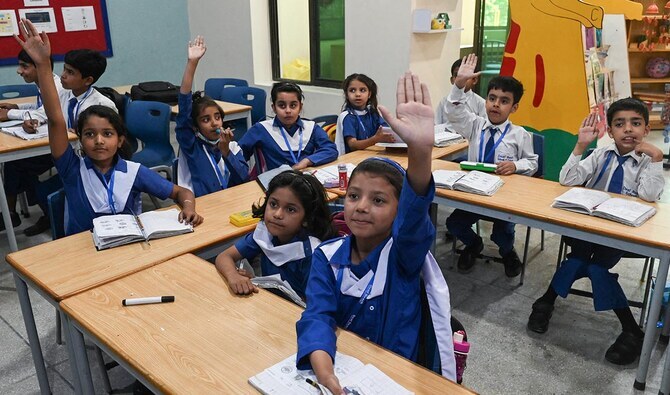
This photograph taken on May 6, 2024, shows hearing-impaired students attending a class at a school run by the charity Deaf Reach, a non-profit organization working to empower disadvantaged deaf children and youths, in Lahore, Pakistan. (AFP/File)
Short Url
Updated 24 January 2025
Follow

On International Day of Education, Pakistan vows to embrace ‘promise of AI’

  • Theme of this year’s International Day of Education is “AI and Education: Preserving Human Agency in a World of Automation” 
  • Around the world, AI is being increasingly used in education to improve the learning experience for both students and teachers

KARACHI: Pakistani Prime Minister Shehbaz Sharif on Friday, the International Day of Education, reaffirmed his government’s commitment to advancing an education system that embraced the “promise of AI” and supported the country’s youth in thriving in an evolving technological landscape.

The theme of this year’s International Day of Education is “AI and Education: Preserving Human Agency in a World of Automation.” Around the world, AI is being increasingly used in education to improve the learning experience for students and teachers. AI can automate tasks, provide real-time feedback, and create personalized learning experiences.

“As AI-driven systems become increasingly integrated into our lives, the boundaries between human intervention and machine-driven actions continue to blur,” Sharif said in a statement.

“This presents both opportunities and challenges, raising the critical question of how we can uphold and enhance human agency amidst the growing tide of automation.”

He said his government recognized the transformative power of education in preparing Pakistan’s youth to thrive in the evolving technological landscape. 

“By fostering critical thinking, innovation, and ethical responsibility, we aim to equip our citizens with the tools not only to adapt to technological changes but to shape them in ways that uphold our values, protect our freedoms, and advance our society,” the PM said. 

He highlighted steps taken in Pakistan to prepare its educational institutions to embrace technological advancements. These initiatives include the establishment of High-Impact IT Labs in ICT degree colleges, Digital Hubs in rural ICT schools, the Google Center of Excellence, SMART Classrooms, and the E-Taleem Portal for blended learning. 

“Additionally, we have introduced E-Rozgar Centers, Software Technology Parks, Robotics and Mind Games programs, and STEAM Labs to foster innovation. It is imperative that our schools are equipped with the latest technologies to equip our children with the requisite skills,” the PM said. 

“On this day, while we reaffirm our resolve to advancing an education system that embraces the promise of AI while safeguarding the essence of human creativity, compassion, and purpose.”


Imran Khan not a ‘national security threat,’ ex-PM’s party responds to Pakistan military

Updated 06 December 2025
Follow

Imran Khan not a ‘national security threat,’ ex-PM’s party responds to Pakistan military

  • Pakistan’s military spokesperson on Friday described Khan’s anti-army narrative as a “national security threat”
  • PTI Chairman Gohar Ali Khan says words used by military spokesperson for Khan were “not appropriate”

ISLAMABAD: Former prime minister Imran Khan’s Pakistan Tehreek-e-Insaf (PTI) party on Saturday responded to allegations by Pakistan military spokesperson Lt. Gen. Ahmed Sharif Chaudhry from a day earlier, saying that he was not a “national security threat.”

Chaudhry, who heads the military’s media wing as director general of the Inter-Services Public Relations (ISPR), spoke to journalists on Friday, in which he referred to Khan as a “mentally ill” person several times during the press interaction. Chaudhry described Khan’s anti-army narrative as a “national security threat.”

The military spokesperson was responding to Khan’s social media post this week in which he accused Chief of Defense Forces Field Marshal Asim Munir of being responsible for “the complete collapse of the constitution and rule of law in Pakistan.” 

“The people of Pakistan stand with Imran Khan, they stand with PTI,” the party’s secretary-general, Salman Akram Raja, told reporters during a news conference. 

“Imran Khan is not a national security threat. Imran Khan has kept the people of this country united.”

Raja said there were several narratives in the country, including those that created tensions along ethnic and sectarian lines, but Khan had rejected all of them and stood with one that the people of Pakistan supported. 

PTI Chairman Gohar Ali Khan, flanked by Raja, criticized the military spokesperson as well, saying his press talk on Thursday had “severely disappointed” him. 

“The words that were used [by the military spokesperson] were not appropriate,” Gohar said. “Those words were wrong.”

NATURAL OUTCOME’

Speaking to reporters earlier on Saturday, Pakistan’s Defense Minister Khawaja Asif defended the military spokesperson’s remarks against Khan.

“When this kind of language is used for individuals as well as for institutions, then a reaction is a natural outcome,” he said. 

“The same thing is happening on the Twitter accounts being run in his [Khan’s] name. If the DG ISPR has given any reaction to it, then I believe it was a very measured reaction.”

Khan, who was ousted after a parliamentary vote of confidence in April 2022, blames the country’s powerful military for removing him from power by colluding with his political opponents. Both deny the allegations. 

The former prime minister, who has been in prison since August 2023 on a slew of charges he says are politically motivated, also alleges his party was denied victory by the army and his political rivals in the 2024 general election through rigging. 

The army and the government both deny his allegations.