

Pakistan rejects Afghanistan’s allegations it hosts Daesh militant camps

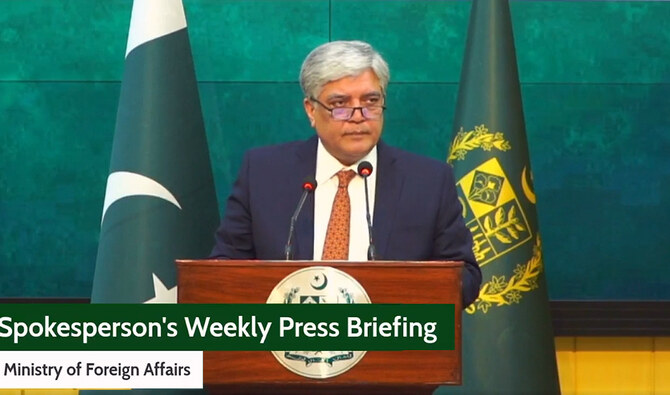
The screengrab taken from the press conference of Pakistan’s Ministry of Foreign Affairs shows the foreign office’s spokesperson Shafqat Ali Khan addressing weekly media briefing in Islamabad on January 23, 2025. (MOFA)
Short Url
Updated 24 January 2025
Follow

Pakistan rejects Afghanistan’s allegations it hosts Daesh militant camps

  • Foreign Office says Afghanistan is a source of “support and logistics” for militant operations against Pakistan
  • Ties between neighbors are strained over surge in militant attacks in Pakistan it blames on Afghanistan

ISLAMABAD: Foreign Office spokesperson Shafqat Ali Khan on Thursday rejected Afghanistan’s allegations Pakistan was hosting and facilitating Daesh militant camps, calling it “weird propaganda.”

The remarks come in response to allegations by Afghan officials that Pakistan was operating training camps for Daesh fighters and facilitating their movement through the Islamabad and Karachi airports for training in its southwestern Balochistan and northwestern Khyber Pakhtunkhwa provinces with the aim of carrying out militant activities in Afghanistan.

Islamabad also frequently accuses neighboring Afghanistan of sheltering and supporting militant groups that launch cross-border attacks amid a surge in militancy in its KP and Balochistan provinces. The Taliban government in Kabul says it does not allow Afghan soil to be used by militants, insisting Pakistan’s security issues are an internal matter for Islamabad.

“Frankly, we completely reject these allegations. They are not grounded in reality,” Khan said during a weekly press briefing when asked about the Afghan allegations on Daesh camps. “It’s just some kind of weird propaganda.”

He reiterated Pakistan’s concern over sanctuaries of the Pakistani Taliban or Tehreek-e-Taliban (TTP) in Afghanistan, accusing the country of being a source of “support and logistics” for TTP militant operations against Pakistan.

“It couldn’t do without the sanctuaries it’s enjoying in Afghanistan,” Khan added. “And we continue to impress upon the Afghan authorities to address this genuine and serious concern so that our bilateral relations can achieve full potential as good neighbors.”

Islamabad says it has consistently taken up the issue of cross-border attacks with the Taliban administration. The issue has also led to clashes between the border forces of the two countries on multiple occasions in recent months.

In December, the Afghan Taliban said bombardment by Pakistani military aircraft in Afghanistan’s eastern Paktika province had killed at least 46 people, most of whom were children and women. Just days later, the Afghan defense ministry said Taliban forces targeted “several points” in neighboring Pakistan, further straining tense ties. 

Relations between the two countries have also soured since Pakistan launched a deportation drive in November 2023 against illegal aliens residing in the country. Though Pakistan insists the campaign does not only target Afghans but all those residing in Pakistan unlawfully, it has disproportionately hit Afghans, with at least 800,000 repatriated so far.


Islamabad launches real-time fuel monitoring system as Iran war rattles oil markets

Updated 1 min 52 sec ago
Follow

Islamabad launches real-time fuel monitoring system as Iran war rattles oil markets

  • Authorities say they will track petrol stocks at 145 stations through City Islamabad app
  • Petrol stations in the city are required to upload daily stock data to prevent shortages

ISLAMABAD: Authorities in Pakistan’s capital have launched a digital system to monitor petroleum stocks at fuel stations in real time, and official statement said on Tuesday, as the government steps up oversight of supplies following market disruptions linked to tensions in the Middle East.

The system has been introduced by the Islamabad district administration days after authorities sealed seven petrol stations for refusing fuel to motorists. It will allow officials to track fuel inventories through the “City Islamabad” mobile application, requiring petrol pump operators to upload daily stock details as authorities seek to prevent hoarding and artificial shortages.

The initiative comes days after Pakistan raised fuel prices sharply and authorities across the country launched crackdowns on hoarding amid fears that escalating conflict in the Middle East could disrupt global energy shipments and push oil prices higher.

“Real-time monitoring will ensure that any shortage of petroleum products can be addressed immediately,” Islamabad Deputy Commissioner Irfan Memon said in the statement announcing the system.

The statement noted the new digital tool would enable authorities to track stock levels at 145 fuel stations across Islamabad and monitor transactions through the mobile platform.

Under the system, petrol pump owners must upload daily stock information, while the district administration has released a tutorial explaining how to use the feature.

Authorities warned that failure to upload stock data could result in action against fuel station owners.

Pakistan has tightened monitoring of fuel supplies in recent days after global oil markets were rattled by United States and Israeli strikes on Iran, which raised concerns about possible disruptions to shipping routes in the Middle East, particularly around the Strait of Hormuz, a key corridor for global energy trade.

The government has said it is closely watching domestic supply conditions and international oil markets while taking steps to ensure fuel availability and prevent panic buying.