

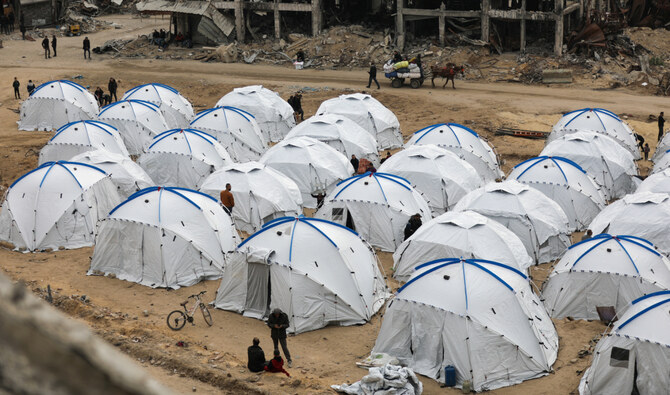
Gazans prepare tent camps for families returning to north

Palestinians set up a new tent camp to shelter people expected to return to northern Gaza after being displaced to the south following a ceasefire between Israel and Hamas, in Gaza City, January 22, 2025. (Reuters)
Short Url
Updated 24 January 2025
Follow

Gazans prepare tent camps for families returning to north

GAZA CITY: Palestinians in northern Gaza prepared tent encampments for displaced families on Thursday, two days before they were expected to return to their home areas under the timeline of a ceasefire deal agreed between Israel and Hamas.

On open ground surrounded by blown-out buildings, a group of men began putting up rows of white tents to receive families who are planning to return north on Saturday when Hamas is due to release a second batch of hostages in return for dozens of Palestinians jailed by Israel.

Many of the hundreds of thousands of Palestinians expected to head back to the northern Gaza Strip will return to homes in ruins after a 15-month Israeli military offensive that has laid waste to the enclave and killed more than 47,000 Gazans.

In October, Israeli forces returned to areas of the north in a major anti-Hamas operation focused on the Jabalia refugee camp near Gaza City and Beit Hanoun and Beit Lahiya towns, clearing the area of its inhabitants and razing most of its buildings.

“Is this the tent that we dreamed of? This will have to fit 10 people. This tent is for my children who are coming from the south. Really, is this adequate space?” asked Wael Jundiya as he prepared a tent for his children, who will return from where they had been sheltering in the Mawasi coastal area of the south.

“On Saturday, people will come from the south and flood Gaza (City). Where will they go? This camp will fit 100, 200 people. There will be 1.5 million coming from the south,” Jundiya told Reuters.

Hamas published a statement on Thursday saying the return of the displaced families would begin after Saturday’s exchange was complete and once Israeli forces had pulled out from the coastal road to the north. 

At least four hostages are expected to be handed over to Israel on Saturday.

Highlighting concerns by many Palestinians over how strong the phased ceasefire is, an Israeli tank shelling killed two Gazans in Rafah in the south of the enclave, the local civil emergency service said.


UN Security Council members blast Israel’s West Bank plans on eve of Trump’s Board of Peace meeting

Updated 19 February 2026
Follow

UN Security Council members blast Israel’s West Bank plans on eve of Trump’s Board of Peace meeting

  • Pakistan denounced Israel’s contentious West Bank settlement project during the meeting as a “clear violation of international law”
  • Pakistan is the only country on the 15-member council that also accepted an invitation to join US President Trump's Board of Peace

UNITED NATIONS: Members of the United Nations Security Council called Wednesday for the Gaza ceasefire deal to become permanent and blasted Israeli efforts to expand control in the West Bank as a threat to prospects of a two-state solution, coming on the eve of President Donald Trump’s first Board of Peace gathering to discuss the future of the Palestinian territories.
The high-level UN session in New York was originally scheduled for Thursday but was moved up after Trump announced the board’s meeting for the same day and it became clear that it would complicate travel plans for diplomats planning to attend both. It is a sign of the potential for overlapping and conflicting agendas between the United Nations’ most powerful body and Trump’s new initiative, whose broader ambitions to broker global conflicts have raised concerns in some countries that it may attempt to rival the UN Security Council.
Pakistan, the only country on the 15-member council that also accepted an invitation to join the Board of Peace, denounced Israel’s contentious West Bank settlement project during the meeting as “null and void” and said it constitutes a “clear violation of international law.”
“Israel’s recent illegal decisions to expand its control over the West Bank are gravely disturbing,” Pakistani Foreign Minister Ishaq Dar said.
The foreign ministers of the United Kingdom, Israel, Jordan, Egypt and Indonesia also attended the Security Council’s monthly Mideast meeting after many Arab and Islamic countries requested last week that it discuss Gaza and the West Bank before some of them head to Washington.
“Annexation is a breach of the UN Charter and of the most fundamental rules of international law,” Palestinian UN Ambassador Riyad Mansour said. “It is a breach of President Trump’s plan, and constitutes an existential threat to ongoing peace efforts.”
Israeli Foreign Minister Gideon Saar said that attention was not on the UN session and that the focus of the international world would be on the Board of Peace meeting.
Saar also accused the council of being “infected with an anti-Israeli obsession” and insisted that no nation has a stronger right than its “historical and documented right to the land of the Bible.”
Bigger ambitions for the Board of Peace
The board to be chaired by Trump was originally envisioned as a small group of world leaders overseeing his 20-point plan for Gaza’s future. But the Republican president’s new vision for the board to be a mediator of worldwide conflicts has led to skepticism from major allies.
While more than 20 countries have so far accepted an invitation to join the board, close US partners, including France, Germany and others, have opted not to join yet and renewed support for the UN, which also is in the throes of major reforms and funding cuts.
British Foreign Secretary Yvette Cooper said there is an opportunity for the UN’s most powerful body to help build “a better future” for Israelis and Palestinians despite the “cycle of violence and suffering” over the more than two-year war between Israel and Hamas.
“Gaza must not get stuck in a no man’s land between peace and war,” Cooper said as she opened the meeting.
Mike Waltz, the US ambassador to the UN, appeared to criticize countries that had not yet signed on to the Board of Peace, saying that unlike the Security Council, the board is “not talking, it is doing.”
“We are hearing the chattering class criticizing the structure of the board, that it’s unconventional, that it’s unprecedented,” Waltz said Wednesday. “Again, the old ways were not working.”
The Security Council is meeting a day after nearly all of its 15 members — minus the United States — and dozens of other diplomats joined Palestinian ambassador Mansour as he read a statement on behalf of 80 countries and several organizations condemning Israel’s latest actions in the West Bank, demanding an immediate reversal and underlining “strong opposition to any form of annexation.”
In the last several weeks, Israel has launched a contentious land regulation process that will deepen its control in the occupied West Bank. Israeli Energy Minister Eli Cohen said it amounts to “de facto sovereignty” that will block the establishment of a Palestinian state.
Outraged Palestinians, Arab countries and human rights groups have called the moves an illegal annexation of the territory, home to roughly 3.4 million Palestinians who seek it for a future state.
‘A pivotal moment in the Middle East’
The UN meeting also delved into the US-brokered ceasefire deal that took effect Oct. 10. UN political chief Rosemary DiCarlo and Israeli and Palestinian civil society representatives gave briefings for the first time since the Hamas-led Oct. 7, 2023, attacks that launched the war.
Hiba Qasas, a Palestinian who is founding executive director of Geneva-based Principles for Peace Foundation, and Nadav Tamir, a former Israeli diplomat who is executive director of J Street Israel, both said they represent a strong coalition of Israelis and Palestinians who believe the only way to end the conflict is through a two-state solution.
“Israel cannot remain the democratic homeland of the Jewish people if Palestinians are denied a homeland of their own. Our futures are interdependent,” Tamir said.
DiCarlo of the UN said this is “a pivotal moment in the Middle East” that opens the possibility for the region to move in a new direction. “But that opening is neither assured nor indefinite,” she said, and whether it will be sustained depends on decisions in the coming weeks.
“The Board of Peace meeting in Washington, D.C., tomorrow is an important step,” she said.
Aspects of the ceasefire deal have moved forward, including Hamas releasing all the hostages it was holding and increased amounts of humanitarian aid getting into Gaza, though the UN says the level is insufficient. A new technocratic committee has been appointed to administer Gaza’s daily affairs.
But the most challenging steps lie ahead, including the deployment of an international security force, disarming Hamas and rebuilding Gaza.
Trump said this week that the Board of Peace members have pledged $5 billion toward Gaza reconstruction and will commit thousands of personnel to international stabilization and police forces for the territory. He didn’t provide details. Indonesia’s military says up to 8,000 of its troops are expected to be ready by the end of June for a potential deployment to Gaza as part of a humanitarian and peace mission.