THE HAGUE: The International Criminal Court’s chief prosecutor on Thursday said he was seeking arrest warrants against senior Taliban leaders in Afghanistan over the persecution of women, a crime against humanity.
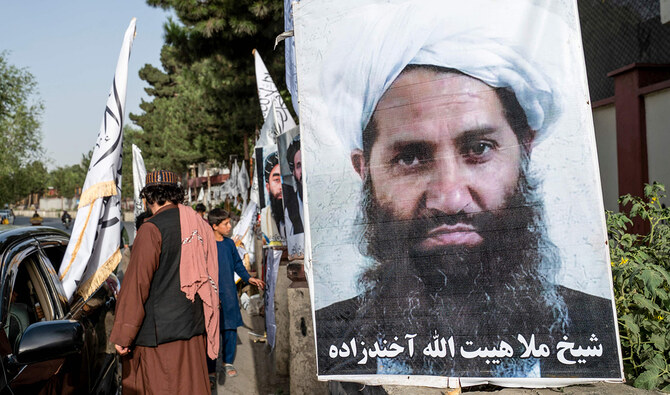
Karim Khan said there were reasonable grounds to suspect that Supreme Leader Haibatullah Akhundzada and chief justice Abdul Hakim Haqqani “bear criminal responsibility for the crime against humanity of persecution on gender grounds.”
Khan said that Afghan women and girls, as well as the LGBTQ community, were facing “an unprecedented, unconscionable and ongoing persecution by the Taliban.
“Our action signals that the status quo for women and girls in Afghanistan is not acceptable,” added Khan.
ICC judges will now consider Khan’s application before deciding whether to issue the warrants — a process that could take weeks or even months.
The court, based in The Hague, was set up to rule on the world’s worst crimes, such as war crimes and crimes against humanity.
It has no police force of its own and relies on its 125 member states to carry out its warrants — with mixed results.
In theory this means that anyone subject to an ICC arrest warrant cannot travel to a member state for fear of being detained.
Khan warned he would soon be seeking additional applications for other Taliban officials.
Akhundzada inherited the Taliban leadership in May 2016 after a US drone strike in Pakistan killed his predecessor.
Believed to be in his 60s or 70s, the reclusive supreme leader rules by decree from the Taliban movement’s birthplace in southern Kandahar.
Haqqani was a close associate of Taliban founder Mullah Omar and served as a negotiator during discussions with US representatives in 2020.
ICC prosecutor Khan argued the Taliban was “brutally” repressing resistance through crimes “including murder, imprisonment, torture, rape and other forms of sexual violence, enforced disappearance, and other inhumane acts.”
Human Rights Watch (HRW) said in a statement the prosecutor’s actions should put the Taliban’s exclusion of women and girls from public life back on the international agenda.
“This is an important moment for Afghan women and girls who have been waiting much too long for justice,” HRW’s women’s rights deputy director, Heather Barr, told AFP, calling for “other efforts to hold the Taliban fully accountable.”
The move was praised by Afghan women activists, including Shukria Barakzai, an Afghan former lawmaker and the ousted government’s ex-ambassador to Norway.
“It’s a victory,” she told AFP from London.
“This also could be counted as (an) important achievement for feminism globally... and particularly for women in Afghanistan.”
The UN special rapporteur for human rights in Afghanistan, Richard Bennett, called the move “a crucial step... for accountability in Afghanistan” on X.
After sweeping back to power in August 2021, the Taliban authorities pledged a softer rule than their first rein from 1996-2001. But they quickly imposed restrictions on women and girls that the United Nations has labelled “gender apartheid.”
Edicts in line with their interpretation of Islamic law have squeezed women and girls from public life.
They have barred girls from secondary school and women from university, making Afghanistan the only country in the world to impose such bans.
Taliban authorities imposed restrictions on women working for non-governmental groups and other employment, with thousands of women losing government jobs — or being paid to stay at home.
Beauty salons have been closed and women blocked from visiting public parks, gyms and baths as well as traveling long distances without a male chaperone.
A “vice and virtue” law announced last summer ordered women not to sing or recite poetry in public and for their voices and bodies to be “concealed” outside the home.
The few remaining women TV presenters wear tight headscarves and face masks in line with a 2022 diktat by Akhundzada that women cover everything but their eyes and hands in public.
The international community has condemned the restrictions, which remain a key sticking point in the Taliban authorities’ pursuit of official recognition, which it has not received from any state.
The Taliban authorities have dismissed international criticism of their policies, saying all citizens’ rights are provided for under Islamic law.


![]()

ICC prosecutor seeks arrest of Taliban leaders over persecution of women
Short Url
https://arab.news/5htp4
ICC prosecutor seeks arrest of Taliban leaders over persecution of women
- ICC judges will consider Khan’s application before deciding whether to issue warrants, a process that could take weeks or even months
- After coming to power in 2021, Taliban quickly imposed restrictions on women and girls that United Nations has called “gender apartheid“
Latest updates


Recommended


© 2026 SAUDI RESEARCH & PUBLISHING COMPANY, All Rights Reserved And subject to Terms of Use Agreement.