

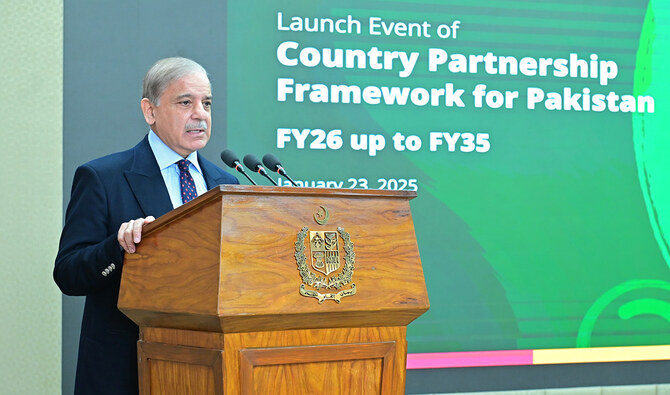
PM launches World Bank’s $20 billion Country Partnership Framework for Pakistan

Prime Minister Shehbaz Sharif speaks during the launching ceremony of World Bank’s Country Partnership Framework for Pakistan, in Islamabad on January 23, 2025. (Photo courtesy: PMO)
Short Url
Updated 23 January 2025
Follow

PM launches World Bank’s $20 billion Country Partnership Framework for Pakistan

  • 10-year-plan will focus on development issues like impact of climate change and boosting private-sector growth
  • Last year, Pakistan secured $7 billion IMF loan deal though Sharif has vowed to reduce dependence on foreign loans

ISLAMABAD: Prime Minister Shehbaz Sharif on Thursday launched the World Bank’s Country Partnership Framework (CPF) for Pakistan, a plan to focus $20 billion in loans to the cash-strapped nation over the coming decade on development issues like the impact of climate change and boosting private-sector growth.
Pakistan in 2023 nearly defaulted on the payment of foreign debts when the International Monetary Fund rescued it by agreeing to a $3 billion bailout to Pakistan. Last year, Islamabad secured a new $7 billion loan deal from the IMF. Since then, the country’s economy has started improving with weekly inflation coming down from 27 percent in 2023 to 1.8 percent earlier this month. Sharif has vowed to reduce dependence on foreign loans in the coming years.
The World Bank’s lending for Pakistan will start in 2026 and focus on six outcomes: improving education quality, tackling child stunting, boosting climate resilience, enhancing energy efficiency, fostering inclusive development and increasing private investment.
“Together, this partnership fosters a unified and focused vision for your county around six outcomes with clear, tangible and ambitious 10-year targets,” Martin Raiser, the World Bank vice president for South Asia, said in an address at the launch ceremony of the loan program. 
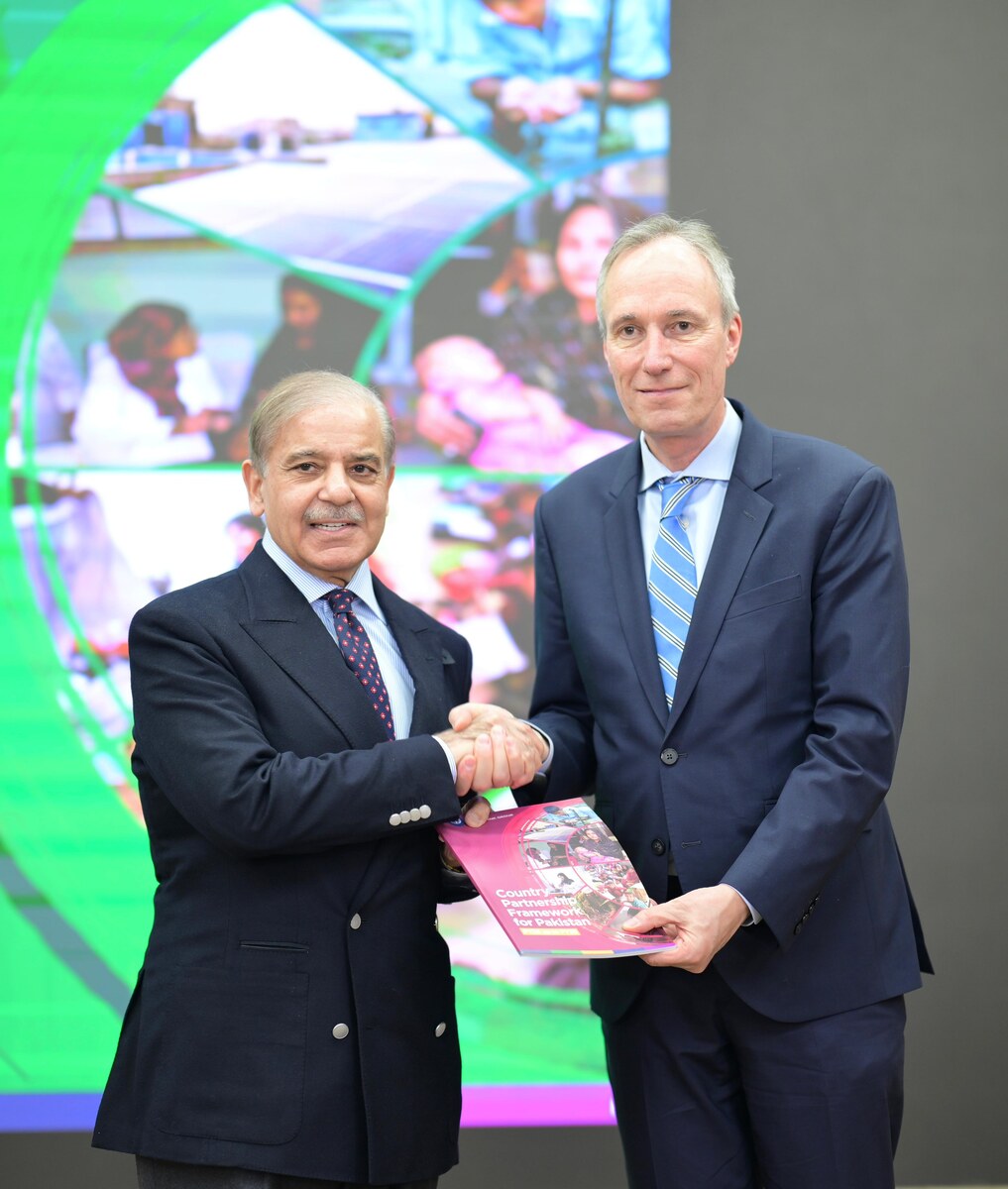


World Bank Vice President for South Asia Martin Raiser (right) presents a copy of booklet of World Bank’s Country Partnership Framework for Pakistan to Prime Minister Shehbaz Sharif during the launching ceremony in Islamabad on January 23, 2025. (Photo courtesy: PMO)

 “We hope that the CPF will serve as an anchor for this engagement to keep us on the right track. Partnerships will equally be critical. More resources will be needed to have the impact at the scale that we wish to achieve and this will require close collaboration with all the development partners.”
Speaking at the ceremony, PM Sharif said the CPF was a “vision to transform Pakistan’s economy, building climate resilient projects, alleviating poverty and unemployment and promoting digitization, agriculture and IT led initiatives.”
Separately, Raiser met Ahad Cheema, Pakistani minister for economic affairs, to discuss in detail the framework’s next steps and its implementation. 
“The two leaders also discussed the need to address key challenges in project implementation, such as land acquisition, project start-up delays, and ensuring compliance with social safeguards,” Cheema’s office said in a statement.
“Cheema stressed that effective coordination between the World Bank and other development partners, as well as streamlined approval processes, would be essential to overcoming these hurdles.”
Cheema also called on the World Bank to enhance Pakistan’s allocation of concessional resources, especially in support of climate change mitigation and foreign debt management.


UN torture expert decries Pakistan ex-PM Khan’s detention

Updated 12 December 2025
Follow

UN torture expert decries Pakistan ex-PM Khan’s detention

  • Khan’s party alleges government is holding him in solitary confinement, barring prison visits
  • Pakistan’s government rejects allegations former premier is being denied basic rights in prison

GENEVA: Pakistan’s former prime minister Imran Khan is being held in conditions that could amount to torture and other inhuman or degrading treatment, the United Nations’ special rapporteur on torture warned Friday.

Alice Jill Edwards urged Pakistan to take immediate and effective action to address reports of the 73-year-old’s inhumane and undignified detention conditions.

“I call on Pakistani authorities to ensure that Khan’s conditions of detention fully comply with international norms and standards,” Edwards said in a statement.

“Since his transfer to Adiala Jail in Rawalpindi on September 26, 2023, Imran Khan has reportedly been held for excessive periods in solitary confinement, confined for 23 hours a day in his cell, and with highly restricted access to the outside world,” she said.

“His cell is reportedly under constant camera surveillance.”

Khan an all-rounder who captained Pakistan to victory in the 1992 Cricket World Cup, upended Pakistani politics by becoming the prime minister in 2018.

Edwards said prolonged or indefinite solitary confinement is prohibited under international human rights law and constitutes a form of psychological torture when it lasts longer than 15 days.

“Khan’s solitary confinement should be lifted without delay. Not only is it an unlawful measure, extended isolation can bring about very harmful consequences for his physical and mental health,” she said.

UN special rapporteurs are independent experts mandated by the Human Rights Council. They do not, therefore, speak for the United Nations itself.

Initially a strong backer of the country’s powerful military leadership, Khan was ousted in a no-confidence vote in 2022, and has since been jailed on a slew of corruption charges that he denies.

He has accused the military of orchestrating his downfall and pursuing his Tehreek-e-Insaf (PTI) party and its allies.

Khan’s supporters say he is being denied prison visits from lawyers and family after a fiery social media post this month accusing army leader Field Marshal Asim Munir of persecuting him.

According to information Edwards has received, visits from Khan’s lawyers and relatives are frequently interrupted or ended prematurely, while he is held in a small cell lacking natural light and adequate ventilation.

“Anyone deprived of liberty must be treated with humanity and dignity,” the UN expert said.

“Detention conditions must reflect the individual’s age and health situation, including appropriate sleeping arrangements, climatic protection, adequate space, lighting, heating, and ventilation.”

Edwards has raised Khan’s situation with the Pakistani government.