

Microsoft’s ties to IDF deepened during Gaza war, investigation reveals

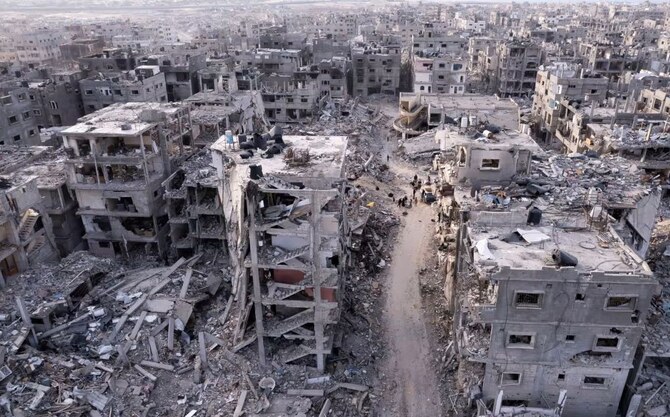
Palestinians walk through the destruction caused by the Israeli air and ground offensive in Rafah, Gaza Strip, early 2025. (AP Photo)
Short Url
Updated 23 January 2025
Follow

Microsoft’s ties to IDF deepened during Gaza war, investigation reveals

  • US tech giant provided Israeli military with computing, cloud services as demand surged
  • Air force unit also used Microsoft services to develop databases of potential targets

LONDON: The Israel Defense Forces’ reliance on Microsoft cloud technology deepened at the height of its invasion of Gaza, an investigation has revealed.

Leaked documents viewed by The Guardian, Israeli-Palestinian publication +972 Magazine and Hebrew-language outlet Local Call show that Microsoft’s business ties with the IDF surged after Oct. 7, 2023.

The US tech giant supplied the IDF with greater computing and cloud services, artificial-intelligence technologies and thousands of hours of technical support.

The Gaza offensive brought new demands for data storage and computing power, with several sources in the Israeli defense community saying the IDF had become dependent on Microsoft, Amazon and Google.

Microsoft’s Azure cloud platform was used by Israeli units across air, sea and ground forces to support combat and intelligence activities.

Staff from the tech giant also worked closely with members of Unit 8200, an IDF intelligence unit that develops cutting-edge espionage technology.

Microsoft’s technology was also used by the IDF to operate Rolling Stone, a system used to manage the population registry of Palestinians in the West Bank and Gaza. The system is capable of tracking the movement of its subjects.

Ofek, an Israeli air force unit, also used Microsoft services to develop “target banks.” The large databases included potential airstrike targets in Gaza, and were used by IDF personnel during the height of the bombing campaign.

Between October 2023 and June 2024, the Israeli Defense Ministry bought 19,000 hours of engineering support and consultancy services from Microsoft, which was awarded about $10 million in fees as a result of the sales.

The leaked documents reportedly show that the IDF’s average monthly consumption of Azure cloud services in the first six months of the war was 60 percent higher than in the four months preceding it.

The IDF also used technologies from Microsoft’s competitors. Google’s cloud division provided the Israeli military with access to AI-based services, the Washington Post reported on Wednesday.

Use of OpenAI’s GPT-4 also surged during the first six months of the war, though the service was made available through Microsoft’s Azure.


Syria accuses Hezbollah of firing shells into its territory

Updated 56 min 43 sec ago
Follow

Syria accuses Hezbollah of firing shells into its territory

  • “The Syrian Arab Army will not tolerate any aggression targeting Syria,” the army said in a statement to SANA

DAMASCUS: Syria said Iran-backed Hezbollah had fired artillery shells into its territory from Lebanon overnight, state media reported on Tuesday, amid the ongoing conflict between Israel and the Lebanese Shia movement.
Syrian army officials said artillery shells fired from Lebanon landed near the town of Serghaya, west of Damascus, the state news agency SANA reported on Tuesday.
The army accused Hezbollah of targeting Syrian army positions, telling the news agency it observed Hezbollah reinforcements at the Syrian-Lebanese border.
“The Syrian Arab Army will not tolerate any aggression targeting Syria,” the army said in a statement to SANA.
Lebanon was drawn into the Middle East war last week when Hezbollah attacked Israel in response to the killing of Iranian supreme leader Ayatollah Ali Khamenei during US-Israeli strikes.
Hezbollah and Israeli forces have clashed in eastern Lebanon in recent days, and Israel has carried out strikes across Lebanon, including on the capital Beirut.
Lebanese President Joseph Aoun accused Hezbollah of working to “collapse” the state, while the head of the group’s parliamentary bloc said it had “no other option... than the option of resistance.”
Hezbollah provided military support to former Syrian president Bashar Assad, who was overthrown in December 2024 by an Islamist coalition hostile to the pro-Iranian Shia movement.
Since then, its supply routes from Syria have been cut off, and Lebanese and Syrian authorities are trying to combat smuggling across the porous border between the two countries.