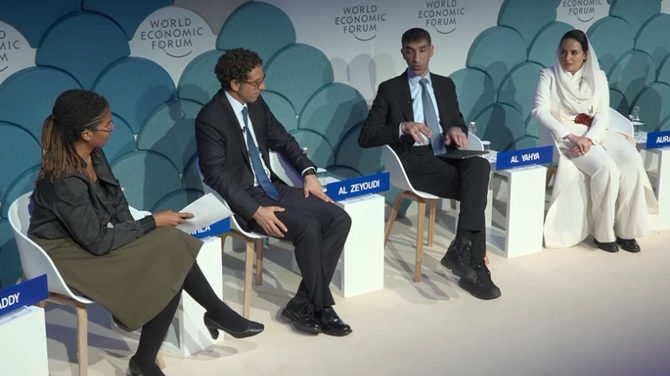
WEF panelists urge for efforts to bridge ‘AI divide’

Short Url
Updated 23 January 2025
Follow

WEF panelists urge for efforts to bridge ‘AI divide’

  • According to UN figures, 2.7 billion people do not have access to the Internet

DUBAI: While smart technologies unleash opportunities in investment and trade, concerted efforts must seek to bridge the “AI divide” in developing countries, a World Economic Forum panel heard on Thursday.

Deemah Al-Yahya, secretary-general of the Digital Cooperation Organization, said the need for energy, computing power and talent to activate AI would expand the digital gap in the developing world.

“An AI-generated image consumes more energy than charging your smartphone. That’s going to cause a great challenge for developed countries, so let alone developing countries that do not even have reliable energy.”

She added: “Another factor is who is going to get access to the computing power, considering the supply chain and cost? How can talents access the computer power to produce algorithms, local content and innovation?”

According to UN figures, 2.7 billion people do not have access to the Internet, with AI growth threatening to widen the digital gap.

However, using trading digital assets can increase access to new technologies, including AI, quantum computing and blockchain, in the global south, Al-Yahya said.

Highlighting the varying degrees of advancement of digital infrastructures among countries, Al-Yahya stressed harmonizing collaboration and bridge communication between the public and private sector, which served as the drivers of the digital economy.

One of the Digital Cooperation Organization’s mandates is to harmonize policies and regulations among 16 member states from Asia, Europe, Africa and the Middle East to expand technology use and grow their digital economy.

Addressing the benefits of AI in improving efficiency and reducing errors, Thani Ahmed Al-Zeyoudi, UAE minister of state for foreign trade, highlighted synergies and links to different tech systems, even within the same country.

“Many of those technologies are under deployment, but in various scattered ways. Each stakeholder is following their own way when it comes to customers, procedures and managements system,” said Al-Zeyoudi, highlighting the role of governments in implementing regulations that put AI to good use and ensure communication across stakeholders.

He addressed the UAE’s export of technologies to Africa, noting that the private sector took the lead in such initiatives.

“To avoid fragmentation as governments, we need to take the lead by putting (in place) a regulatory system that ensures that the private sector has the freedom to start doing their job, get the funding whenever required, and support them in talking to the right stakeholders,” he said.


Saudi Mawani achieves a 10.58% YoY increase in container handling during 2025

Updated 6 sec ago
Follow

Saudi Mawani achieves a 10.58% YoY increase in container handling during 2025

RIYADH: Saudi ports supervised by the Saudi Ports Authority, or Mawani, have recorded a 10.58 percent year-on-year increase in the number of containers handled during 2025 by 10.58 percent to reach 8.3 million standard containers, compared to 7.5 million standard containers last year.

Transshipment containers achieved an 11.78 percent rise, to reach 1.9 million standard containers, compared to 1.7 million standard containers in the same period last year.

The total number of outgoing containers rose by 11.72 percent to reach 3.1 million twenty-foot equivalent units, compared to 2.8 million TEUs, while the total number of incoming containers increased by 8.82 percent to reach 3.2 million TEUs, compared to 2.9 million TEUs last year.

The total tonnage handled, general cargo, solid bulk cargo, and liquid bulk cargo, recorded an increase of 1.06 percent, reaching 242 million tonnes compared to 239 million tonnes in 2024. The total general cargo amounted to 12 million tonnes, liquid bulk cargo to 176 million tonnes, and solid bulk cargo to 53 million tonnes.

Passenger numbers increased by 47.07 percent to reach 1.8 million passengers, compared to 736,177 passengers last year.

Shipping traffic decreased by 17.98 percent to reach 9,508 ships, compared to 11,592 during the same period last year.

The number of vehicles decreased by 4.92 percent to reach 1.03 million, compared to 1.08 million last year.

Ports received 8.9 million head of cattle, a decrease of 7.55 percent compared to 9.7 million during the same period last year.

The increase in the number of containers handled contributes to several economic benefits, including boosting trade and stimulating industries and sectors related to maritime transport.

It also contributes to fostering growth in tourism, maritime activity, and associated services, supporting supply chains, as well as the Kingdom’s food security, in line with the objectives of the National Transport and Logistics Strategy to solidify Saudi Arabia’s position as a global logistics hub.

It is worth noting that the ports overseen by Mawani achieved a 12.5 percent increase in the number of containers handled during December, reaching 800,089 TEUs, compared to 711,170 TEUs in 2024.

Transshipment containers also saw a 19.25 percent increase, reaching 188,995 TEUs, compared to 158,491 TEUs during the same period last year.