Police in Hungary investigate bomb threats affecting over 240 schools

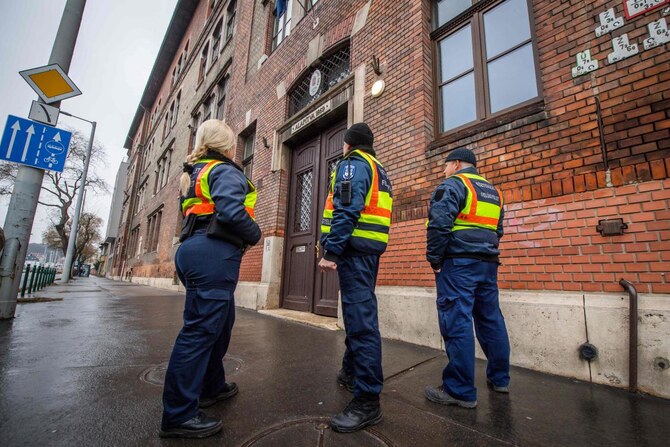
Traffic wardens stand in front of an empty school in Budapest on Jan. 23, 2025 following bomb threats. (AFP)
Short Url
Updated 23 January 2025
Follow

Police in Hungary investigate bomb threats affecting over 240 schools

  • The threats, which came in the form of emails, were identical in their text
  • Officers were being dispatched to all affected institutions

BUDAPEST: Police in Hungary said Thursday they were investigating bomb threats that were sent to more than 240 schools across the country, resulting in classes being canceled at some schools.
The threats, which came in the form of emails, were identical in their text and likely sent by a single sender, police said in a statement. Officers were being dispatched to all affected institutions. No explosives or explosive devices were found in the buildings inspected so far, police added.
Gergely Gulyás, chief of staff to Prime Minister Viktor Orbán, said that “education in most schools in the country proceeds smoothly,” and that school administrators could decide for themselves whether to send students home.
He said Orbán on Thursday had consulted repeatedly with the interior minister and the minister in charge of Hungary’s secret services.
The emails were sent from numerous email providers “including foreign ones,” Gulyás said. Hungarian secret services were in consultation with their counterparts in neighboring Slovakia, where similar bomb threats were made last year, Gulyás said.
On Wednesday, numerous schools in around a dozen cities in Bulgaria also received bomb threats, according to Bulgarian public broadcaster BNT.


US envoy says Trump questioning why Iran has not ‘capitulated’

Updated 6 sec ago
Follow

US envoy says Trump questioning why Iran has not ‘capitulated’

  • US envoy Steve Witkoff said on Saturday that President Donald Trump is questioning why Iran has not “capitulated” in the face of Washington’s military build-up
WASHINGTON: US envoy Steve Witkoff said on Saturday that President Donald Trump is questioning why Iran has not “capitulated” in the face of Washington’s military build-up aimed at pressuring them into a nuclear deal.
The United States and Iran this week resumed Oman-mediated talks in Geneva aimed at averting the possibility of military action, after Washington dispatched two aircraft carriers, jets and weaponry to the region to back its warnings.
In a Fox News interview with Trump’s daughter-in-law Lara, Witkoff said the president was “curious” about Iran’s position after he had warned them of severe consequences in the event they failed to strike a deal.
“I don’t want to use the word ‘frustrated,’ because he understands he has plenty of alternatives, but he’s curious as to why they haven’t... I don’t want to use the word ‘capitulated,’ but why they haven’t capitulated,” he said.
“Why, under this pressure, with the amount of seapower and naval power over there, why haven’t they come to us and said, ‘We profess we don’t want a weapon, so here’s what we’re prepared to do’? And yet it’s sort of hard to get them to that place.”
The US envoy also confirmed in the interview that he had met with Reza Pahlavi, who has not returned to Iran since before the 1979 Islamic Revolution that ousted the monarchy.
“I met him at the direction of the president,” he said, without providing further details.
US-based Pahlavi last week told a crowd in Munich that he was ready to lead the country to a “secular democratic future” after Trump said regime change would be best for the country.
Witkoff’s comments come after Iranian Foreign Minister Abbas Araghchi said a draft proposal for an agreement with Washington would be ready in a matter of days.
Trump said on Thursday that Iran had at most 15 days to make a deal on concerns starting with its nuclear program.
As talks between the two nations continued in Geneva, Iran’s supreme leader Ayatollah Ali Khamenei on Tuesday said that Trump would not succeed in destroying the Islamic republic.
Western countries accuse the Islamic Republic of seeking to acquire nuclear weapons, which Tehran denies, though it insists on its right to enrichment for civilian purposes.
Iran, for its part, is seeking to negotiate an end to sanctions that have proven to be a massive drag on its economy, which played a role in sparking anti-government protests in December.