Pakistan lawmakers seek Musk apology before Starlink approval

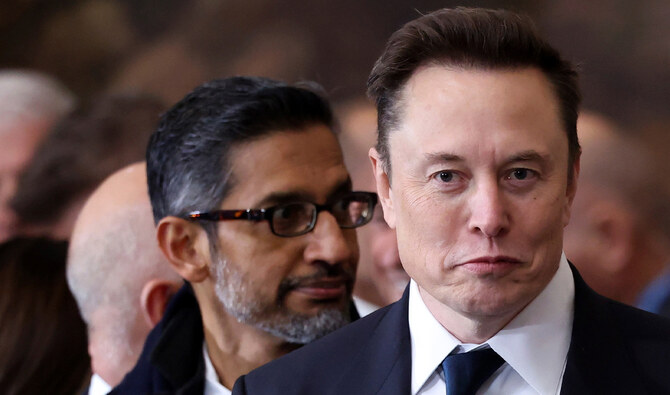
Elon Musk, right, and Google CEO Sundar Pichai arrive before the 60th Presidential Inauguration in the Rotunda of the U.S. Capitol in Washington, on Jan. 20, 2025. (AP/File)
Short Url
Updated 23 January 2025
Follow

Pakistan lawmakers seek Musk apology before Starlink approval

  • Musk’s Starlink satellite Internet service has applied for a license to operate in Pakistan, but is awaiting clearance before users will be allowed to log on
  • ‘Several senators denounced’ Musk’s ‘anti-Pakistani propaganda’ in recent comments he made on social media platform X, says Senate committee chair

Islamabad: Pakistan senators are demanding an apology from billionaire Elon Musk, a lawmaker told AFP on Thursday, accusing him of “anti-Pakistan propaganda” as he seeks regulatory approval for his Starlink service in the country.
Musk’s Starlink satellite Internet service has applied for a license to operate in Pakistan but is awaiting clearance before users will be allowed to log on.
A senate committee on information technology and telecommunications met Wednesday to hear updates from officials assessing his application.
But committee chair Palwasha Mohammad Zai Khan told AFP “several senators denounced” Musk’s “anti-Pakistani propaganda” in recent comments he made on his social media platform X.
Musk has repeatedly highlighted claims that men of Pakistani origin were responsible for a spate of historic rape cases targeting mostly white girls in England.
“It was said that approval should be given on condition of his apology,” Khan told AFP.
“We are not saying it should be a pre-condition but it was a part of the discussion and we can only give our recommendations to the government,” she added.
Musk began launching attacks against the UK government this month after it resisted calls for a national inquiry into the historic abuse cases.
In Rotherham, a town of 265,000 inhabitants, a gang drugged, raped and sexually exploited at least 1,400 girls over a 16-year period from 1997, a public inquiry concluded in 2014.
A series of court cases eventually led to the conviction of dozens of men, mostly of South Asian origin. The victims were vulnerable, mostly white, girls.
An Indian lawmaker made a post on 8 January saying: “They aren’t ASIAN Grooming Gangs but PAKISTANI grooming gangs. Why should Asians take the fall for one absolute rogue nation?“
Musk commented with a message saying: “True.”
The historic abuse cases regularly prompt debate in the UK, where some claim they are used to enflame Islamaphobia while others say they are being quashed to prevent debate.
Whilst Musk’s electric vehicle and space ventures made him a billionaire, he has recently emerged as a political figure affiliated with newly inaugurated President Donald Trump.
Trump has tasked Musk, the world’s richest man, with slashing billions of dollars of federal government spending as head of a new “Department of Government Efficiency.”


Climate disasters to shave 0.5% points off growth this year, Pakistan tells Riyadh forum

Updated 4 sec ago
Follow

Climate disasters to shave 0.5% points off growth this year, Pakistan tells Riyadh forum

  • Finance minister says Pakistan lacks resources to fund large-scale climate adaptation without external support
  • Calls global climate funds “slow and bureaucratic” as vulnerable states struggle to access financing

ISLAMABAD: Pakistan’s finance minister said on Thursday increasingly severe floods are now routinely reducing the country’s economic growth, warning that this year’s climate disasters alone are expected to shave around half a percentage point off GDP as Islamabad presses global lenders to accelerate climate financing.

Speaking at the Global Development Finance Conference – Momentum 2025 in Riyadh, Finance Minister Muhammad Aurangzeb said Pakistan is facing a new economic normal in which climate shocks impose annual losses, strain fiscal resources and undermine its recovery from past balance-of-payments crises.

Pakistan is among the countries most exposed to climate-driven extremes, with the 2022 super-floods causing an estimated $30 billion in losses and renewed flooding this year again overwhelming provincial and federal budgets. Islamabad has created early-warning systems and emergency buffers, but Aurangzeb said adaptation costs far exceed domestic capacity and require faster external support.

“Our recent experience shows that climate change is an increasingly tangible and costly reality for Pakistan,” he told the Riyadh forum. “Pakistan expects to lose roughly half a percentage point of GDP growth this year, placing additional strain on an already challenged emerging economy.”

He said Pakistan’s commitment to macroeconomic stability, including building fiscal and external buffers, had allowed it to manage immediate rescue and relief operations from domestic resources. But long-term rehabilitation, he added, can only advance if global climate financing flows more quickly.

Aurangzeb criticized mechanisms such as the Green Climate Fund and Loss and Damage Fund for slow and bureaucratic disbursement processes that make it difficult for vulnerable countries to access urgently needed support. Pakistan, he said, has made more progress through multilaterals, including receiving the first $200 million tranche from the IMF’s Climate Resilience Fund.

The minister highlighted Pakistan’s new 10-year Country Partnership Framework with the World Bank announced this year, which allocates about $20 billion, with one-third earmarked for climate resilience and decarbonization. 

Unlocking those funds, he stressed, now depends on Pakistan rapidly preparing “high-quality, bankable projects.”

REKO DIQ

The Riyadh panel, which included ministers from Jordan and Tajikistan and the head of the West African Development Bank, underscored that emerging economies face converging pressures from climate risk, tight fiscal positions and sluggish global growth. Speakers said unlocking blended finance, streamlining multilateral processes and mobilizing private capital will be essential for adaptation in the coming decade.

Aurangzeb also linked climate adaptation to broader economic strategy, describing the near-finalization of financing for Pakistan’s flagship $7 billion Reko Diq copper and gold mining project, where the International Finance Corporation is leading a syndicate and the US Export-Import Bank has joined as a major participant.

He said the mine is expected to generate export revenues equivalent to 10 percent of Pakistan’s current export base in its first year of commercial production in 2028, helping diversify a stagnant economy.

Responding to questions on geopolitical balancing, Aurangzeb said Pakistan would continue an “and-and” approach, maintaining ties with both the United States and China. He noted that China remains Pakistan’s largest development partner through the China-Pakistan Economic Corridor (CPEC), a flagship Belt and Road Initiative program that has financed power plants, highways and ports since 2013. He said CPEC Phase 2.0, launched this year, seeks to move beyond government-to-government infrastructure by attracting private investment and export-oriented industrial projects.

At the same time, he said Pakistan’s relationship with the United States had “significantly strengthened,” particularly in sectors such as critical minerals, advanced technologies and digital infrastructure. 

His remarks came a day after Washington said the US Export-Import Bank had approved $1.25 billion in financing to support mining at the Reko Diq copper-and-gold project, with the package expected to enable up to $2 billion in US equipment and service exports. 

Aurangzeb said Pakistan expected strong interest from US, Chinese, Gulf and other global investors as the project scales.