

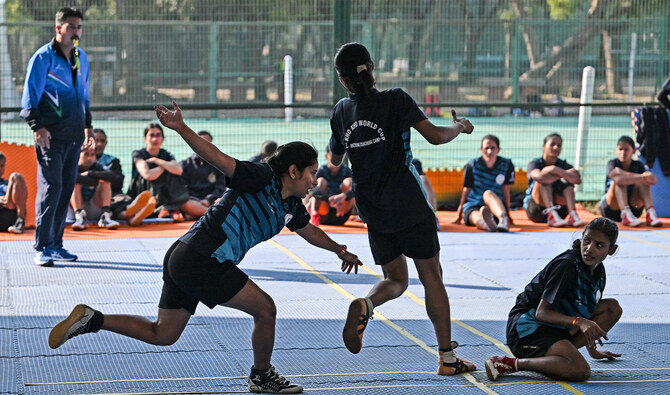

New Delhi: The ancient game of kho kho is enjoying a resurgence in India, with organizers of the first international tournament hoping their efforts will secure the sport’s place in the Olympics.
Kho kho, a catch-me-if-you-can tag sport, has been played for more than 2,000 years across southern Asia but only saw its rules formalized in the early 20th century.
It was played as a demonstration sport at the 1936 Olympics in Berlin but did not gather enough support to be included in the Summer Games and since then has been largely eclipsed by India’s ferocious love of cricket.
Nearly a century later, enthusiasts have sought to raise its profile with the inaugural Kho Kho World Cup featuring teams from 23 nations competing in India’s capital New Delhi.
The tournament’s opening ceremony saw a gala of song, dance and an Olympic-style team parade, reflecting the aspirations of organizers and athletes to take the sport global.
“My elder sister played the sport, but was not able to pursue her dreams,” Indian women’s team player Nasreen Shaikh, 26, told AFP.
“We have crossed the first barrier of playing in a World Cup. The next big step would be an entry in the Olympics.”
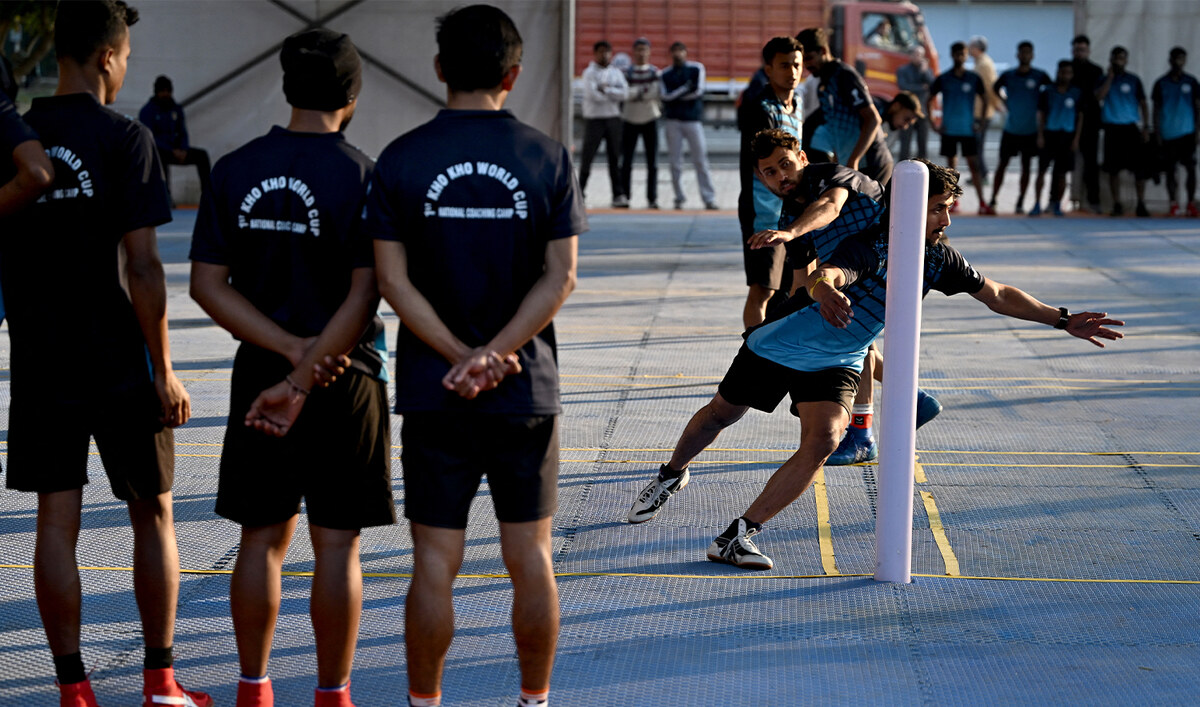
In this photograph taken on January 8, 2025, members of India's men's kho kho team take part in selection trials ahead of the upcoming Kho Kho World Cup in New Delhi. (AFP)
Kho kho is traditionally played outside on a rectangular court, divided in two by a line that connects two poles at either end of the field.
Teams switch between attack and defense, with the former chasing and tagging defending players around the field.
Only one player can give chase at a time and attacking players can only move in one direction around the court, forcing them to tag in team-mates crouched on the center line to take over pursuit.
The match is won by whichever team can gain the most points, primarily by tagging defenders faster than the opposing team.
The franchise-based Ultimate Kho Kho League, founded in 2022, brought the sport off grassy fields and onto indoor mats, also boosting its profile with a television audience.
Since then the league has become the third most-watched non-cricket sports tournament in the world’s most populous country after the Pro Kabaddi League — another ancient Indian tag sport — and the Indian Super League football competition.
“The turning point was when it transitioned from mud to mat. It made it into a global game,” Kho Kho Federation of India president Sudhanshu Mittal told AFP.
“Today we are in 55 countries... Native players in countries like Germany, Brazil, and Kenya are embracing the game because of its speed, agility and minimal equipment required.”
Mittal said he expected the sport to gain a foothold in dozens more countries by the end of the year, giving it a strong claim to be featured in the Olympics in the coming decade.
That would coincide with India’s audacious bid to host the 2036 Games in the city of Ahmedabad, 100 years after kho kho last appeared at the Olympics.
The United States, England and Australia were among the nations that competed in this month’s World Cup in New Delhi, with expatriate Indians heavily represented after taking the game to foreign shores.
But Pakistan is a glaring omission from the competition despite the sport being popular there — a reflection of the deep animosity between the nuclear-armed archrivals.
World Cup organizers refused to comment on the absence, which failed to dim the sense of optimism at the competition that the sport is destined to thrive.
“There has been a sea change in the sport,” Indian men’s team captain Pratik Waikar, 32, told AFP.
“Cricket has a rich history and they developed it well by going live on TV, and now our sport has also gone live,” he said. “In the next five years it will be on another level.”


