



NAWA, Syria: As opposition forces raced across Syria in a surprise offensive launched in the country’s northwest late last year, officials from several countries backing either the rebels or Syria’s government met in Qatar on what to do.
According to people briefed on the Dec. 7 meeting, officials from Turkiye, Russia, Iran and a handful of Arab countries agreed that the fighters would stop their advance in Homs, the last major city north of Damascus, and that internationally mediated talks would take place with Syrian leader Bashar Assad on a political transition.
But opposition factions from Syria’s south had other plans. They pushed toward the capital, arriving in Damascus’ largest square before dawn. Those from the north, led by the Islamist group Hayyat Tahrir Al-Sham, arrived hours later. Assad, meanwhile, had fled.
HTS, the most organized of the groups, has since established itself as Syria’s de facto rulers after coordinating with the southern fighters during the lighting-fast offensive.
Wariness among the southern factions since then, however, has highlighted questions over how the interim administration can bring together a patchwork of former rebel groups, each with their own leaders and ideology.
HTS leader Ahmad Al-Sharaa has called for a unified national army and security forces. The interim defense minister, Murhaf Abu Qasra, has begun meeting with armed groups. But some prominent leaders like southern rebel commander Ahmad Al-Awda have refused to attend.
Officials with the interim government did not respond to questions.

A handout picture released by Sham News Network shows an anti-regime demonstration in the early hours of April 15, 2012 in the southern city of Daraa, where the uprising against President Bashar al-Assad began in March 2011. (AFP)
Cradle of the revolution
The southern province of Daraa is widely seen as the cradle of the Syrian uprising in 2011. When anti-government protests were met with repression by Assad’s security forces, “we were forced to carry weapons,” said Mahmoud Al-Bardan, a rebel leader there.
The opposition groups that formed in the south had different dynamics from those in the north, less Islamist and more localized, said Aron Lund, a fellow with the Century International think tank. They also had different backers.
“In the north, Turkiye and Qatar favored Islamist factions very heavily,” he said. “In the south, Jordanian and American involvement nudged the insurgency in a different direction.”
In 2018, factions in Daraa reached a Russian-mediated “reconciliation agreement” with Assad’s government. Some former fighters left for Idlib, the destination for many from areas recaptured by government forces, while others remained.
The deal left many southern factions alive and armed, Lund said.
“We only turned over the heavy weapons … the light weapons remained with us,” Al-Bardan said.
When the HTS-led opposition groups based in the north launched their surprise offensive last year in Aleppo, those weapons were put to use again. Factions in the southern provinces of Daraa, Sweida and Quneitra reactivated, forming a joint operations room to coordinate with northern ones.
Defying international wishes
On Dec. 7, “we had heard from a number of parties that there might be an agreement that … no one would enter Damascus so there could be an agreement on the exit of Bashar Assad or a transitional phase,” said Nassim Abu Ara, an official with one of the largest rebel factions in the south, the 8th Brigade of Al-Awda.
However, “we entered Damascus and turned the tables on these agreements,” he said.

Nassim Abu Ara, known as Abu Murshid, a rebel leader, poses for a portrait during an interview with the Associated Press, in Nawa, near Daraa, Syria, on Jan. 4, 2025. (AP)
Al-Bardan confirmed that account, asserting that the agreement “was binding on the northern factions” but not the southern ones.
“Even if they had ordered us to stop, we would not have,” he said, reflecting the eagerness among many fighters to remove Assad as soon as possible.
Ammar Kahf, executive director of the Istanbul-based Omran Center for Strategic Studies, who was in Doha on Dec. 7 and was briefed on the meetings, said there was an agreement among countries’ officials that the rebels would stop their offensive in Homs and go to Geneva for negotiations on “transitional arrangements.”
But Kahf said it was not clear that any Syrian faction, including HTS, agreed to the plan. Representatives of countries at the meeting did not respond to questions.
A statement released by the foreign ministers of Turkiye, Russia, Iran, Qatari, Saudi Arabia, Jordan and Iraq after the Dec. 7 meeting said they “stressed the need to stop military operations in preparation for launching a comprehensive political process” but did not give specifics.
The initial hours after armed groups’ arrival in Damascus were chaotic. Observers said the HTS-led forces tried to re-impose order when they arrived. An Associated Press journalist saw an argument break out when HTS fighters tried to stop members of another faction from taking abandoned army munitions.
Abu Ara acknowledged that “there was some chaos” but added, “we have to understand that these people were pent-up and suddenly they achieved the joy of victory in this manner.”

A member of the new Syrian security forces checks ammunition that belonged to the Assad government, in Nawa, near Daraa, Syria, on Jan. 4, 2025. (AP)
Waiting for a state
During a visit by AP journalists to the western countryside of Daraa province this month, there was no visible presence of HTS forces.
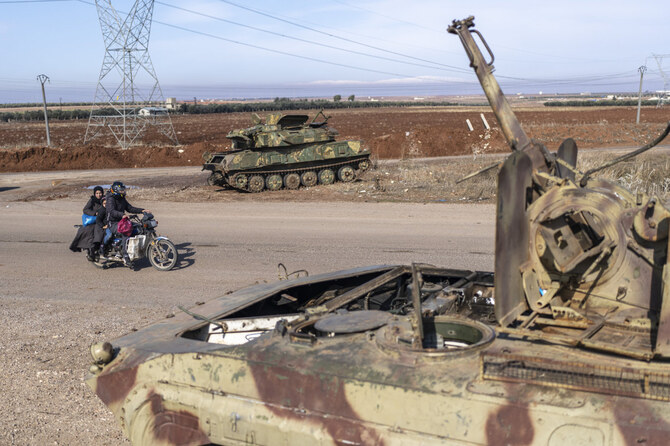
At one former Syrian army site, a fighter with the Free Syrian Army, the main faction in the area, stood guard in jeans and a camouflage shirt. Other local fighters showed off a site where they were storing tanks abandoned by the former army.
“Currently these are the property of the new state and army,” whenever it is formed, said one fighter, Issa Sabaq.
The process of forming those has been bumpy.
On New Year’s Eve, factions in the Druze-majority city of Sweida in southern Syria blocked the entry of a convoy of HTS security forces who had arrived without giving prior notice.
Ahmed Aba Zeid, a Syrian researcher who has studied the southern insurgent groups, said some of the factions have taken a wait-and-see approach before they agree to dissolve and hand over their weapons to the state.
Local armed factions are still the de facto security forces in many areas.

Members of the new Syrian security forces stand outside a security building, in Nawa, near Daraa, Syria, on Jan. 4, 2025. (AP)
Earlier this month, the new police chief in Daraa city appointed by the HTS-led government, Badr Abdel Hamid, joined local officials in the town of Nawa to discuss plans for a police force there.
Hamid said there had been “constructive and positive cooperation” with factions in the region, adding the process of extending the “state’s influence” takes time.
Abu Ara said factions are waiting to understand their role. “Will it be a strong army, or a border guard army, or is it for counterterrorism?” he asked.
Still, he was optimistic that an understanding will be reached.
“A lot of people are afraid that there will be a confrontation, that there won’t be integration or won’t be an agreement,” he said. “But we want to avoid this at all costs, because our country is very tired of war.”


