New explosive wildfire erupts near Los Angeles

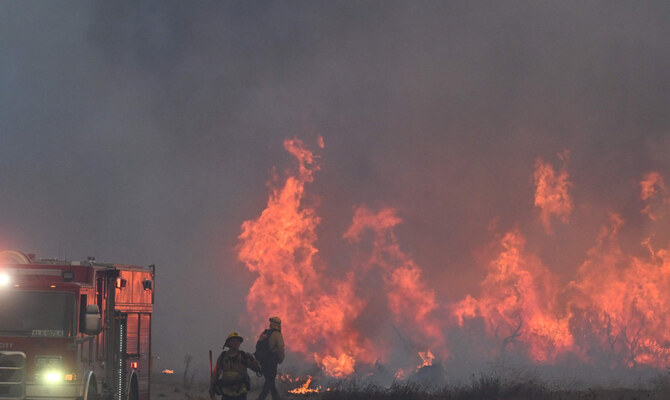
Firefighters light backfires near power lines as smoke from the Hughes Fire fills the sky in Castaic, a northwestern neighborhood of Los Angeles, California, January 22, 2025. (AFP)
Short Url
Updated 23 January 2025
Follow

New explosive wildfire erupts near Los Angeles

  • Meteorologists say strong winds and low humidity create conditions ripe for rapid fire spread

CASTAIC, United States: A new wildfire erupted north of Los Angeles on Wednesday, exploding in size and sparking orders for tens of thousands of people to evacuate in a region already staggering from the effects of huge blazes.
Ferocious flames were devouring hillsides near Castaic Lake, spreading rapidly to cover more than 5,000 acres (2,000 hectares) in just a few hours.
The fire was being fanned by strong, dry Santa Ana winds that were racing through the area, pushing a vast pall of smoke and dangerous embers ahead of the flames.
Evacuations were ordered for 31,000 people around the lake, which sits around 35 miles (56 kilometers) north of Los Angeles, and close to the city of Santa Clarita.
“I’m just praying that our house doesn’t burn down,” one man told broadcaster KTLA as he packed his car.
The fire came with the greater Los Angeles area still suffering after two enormous fires that killed more than two dozen people and destroyed thousands of structures.
Robert Jensen, of the Los Angeles County Sheriff’s Department, urged everyone in the impacted area of the new blaze — dubbed the Hughes Fire — to leave immediately.
“We’ve seen the devastation caused by people failing to follow those orders in the Palisades and Eaton fires,” he said.
“I don’t want to see that here in our community as well. If you’ve been issued an evacuation order, please get out.”
Television footage showed police driving around neighborhoods urging people to leave.
Los Angeles County Sheriff Robert Luna said the Pitchess Detention Center in Castaic was under an evacuation order, and around 500 inmates were being moved to a neighboring facility.
He told broadcaster KCAL9 that around 4,600 inmates being held at other jails in the area were sheltering in place, but buses were on hand in case conditions changed and they needed to be moved.
Melissa Camacho, an attorney with the American Civil Liberties Union, noted the rights group’s opposition to “the expansion of the jail system especially in dangerous fire zones,” adding that “we are gravely concerned for the safety of people incarcerated in those jails.”
California Highway Patrol said the fire was impacting traffic on the I5 freeway, with a section of the road — which runs the length of the US West Coast — shuttered.
Helicopters and planes were on the scene dropping water and retardant on the blaze.
That fleet included two Super Scoopers, enormous amphibious planes that can carry hundreds of gallons (liters) of water.
Crews from Los Angeles County Fire Department and Angeles National Forest were also attacking the blaze from the ground.
California Governor Gavin Newsom, who has been the target of criticism by President Donald Trump over his handling of the Los Angeles fires, said he had ordered officials into action.
“State resources have been deployed to the Hughes Fire in the Angeles National Forest to assist in the federal response,” he said.
“We will continue to monitor the situation closely and provide the federal government with whatever it needs to extinguish this fire.”
It was not immediately clear what sparked the fire, but it occurred during red flag fire conditions — when meteorologists say strong winds and low humidity create conditions ripe for rapid fire spread.
Human activity, including the unchecked burning of fossil fuels, is changing Earth’s climate, increasing average global temperatures and altering weather patterns.
Even though January is the middle of the region’s rainy season, Southern California has not seen any significant precipitation in around eight months, leaving the countryside tinder dry.


Carney says Canada has no plans to pursue free trade agreement with China as Trump threatens tariffs

Updated 26 January 2026
Follow

Carney says Canada has no plans to pursue free trade agreement with China as Trump threatens tariffs

TORONTO: Canadian Prime Minister Mark Carney said Sunday his country has no intention of pursuing a free trade deal with China. He was responding to US President Donald Trump’s threat to impose a 100 percent tariff on goods imported from Canada if America’s northern neighbor went ahead with a trade deal with Beijing.
Carney said his recent agreement with China merely cuts tariffs on a few sectors that were recently hit with tariffs.
Trump claims otherwise, posting that “China is successfully and completely taking over the once Great Country of Canada. So sad to see it happen. I only hope they leave Ice Hockey alone! President DJT”
The prime minister said under the free trade agreement with the US and Mexico there are commitments not to pursue free trade agreements with nonmarket economies without prior notification.
“We have no intention of doing that with China or any other nonmarket economy,” Carney said. “What we have done with China is to rectify some issues that developed in the last couple of years.”
In 2024, Canada mirrored the United States by putting a 100 percent tariff on electric vehicles from Beijing and a 25 percent tariff on steel and aluminum. China had responded by imposing 100 percent import taxes on Canadian canola oil and meal and 25 percent on pork and seafood.
Breaking with the United States this month during a visit to China, Carney cut its 100 percent tariff on Chinese electric cars in return for lower tariffs on those Canadian products.
Carney has said there would be an initial annual cap of 49,000 vehicles on Chinese EV exports coming into Canada at a tariff rate of 6.1 percent, growing to about 70,000 over five years. He noted there was no cap before 2024. He also has said the initial cap on Chinese EV imports was about 3 percent of the 1.8 million vehicles sold in Canada annually and that, in exchange, China is expected to begin investing in the Canadian auto industry within three years.
Trump posted a video Sunday in which the chief executive of the Canadian Vehicle Manufacturers’ Association warns there will be no Canadian auto industry without US access, while noting the Canadian market alone is too small to justify large scale manufacturing from China.
“A MUST WATCH. Canada is systematically destroying itself. The China deal is a disaster for them. Will go down as one of the worst deals, of any kind, in history. All their businesses are moving to the USA. I want to see Canada SURVIVE AND THRIVE! President DJT,” Trump posted on social media.
Trump’s post on Saturday said that if Carney “thinks he is going to make Canada a ‘Drop Off Port’ for China to send goods and products into the United States, he is sorely mistaken.”
“We can’t let Canada become an opening that the Chinese pour their cheap goods into the U.S,” US Treasury Secretary Scott Bessent said on ABC’s “This Week.”
“We have a , but based off — based on that, which is going to be renegotiated this summer, and I’m not sure what Prime Minister Carney is doing here, other than trying to virtue-signal to his globalist friends at Davos.”
Trump’s threat came amid an escalating war of words with Carney as the Republican president’s push to acquire Greenland strained the NATO alliance.
Carney has emerged as a leader of a movement for countries to find ways to link up and counter the US under Trump. Speaking in Davos before Trump, Carney said, “Middle powers must act together because if you are not at the table, you are on the menu” and he warned about coercion by great powers — without mentioning Trump’s name. The prime minister received widespread praise and attention for his remarks, upstaging Trump at the World Economic Forum.
Trump’s push to acquire Greenland has come after he has repeatedly needled Canada over its sovereignty and suggested it also be absorbed into the United States as a 51st state. He posted an altered image on social media this week showing a map of the United States that included Canada, Venezuela, Greenland and Cuba as part of its territory.