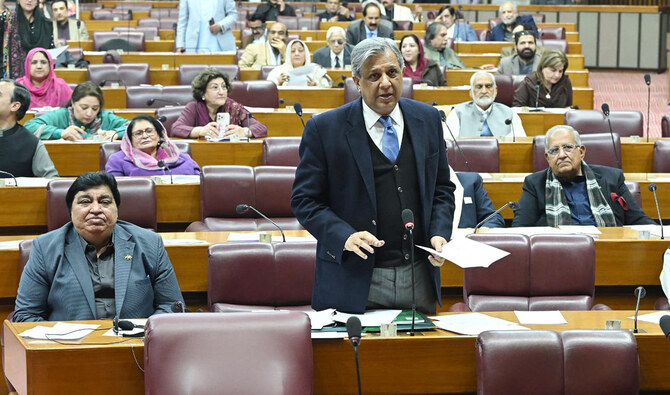
ISLAMABAD: Pakistan’s Law Minister Azam Nazeer Tarar on Wednesday tabled amendments to a contentious cybercrime law in parliament, lowering the punishment for spreading “fake information” online to three years, according to a draft of the document.
Pakistan’s state minister for information technology, Shaza Fatima Khawaja, last month confirmed the government was reviewing amendments to the Pakistan Electronic Crimes Act (PECA) 2016. Passed in 2016 by the then government of Prime Minister Shehbaz Sharif’s Pakistan Muslim League-Nawaz (PML-N) party, the law was originally enacted to combat various forms of cybercrime, including cyber terrorism, unauthorized access, electronic fraud and online harassment, but it has variously been used to crack down on journalists, bloggers and other critics of the state.
The amendments proposed up to five-year imprisonment or fine extending to Rs1 million ($3,588) or both for anyone who “intentionally” posts false information online to create “a sense of fear, panic or disorder or unrest.”
“Whoever intentionally disseminates, publicly exhibits or transmits any information through any information system , that he knows or has reason to believe or has reason to believe to be false or fake and likely to cause or create a sense of fear, panic or disorder or unrest in general public or society shall be punished with imprisonment which may extend up to three years or with fine which may extend to two million rupees or with both,” Section 26A of the Prevention of Electronic Crimes (Amendment) Bill, 2025 states.
The amendments also propose establishing a “Social Media Protection and Regulatory Authority,” which would perform several functions related to social media such as education, awareness, training, regulation, enlistment, blocking and more.
It said that anyone “aggrieved by fake and false information” would be able to approach the authority to remove or block access to the content in question, adding that the authority would issue orders no later than 24 hours on the request.
“Any person aggrieved by fake or false information may apply to the Authority for removal or blocking of access to such information, and the Authority shall, on receipt of such application, not later than twenty-four hours, pass such orders as it considers necessary including an order for removal or blocking access to such information,” a copy of the amendment bill states.
The draft stated that authority would have the power to issue directions to a social media platform to remove or block online content if it was against the “ideology of Pakistan,” incited the public to violate the law, take the law in their own hands with a view to coerce, intimidate or “terrorize” public, individuals, groups, communities, government officials and institutions.
The authority will also have the power to issue directions to the social media platform if the online content incited the public or section of the public to cause damage to governmental or private property; coerced or intimidated the public or section of the public and thereby prevented them from carrying on their lawful trade and disrupted civic life, the draft said.
Pakistan’s digital rights experts have recently pointed to the government’s restrictions on the Internet, which include a ban on social media platform X since February 2024 and on the use of virtual private networks (VPNs) as moves to curtail freedom of speech and voices of dissent.
The government rejects these allegations and has repeatedly said it is enacting laws to battle fake news on social media platforms.


![]()

Pakistan minister tables amendments lowering jail term for spreading ‘fake’ information to 3 years
Short Url
https://arab.news/vwrxv
Pakistan minister tables amendments lowering jail term for spreading ‘fake’ information to 3 years
- Changes to contentious cybercrime law says fake news disseminator could be fined up to Rs2 million [$7,177]
- Amendments propose creation of social media authority with powers to block content on online platforms
Latest updates



Recommended


© 2026 SAUDI RESEARCH & PUBLISHING COMPANY, All Rights Reserved And subject to Terms of Use Agreement.