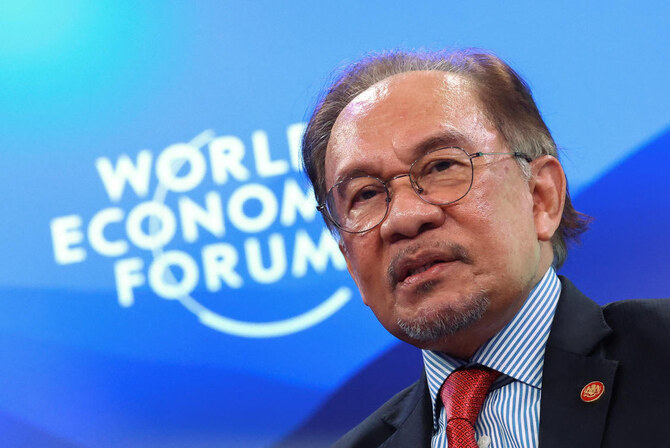
DAVOS: There will always be border disputes in Asia, and China should not be singled out because of tensions in the South China Sea, Malaysian Prime Minister Anwar Ibrahim said Wednesday.
Speaking at the World Economic Forum in Davos, Switzerland, Anwar said that Malaysia had border issues with Singapore and its other neighbors in Southeast Asia but they still managed to cultivate good relations.
While Malaysia also has maritime issues with China, it will push ahead with improving ties because it is an important country, he said.
“We have excellent relationship with Singapore. We still have border issues with them,” Anwar said.
“I treat the Thais as my family members, the leaders, but still we have some border issues with them. So it is with Indonesia, with the Philippines.
“(But) we don’t go to war, we don’t threaten. We do discuss. We get a bit... angry, but we do focus on the economic fundamentals and move on,” he added.
“Why is it that we must then single out China as an issue?” Anwar asked.
“That’s my only contention. Do I have an issue about it? Yes, but do I have a problem? No. Do we have any undesired tensions? No,” he said.
He said that while Malaysia has strong ties with the United States, China is an important neighbor that it must also engage with.
“Of course, people highlight the issue of the South China Sea... But may I remind you that Malaysia is a maritime country,” he said.
China has been “very reasonable” in dealing with Malaysia, Anwar added.
“They take us seriously, more seriously than many of the countries of our old allies and friends,” he said, without mentioning any country.
China has ruffled diplomatic feathers in Southeast Asia because of its assertion that it owns most of the strategic waterway despite an international ruling that the claim has no legal basis.
This has pitted it against Brunei, Malaysia, the Philippines, Taiwan and Vietnam, which have partial claims to the sea.
In recent years, China and the Philippines have seen an escalation of confrontations, including boat-ramming incidents and Chinese ships firing water cannons on Filipino vessels.
The clashes have sparked concern they could draw the United States, Manila’s long-time security ally, into armed conflict with China.

Malaysia’s Anwar says don’t single out China in sea tensions
https://arab.news/yprzx
Malaysia’s Anwar says don’t single out China in sea tensions
- There will always be border disputes in Asia, and China should not be singled out because of tensions in the South China Sea, Malaysian Prime Minister Anwar Ibrahim said Wednesday
US and Mideast countries seek Kyiv’s drone expertise as Russia-Ukraine talks put on ice
KYIV, Ukraine: The United States and its allies in the Middle East are seeking Ukraine's expertise in countering Iran's Shahed drones, according to Ukrainian President Volodymyr Zelenskyy.
Various countries, including the United States, have approached Ukraine for help in defending against the Iranian drones, Zelenskyy said late Wednesday. He said he has spoken in recent days with the leaders of the United Arab Emirates, Qatar, Bahrain, Jordan and Kuwait about possible cooperation.
Russia has fired tens of thousands of Shaheds at Ukraine since it invaded its neighbor just over four years ago, launching a swarm of more than 800 drones and decoys in its biggest nighttime barrage. Iran has responded to joint U.S.-Israeli strikes by launching the same type of drones at countries in the Middle East.
Ukrainian assistance in countering Iranian drones will be provided only if it does not weaken Ukraine's own defenses, and if it adds leverage to Kyiv's diplomatic efforts to stop the Russian invasion, according to the Ukrainian leader.
"We help to defend from war those who help us, Ukraine, bring a just end to the war" with Russia, Zelenskyy said. Later Thursday, Zelenskyy said he had received a U.S. request for support to defend against the drones in the Middle East and had given the order for equipment to be provided along with Ukrainian experts without providing further details.
"Ukraine helps partners who help our security and the protection of our people's lives," he added in a social media post.
Trump, in an interview Thursday with Reuters, said, "Certainly I'll take, you know, any assistance from any country."
Ukraine has battle-tested drone defenses
Ukraine has pioneered the development of cut-price drone killers that cost as little as $1,000, rewriting the air defense rule book and making other countries take notice.
European countries got a wake-up call last September on the changed nature of air defense when Poland scrambled multimillion-dollar military assets, including F-35 and F-16 fighter jets and Black Hawk helicopters, in response to airspace violations by cheap drones.
Ukrainian manufacturers have developed low-cost interceptor drones specifically designed to hunt and destroy Shaheds, and its rapidly expanding drone industry is producing excess capacity.
Zelenskyy announced earlier this year that Ukraine would begin exporting the battle-tested systems.
The European Union's top diplomat, Kaja Kallas, said before chairing a meeting of EU and Gulf foreign ministers via video link Thursday that the talks would look at how Ukraine's experience can help countries counter Iranian drones.
Middle East war delays Russia-Ukraine talks
The Iran war, now in its sixth day, has drawn international attention away from Europe's biggest conflict since World War II, and forced the postponement of a new round of U. S-brokered talks between Russia and Ukraine planned for this week, Zelenskyy said.
Western governments and analysts say the Russia-Ukraine war has killed hundreds of thousands of people, while there is no sign that yearlong U.S.-led peace efforts will stop the fighting any time soon.
"Right now, because of the situation around Iran, there are not yet the necessary signals for a trilateral meeting," Zelenskyy said. "But as soon as the security situation and the overall political context allow us to resume that trilateral diplomatic work, it will be done."
Zelenskyy thanked the United States for the return from Russia on Thursday of 200 Ukrainian prisoners of war. Russia's Defense Ministry also said it received the same number of prisoners from Ukraine and thanked the U.S. and United Arab Emirates for mediating.
Prisoner swaps have been one of the few tangible results of the talks. Vladimir Medinsky, a Russian negotiator, said on social media that a total of 500 prisoners from each side would be exchanged between Thursday and Friday.
Oleksandr Merezhko, the head of Ukraine's parliamentary foreign affairs committee, said Russian President Vladimir Putin is trying to drag out the negotiations so that he can press on with Russia's invasion while escaping further U.S. sanctions.
He urged the U.S. administration to look at the Russia-Ukraine war and the war in the Middle East as linked.
"In reality, Russia and Iran are close allies that act in concert — Iran supplies weapons and Russia helps Iran develop its defense industry. These are interconnected conflicts," Merezhko told The Associated Press.
Ukraine's army has recently pushed back Russian forces at some points along the roughly 1,250-kilometer (750-mile) front line, according to the Institute for the Study of War.
Localized Ukrainian counterattacks liberated more territory than Ukrainian forces lost in the last two weeks of February, the Washington-based think tank said this week, estimating the recovered land at about 257 square kilometers (100 square miles) since Jan. 1.


