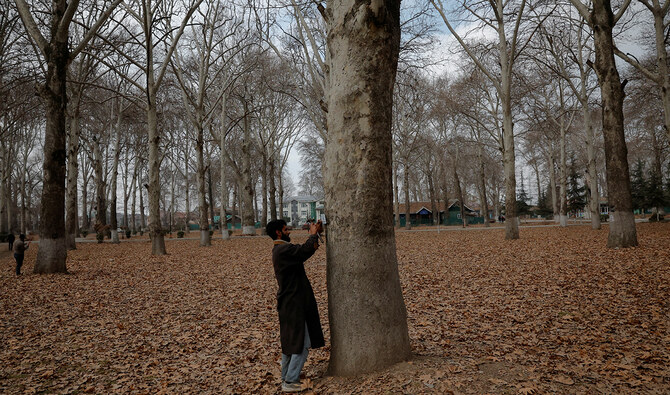
SRINAGAR: Authorities in Indian-administered Kashmir are geo-tagging thousands of ‘Chinar’ trees to create a comprehensive database for their management and help conserve them amid threats from rising urbanization, road-widening projects and diseases.
The trees are a cultural and ecological symbol of the restive northern territory, which is claimed in full by India and Pakistan and ruled in part by both, but hundreds of them have been lost over the last few decades.
Under the geo-tagging process, QR codes are attached to each surveyed tree, recording information about 25 characteristics, including its geographical location, health, age, and growing patterns, enabling conservationists to track changes and address risk factors.
The public can also scan the code to access the details, Syed Tariq, the head of the project, told Reuters.
“We have geo-tagged nearly 29,000 trees, but we still have more small-sized trees that haven’t been tagged... These will be tagged in due course,” Tariq said.
The Chinar trees take around 150 years to reach their full size of up to 30 meters (100 ft) in height with a girth of 10 to 15 meters (30 to 50 ft) at ground level.
The oldest Chinar in the region lies on the outskirts of the city of Srinagar and is around 650 years old.
“We are using a USG-based (ultrasonography-based) gadget capable of determining risk levels without human intervention. The gadget will assess risk factors, eliminating the need for manual evaluation,” Tariq said.
The portion of Kashmir under India’s control was roiled by violence for decades as militants fought security forces, but the conflict has eased in recent years, leading to a gradual rise in development projects and tourism.
Indian Prime Minister Narendra Modi visited Kashmir last week to inaugurate a tunnel and, during the event, said that numerous road and rail connectivity projects in the region would be completed in the coming days.

India turns to geo-tagging to conserve Kashmir’s iconic ‘Chinar’ trees
Short Url
https://arab.news/g4h37
India turns to geo-tagging to conserve Kashmir’s iconic ‘Chinar’ trees
- The trees are a cultural and ecological symbol of the restive northern territory
- The trees face threats from rising urbanization, road-widening projects, diseases
ICE agents can’t make warrantless arrests in Oregon unless there’s a risk of escape, US judge rules
- US District Judge Mustafa Kasubhai issued a preliminary injunction in a proposed class-action lawsuit
- Case targets Department of Homeland Security’s practice of arresting immigrants they happen to come across
PORTLAND, Oregon: US immigration agents in Oregon must stop arresting people without warrants unless there’s a likelihood of escape, a federal judge ruled Wednesday.
US District Judge Mustafa Kasubhai issued a preliminary injunction in a proposed class-action lawsuit targeting the Department of Homeland Security’s practice of arresting immigrants they happen to come across while conducting ramped-up enforcement operations — which critics have described as “arrest first, justify later.”
The department, which is named as a defendant in the suit, did not immediately comment in response to a request from The Associated Press.
Similar actions, including immigration agents entering private property without a warrant issued by a court, have drawn concern from civil rights groups across the country amid President Donald Trump’s mass deportation efforts.
Courts in Colorado and Washington, D.C., have issued rulings like Kasubhai’s, and the government has appealed them.
In a memo last week, Todd Lyons, the acting head of US Immigration and Customs Enforcement, emphasized that agents should not make an arrest without an administrative arrest warrant issued by a supervisor unless they develop probable cause to believe that the person is in the US illegally and likely to escape from the scene before a warrant can be obtained.
But the judge heard evidence that agents in Oregon have arrested people in immigration sweeps without such warrants or determining escape was likely.
The daylong hearing included testimony from one plaintiff, Victor Cruz Gamez, a 56-year-old grandfather who has been in the US since 1999. He told the court he was arrested and held in an immigration detention facility for three weeks even though he has a valid work permit and a pending visa application.
Cruz Gamez testified that he was driving home from work in October when he was pulled over by immigration agents. Despite showing his driver’s license and work permit, he was detained and taken to the ICE building in Portland before being sent to an immigration detention center in Tacoma, Washington. After three weeks there, he was set to be deported until a lawyer secured his release, he said.
He teared up as he recounted how the arrest impacted his family, especially his wife. Once he was home they did not open the door for three weeks out of fear and one of his grandchildren did not want to go to school, he said through a Spanish interpreter.
Afterward a lawyer for the federal government told Cruz Gamez he was sorry about what he went through and the effect it had on them.
Kasubhai said the actions of agents in Oregon — including drawing guns on people while detaining them for civil immigration violations — have been “violent and brutal,” and he was concerned about the administration denying due process to those swept up in immigration raids.
“Due process calls for those who have great power to exercise great restraint,” he said. “That is the bedrock of a democratic republic founded on this great constitution. I think we’re losing that.”
The lawsuit was brought by the nonprofit law firm Innovation Law Lab, whose executive director, Stephen Manning, said he was confident the case will be a “catalyst for change here in Oregon.”
“That is fundamentally what this case is about: asking the government to follow the law,” he said during the hearing.
The preliminary injunction will remain in effect while the lawsuit proceeds.
US District Judge Mustafa Kasubhai issued a preliminary injunction in a proposed class-action lawsuit targeting the Department of Homeland Security’s practice of arresting immigrants they happen to come across while conducting ramped-up enforcement operations — which critics have described as “arrest first, justify later.”
The department, which is named as a defendant in the suit, did not immediately comment in response to a request from The Associated Press.
Similar actions, including immigration agents entering private property without a warrant issued by a court, have drawn concern from civil rights groups across the country amid President Donald Trump’s mass deportation efforts.
Courts in Colorado and Washington, D.C., have issued rulings like Kasubhai’s, and the government has appealed them.
In a memo last week, Todd Lyons, the acting head of US Immigration and Customs Enforcement, emphasized that agents should not make an arrest without an administrative arrest warrant issued by a supervisor unless they develop probable cause to believe that the person is in the US illegally and likely to escape from the scene before a warrant can be obtained.
But the judge heard evidence that agents in Oregon have arrested people in immigration sweeps without such warrants or determining escape was likely.
The daylong hearing included testimony from one plaintiff, Victor Cruz Gamez, a 56-year-old grandfather who has been in the US since 1999. He told the court he was arrested and held in an immigration detention facility for three weeks even though he has a valid work permit and a pending visa application.
Cruz Gamez testified that he was driving home from work in October when he was pulled over by immigration agents. Despite showing his driver’s license and work permit, he was detained and taken to the ICE building in Portland before being sent to an immigration detention center in Tacoma, Washington. After three weeks there, he was set to be deported until a lawyer secured his release, he said.
He teared up as he recounted how the arrest impacted his family, especially his wife. Once he was home they did not open the door for three weeks out of fear and one of his grandchildren did not want to go to school, he said through a Spanish interpreter.
Afterward a lawyer for the federal government told Cruz Gamez he was sorry about what he went through and the effect it had on them.
Kasubhai said the actions of agents in Oregon — including drawing guns on people while detaining them for civil immigration violations — have been “violent and brutal,” and he was concerned about the administration denying due process to those swept up in immigration raids.
“Due process calls for those who have great power to exercise great restraint,” he said. “That is the bedrock of a democratic republic founded on this great constitution. I think we’re losing that.”
The lawsuit was brought by the nonprofit law firm Innovation Law Lab, whose executive director, Stephen Manning, said he was confident the case will be a “catalyst for change here in Oregon.”
“That is fundamentally what this case is about: asking the government to follow the law,” he said during the hearing.
The preliminary injunction will remain in effect while the lawsuit proceeds.
© 2026 SAUDI RESEARCH & PUBLISHING COMPANY, All Rights Reserved And subject to Terms of Use Agreement.