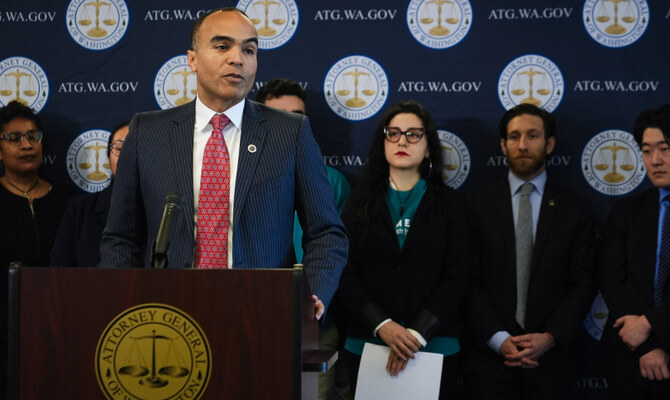
Attorneys general from 22 states sued Tuesday to block President Donald Trump’s move to end a century-old immigration practice known as birthright citizenship guaranteeing that US-born children are citizens regardless of their parents’ status.
Trump’s roughly 700-word executive order, issued late Monday, amounts to a fulfillment of something he’s talked about during the presidential campaign. But whether it succeeds is far from certain amid what is likely to be a lengthy legal battle over the president’s immigration policies and a constitutional right to citizenship.
The Democratic attorneys general and immigrant rights advocates say the question of birthright citizenship is settled law and that while presidents have broad authority, they are not kings.
“The president cannot, with a stroke of a pen, write the 14th Amendment out of existence, period,” New Jersey Attorney General Matt Platkin said.
The White House said it’s ready to face the states in court and called the lawsuits “nothing more than an extension of the Left’s resistance.”
“Radical Leftists can either choose to swim against the tide and reject the overwhelming will of the people, or they can get on board and work with President Trump,” White House deputy press secretary Harrison Fields said.
Connecticut Attorney General William Tong, a US citizen by birthright and the nation’s first Chinese American elected attorney general, said the lawsuit was personal for him.
“The 14th Amendment says what it means, and it means what it says — — if you are born on American soil, you are an American. Period. Full stop,” he said.
“There is no legitimate legal debate on this question. But the fact that Trump is dead wrong will not prevent him from inflicting serious harm right now on American families like my own.”
What is birthright citizenship?
At issue in these cases is the right to citizenship granted to anyone born in the US, regardless of their parents’ immigration status. People in the United States on a tourist or other visa or in the country illegally can become the parents of a citizen if their child is born here.
It’s enshrined in the 14th Amendment to the Constitution, supporters say. But Trump and allies dispute the reading of the amendment and say there need to be tougher standards on becoming a citizen.
The US is among about 30 countries where birthright citizenship — the principle of jus soli or “right of the soil” — is applied. Most are in the Americas, and Canada and Mexico are among them. Most other countries confer citizenship based on whether at least one parent — jus sanguinis, or “right of blood” — is a citizen, or have a modified form of birthright citizenship that may restrict automatic citizenship to children of parents who are on their territory legally.
What does Trump’s order say?
Trump’s order questions that the 14th Amendment extends citizenship automatically to anyone born in the United States.
Ratified in 1868 in in the aftermath of the Civil War, the 14th Amendment says: “All persons born or naturalized in the United States and subject to the jurisdiction thereof, are citizens of the United States and of the State wherein they reside.”
Trump’s order asserts that the children of noncitizens are not subject to the jurisdiction of the United States. It excludes the following people from automatic citizenship: those whose mothers were not legally in the United States and whose fathers were not US citizens or lawful permanent residents, and people whose mothers were in the country legally but on a temporary basis and whose fathers were not citizens or legal permanent residents.
It goes on to bar federal agencies from recognizing the citizenship of people in those categories. It takes effect 30 days from Tuesday, on Feb. 19.
It’s not clear whether the order would retroactively affect birthright citizens. It says that federal agencies “shall” not issue citizenship documents to the people it excludes or accept other documents from states or local governments.
What is the history of the issue?
The 14th Amendment did not always guarantee birthright citizenship to all US-born people. Congress did not authorize citizenship for all Native Americans born in the United States until 1924.
In 1898 an important birthright citizenship case unfolded in the US Supreme Court. The court held that Wong Kim Ark, who was born in San Francisco to Chinese immigrants, was a US citizen because he was born in the country. After a trip abroad, he had faced denied reentry by the federal government on the grounds that he wasn’t a citizen under the Chinese Exclusion Act.
But some advocates of immigration restrictions have argued that while the case clearly applied to children born to parents who are both legal immigrants, it’s less clear whether it applies to children born to parents without legal status.
The issue of birthright citizenship arose in Arizona — one of the states suing to block Trump’s order — during 2011 when Republican lawmakers considered a bill that would have challenged automatic birthright citizenship. Supporters said then that the goal wasn’t to get every state in the nation to enact such a law, but rather to bring the dispute to the courts. The bill never made it out of the Legislature.
What has the reaction to Trump’s order been?
In addition to the states, the District of Columbia and San Francisco, immigrant rights groups are also suing to stop Trump’s order.
Chapters of the American Civil Liberties Union in New Hampshire, Maine and Massachusetts along with other immigrant rights advocates filed a suit in New Hampshire federal court.
The suit asks the court to find the order to be unconstitutional. It highlights the case of a woman identified as “Carmen,” who is pregnant but is not a citizen. The lawsuit says she has lived in the United States for more than 15 years and has a pending visa application that could lead to permanent status. She has no other immigration status, and the father of her expected child has no immigration status either, the suit says.
“Stripping children of the ‘priceless treasure’ of citizenship is a grave injury,” the suit says. “It denies them the full membership in US society to which they are entitled.”
In addition to New Jersey and the two cities, California, Massachusetts, Colorado, Connecticut, Delaware, Hawaii, Maine, Maryland, Michigan, Minnesota, Nevada, New Mexico, New York, North Carolina, Rhode Island, Vermont, and Wisconsin joined the lawsuit to stop the order.
Arizona, Illinois, Oregon and Washington filed a separate suit in federal court challenging Trump’s order as well.


![]()

22 states sue to stop Trump’s order blocking birthright citizenship
Short Url
https://arab.news/2xrv4
22 states sue to stop Trump’s order blocking birthright citizenship
- The White House said it’s ready to face the states in court and called the lawsuits “nothing more than an extension of the Left’s resistance”


Latest updates


© 2026 SAUDI RESEARCH & PUBLISHING COMPANY, All Rights Reserved And subject to Terms of Use Agreement.