

UAE’s economy minister says Middle East desires ‘more peace’ as US President Trump takes charge

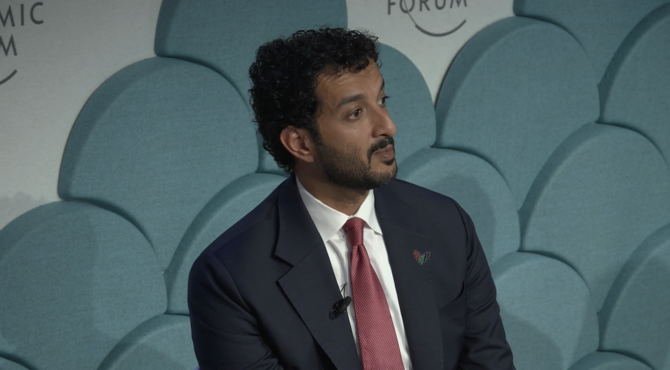
UAE’s Minister of Economy Abdulla bin Touq Al-Marri speaking on a panel in Davos, Jan. 21 (Screengrab/Courtesy: WEF)
Short Url
Updated 22 January 2025
Follow

UAE’s economy minister says Middle East desires ‘more peace’ as US President Trump takes charge

  • Abdulla bin Touq Al-Marri speaks of need to strengthen historic ties with US
  • GCC region has experienced significant economic growth over past 50 years
  • Emirati minister spoke on panel addressing geopolitical, environmental issues
  • Minister shares hopes of Dubai becoming ‘20-minute commute’ city

DAVOS: Arab Gulf countries want to strengthen their historic ties with the US under the new administration of President Donald Trump as the Middle East urgently needs peace and stability, according to the UAE’s Minister of Economy Abdulla bin Touq Al-Marri.

The Emirati minister spoke at the World Economic Forum in Davos on Tuesday and said that the UAE was the US’ No. 1 commerce partner within the Gulf Cooperation Council, with a bilateral trade of $40 billion annually.

He added that the relationship between the UAE and the US was an example of the strategic ties that Washington had forged with other GCC countries, such as Oman and Bahrain.

Al-Marri said the GCC region had experienced significant economic growth over the past 50 years. However, the Middle East continued to be a volatile region, riddled with political and armed conflicts.

Al-Marri said: “Now, what do we want in the region? We want more peace and we want more stability, and we want more growth for the region.”

He added that the UAE viewed its relationship with the US from a macro perspective and wished to continue on a strong and steady path during the Trump administration.

The Emirati minister was speaking on a panel called “Hard Power: Wake-up Call for Companies,” which addressed geopolitical and environmental issues related to corporations and investments.

Other panelists included Ukraine’s Deputy Prime Minister Yulia Svyrydenko; Nader Mousavizadeh, the CEO of Macro Advisory Partners; and Nir Bar Dea, the CEO of Bridgewater Associates.

Svyrydenko said that Ukraine faced a challenge in convincing investors and corporations to conduct business in a country locked in a conflict with Russia.

The deputy premier said that Ukrainian officials had done their homework to create a secure environment for investments in Ukraine, but that Kyiv was finding it challenging to meet the safety expectations of potential investors.

Svyrydenko said: “What kind of security guarantee do (investors) need? Do you need an anti-missile system in the industrial belts? Or do you need troops, or do you need NATO? It’s time for business to be more vocal about this and help us (answer) this issue.”


Ukraine's Deputy Prime Minister, Yulia Svyrydenko, said that Kyiv was finding it challenging to meet the safety expectations of potential investors (AFP)

Al-Marri said the UAE was “supportive” of the government of Ukraine when asked if Russian nationals residing in the UAE could return home if Trump helps to end the conflict in Eastern Europe.

There are no officially published figures regarding the number of Russian residents in the UAE although at least 1 million Russians visit the country annually as tourists.

Despite the potential for a tariff war between the US and China, Al-Marri stressed that the annual bilateral trade volume between Beijing and Abu Dhabi stood at $80 billion annually.

He said: “You can’t say ‘I need the world without China,’ and you can’t have the world without China; let’s be clear on that. You need China in this kind of trade domain.”

Al-Marri said that the UAE had “always built a bridge, always designed a supply chain” between regions.

He added: “We are ready for the world. We are very open, and we need corporations as well to think about the UAE as a place (for business and trade).”

He said that the UAE’s strategic location between East and West was ideal for companies connecting with various markets.

He added: “So, if you open a shop in Dubai or Abu Dhabi, you are operating the whole world.”

The minister shared his hopes of Dubai becoming a “20-minute commute” city, as its population is projected to reach 4 million next year.


Saudi banking sector outlook stable on higher non-oil growth: Moody’s 

Updated 4 sec ago
Follow

Saudi banking sector outlook stable on higher non-oil growth: Moody’s 

RIYADH: Saudi Arabia’s banking sector outlook remains stable as stronger non-oil economic growth and solid capital buffers support lending and profitability, Moody’s Ratings said, forecasting continued expansion despite liquidity constraints. 

In its latest report, credit rating agency Moody’s said the Kingdom’s non-oil gross domestic product is projected to expand by 4.2 percent this year, up from 3.7 percent recorded in 2025. 

In January, S&P Global echoed a similar view, saying banks operating in Saudi Arabia are expected to sustain strong lending growth in 2026, driven by financing demand tied to Vision 2030 projects. 

Fitch Ratings also underscored the healthy state of Saudi Arabia’s banking system last month, stating that credit growth and high net interest margins are supporting bank profitability in the Kingdom. 

Commenting on the latest report, Ashraf Madani, vice president and senior credit officer at Moody’s Ratings, said: “We expect credit demand to remain robust, but tight liquidity conditions will continue to limit the sector’s lending capacity.” 

Madani added that operating conditions in Saudi Arabia will continue to support banks’ strong asset quality and profitability. 

“The operating environment for banks remains buoyant, underpinned by a forecast increase in non-oil GDP growth, robust solvency and continued progress toward the government’s economic diversification goals,” he added.  

Moody’s said authorities in the Kingdom are introducing business-friendly reforms to bolster investment and private sector activity, while implementing key development projects and preparing for major global events. 

Saudi Arabia continues to advance reforms including full foreign ownership rights, simplified capital market registration procedures and improved investor protections, which could accelerate credit growth to 8 percent this year. 

Problem loans are expected to remain near historical lows at around 1.3 percent of total loans, supported by ongoing credit growth, favorable operating conditions and lower interest rates, which collectively strengthen borrowers’ repayment capacity. 

Retail credit risk remains controlled in Saudi Arabia because most borrowers are government employees with stable income streams. 

“Concentration of single borrowers and specific sectors remains high although the growing proportion of consumer loans — now nearing 50 percent of overall sector lending — continues to reduce aggregate concentration risk,” added Moody’s.  

The report said profitability is expected to remain solid among Saudi banks, supported by sustained loan growth and fee income. 

Margins are expected to remain stable despite lower asset yields as banks take advantage of credit demand to widen loan spreads on existing and new lending. 

Moody’s expects net income to tangible assets to remain stable at 1.8 percent to 1.9 percent this year. 

The report added that Saudi banks benefit from a very high likelihood of government support in the event of any failures. 

“We assume a very high likelihood of government support in the event of a bank failure. This is based on the government’s track record of timely intervention,” Moody’s said.  

It added that Saudi Arabia remains the only G-20 country that has not adopted a banking resolution framework. However, it is the only Gulf Cooperation Council member to have introduced a law for systemically important financial institutions.