



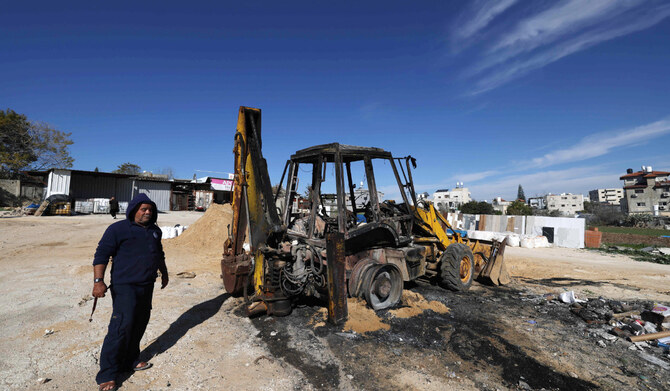
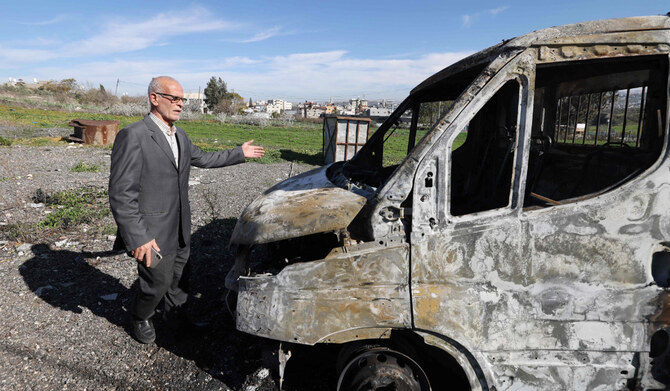

JINSAFUT, West Bank: Shortly after suspected Jewish settlers stormed Palestinian villages in the occupied West Bank late Monday, setting cars and property ablaze, US President Donald Trump canceled sanctions against Israelis accused of violence in the territory.
The reversal of the Biden administration’s sanctions, which were meant to punish radical settlers, could set the tone for a presidency that is expected to be more tolerant of Israel’s expansion of settlements and of violence toward Palestinians. In Trump’s previous term he lavished support on Israel, and he has once again surrounded himself with aides who back the settlers.
Settler leaders rushed to praise Trump’s decision on the sanctions, which were first imposed nearly a year ago as violence surged during the war in Gaza. The sanctions were later expanded to include other Israelis seen as violent or radical.
Finance Minister and settler firebrand Bezalel Smotrich called it a just decision, saying the sanctions were a “severe and blatant foreign intervention.” In a post on social media platform X, he went on to praise Trump’s “unwavering and uncompromising support for the state of Israel.”
The West Bank’s 3 million Palestinians already live under seemingly open-ended Israeli military rule, with the Palestinian Authority administering cities and towns. Smotrich and other hard-line settler leaders want Israel to annex the West Bank and rebuild settlements in Gaza, territories that Israel seized during the 1967 Mideast war.
Palestinians want both territories for a future state and have long viewed the settlements as a major obstacle to peace, while the international community overwhelmingly considers them illegal. There are more than 500,000 settlers in the West Bank who have Israeli citizenship.
Late Monday, dozens of masked men who are widely believed to be settlers marauded through at least two Palestinian villages and attacked homes and businesses, according to officials in Jinsafut and Al-Funduq, which are roughly 30 miles (50 kilometers) north of Jerusalem.
The Palestinian Red Crescent said it treated 12 people who were beaten by the men. It gave no details on their condition. Israel’s military said the men hurled rocks at soldiers who had arrived to disperse them, and that it had launched an investigation.
Violence has surged in the West Bank during the Gaza war, so it was not clear if the attack had any link to the inauguration. On Tuesday, meanwhile, Israel launched a deadly raid on the Jenin refugee camp.
Jalal Bashir, the head of Jinsafut’s village council, said that the men attacked three houses, a nursery and a carpentry shop located on the village’s main road. Louay Tayem, head of the local council in Al-Funduq, said dozens of men had fired shots, thrown stones, burned cars, and attacked homes and shops.
“The settlers were masked and had incendiary materials,” said Bashir. “Their numbers were large and unprecedented.”
On Tuesday, the charred shells of cars lay on the side of the road in Jinsafut and residents surveyed the damage to a burned storage space.
Growing impunity, even after Biden’s sanctions
Biden’s executive order against the settlers marked a rare break with America’s closest Middle East ally, and signaled his frustration with what critics say is Israel’s leniency in dealing with violent settlers.
Rights groups say that impunity has deepened since Israeli Defense Minister Israel Katz exempted settlers from what is known as administrative detention — Israel’s practice of detaining individuals on security grounds without charge or trial — which is routinely used against Palestinians.
Katz, who freed all Israelis held in administrative detention just last week, said those behind Monday’s attack should be held accountable in Israel’s more transparent criminal justice system.
Palestinian residents, meanwhile, are tried in Israeli military courts.
Biden’s sanctions were aimed at settlers who were involved in acts of violence, as well as threats against and attempts to destroy or seize Palestinian property. They later were broadened to include other groups, including Tzav 9, an activist organization that was accused of disrupting the flow of aid into Gaza by trying to block trucks heading into the territory.
Reut Ben-Chaim, a mother of eight who founded the group and was then slapped with sanctions that crippled her wellness company and prohibited her access to credit cards or banking apps, welcomed Trump’s step.
“We have heard in the last few days that the Trump administration is going to be the most pro-Israel there has been,” she told The Associated Press. “These actions, such as the removal of the sanctions … these are actions that already mark the way forward.”
Support for Israel could clash with wider ambitions
Trump has long boasted of his support for Israel, but he has also pledged to end wars in the Middle East that could require exerting some pressure on Israeli Prime Minister Benjamin Netanyahu.
Even before taking office, Trump appears to have pressed Netanyahu to accept a Gaza ceasefire agreement with Hamas that strongly resembled one the Biden administration had been pushing for months.
During his first term, Trump moved the American embassy to Jerusalem, recognized Israel’s annexation of the Golan Heights — which it captured from Syria in the 1967 war — and presented a Mideast peace plan that was seen as overwhelmingly favorable to Israel.
He also let settlement construction in the West Bank surge unchecked.
But he seemed at the time to have tapped the brakes on Netanyahu’s plans to annex large parts of the West Bank, something Israel’s far-right settlers have demanded for years. Netanyahu said he temporarily shelved the idea as part of the agreement with the UAE.


