Lawmakers in Pakistan’s Punjab impose total ban on kite flying over safety concerns

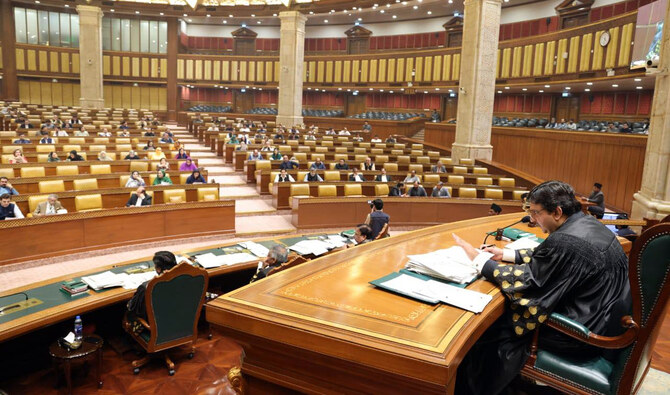
Speaker Punjab Assembly Malik Muhammad Ahmad Khan (right) speaks during an assembly session at the Punjab Assembly in Lahore, Pakistan, on November 15, 2025. (Photo Courtesy: Facebook/Speaker Punjab Assembly)
Short Url
Updated 21 January 2025
Follow

Lawmakers in Pakistan’s Punjab impose total ban on kite flying over safety concerns

  • Measure comes days ahead of decades-old Basant festival which features kite flying
  • Those breaching the law could face up to 3-5 years in prison, pay heavy fines of $7,200

LAHORE, Pakistan: Lawmakers in Pakistan’s most populous Punjab province on Tuesday passed a law permanently banning kite flying.

The measure, which includes enhanced prison terms and heavy fines on kite fliers and kite manufacturers, comes ahead of the decades-old festival of Basant.

A ban on kite flying was initially imposed in 2005 in Lahore, the capital of the province, when at least 11 bystanders were fatally cut by wire or string made from metal or coated with glass during competitions.

The ban was extended beyond Lahore to other cities and under the latest legislation it will come into effect across the province ahead of the Basant festival, whose centerpiece is kite flying to welcome spring.

Mujtaba Shuja-ur-Rehman, a lawmaker from the ruling Pakistan Muslim League party, moved the bill in the Punjab Assembly on Tuesday, which was passed with a majority vote. Those breaching the law could face a prison sentence of between three to five years and a fine of up to 2 million rupees ($7,200).

Manufacturers of kites and strings could also face custodial sentences of up to seven years and a fine of five million rupees ($18,000), Rehman said. He said the new law was needed to save the lives of innocent people.

The centuries-old Basant festival traditionally culminates with thousands of kites soaring into the sky. Basant means “yellow” in the Hindi language, a reference to the fields of blooming yellow flowers as spring approaches.


Pakistan PM directs ministries to fast-track foreign investment recommendations

Updated 57 min 57 sec ago
Follow

Pakistan PM directs ministries to fast-track foreign investment recommendations

  • Pakistan’s foreign direct investment fell by over 25 percent during July-November period, official data states
  • Premier directs ministries to provide support via embassies worldwide to facilitate foreign investors

ISLAMABAD: Prime Minister Shehbaz Sharif on Thursday directed all ministries to prepare recommendations for domestic, foreign investment and development projects related to their sectors, state media reported as Islamabad eyes sustainable economic growth. 

The premier’s directives came while he chaired a meeting of the federal ministries on the implementation of economic governance reforms, state broadcaster Radio Pakistan reported. 

Foreign direct investment inflows in Pakistan fell by more than 25 percent to $927 million during the July-November period, as per data from the central bank. Pakistan’s FDI inflows have never surged beyond $3 billion in nearly 20 years, worrying Islamabad as it seeks to escape a prolonged macroeconomic crisis. 

“Prime Minister Shehbaz Sharif has directed all ministries to promptly prepare recommendations for domestic and foreign investment and development projects related to their respective sectors,” Radio Pakistan reported. 
 
Sharif said it was his government’s top priority to provide institutional and administrative facilitation to investors.

The prime minister instructed federal ministries to provide “special importance” to proposals that promote exports.

“The prime minister directed the concerned ministries to provide effective support through Pakistani embassies worldwide to facilitate foreign investors,” the state media said. 

Sharif stressed that equal attention be provided to industrial production, agriculture, and other key sectors to increase investment.

Pakistan’s government has said it is eyeing sustainable economic growth, driven by exports and foreign investment. 

The South Asian country has recently signed agreements worth billions of dollars with regional allies such as Gulf nations, China and Central Asian nations to enhance cooperation in trade, investment, tourism, livestock, mines and minerals, and other sectors.