

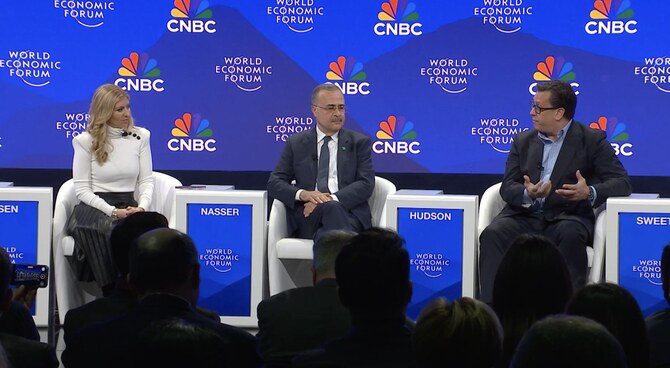

DUBAI: Industry leaders at the 2025 World Economic Forum in Davos have explored how artificial intelligence is reshaping business models and driving growth across sectors.
AI has evolved from an emerging technology into a transformative force capable of driving efficiency, innovation and growth, as highlighted in a panel discussion on Tuesday. However, to unlock the technology’s full potential, the panel highlighted the need for responsible, ethical and equitable implementation.
Transforming Industries
AI is revolutionizing how businesses operate by automating tasks, improving efficiency and enabling groundbreaking advancements, Julie Sweet, chair and CEO of Accenture, said.
“In most cases, AI isn’t replacing people, it’s replacing tasks or parts of the processes ... you can then create new opportunities for your people,” Sweet said, adding that AI frees up human talent for more complex work, allowing businesses to rethink their processes entirely.
Matt Garman, CEO of Amazon Web Services, said that AI is “not just doing something 5 percent better, it’s doing something 1,000 percent better or more,” highlighting the technology’s ability to deliver exponential improvements.
Responsible AI
While AI promises tremendous benefits, its success depends on how it is implemented.
Sweet highlighted the importance of building trust in AI through responsible practices.
“Building trust by treating AI like other programs ... it’s going to be absolutely critical,” she said.
For AI to be widely accepted, businesses must develop transparent frameworks and ensure that the technology is deployed ethically, she added.
Leadership and Collaboration
AI’s true value can only be unlocked when companies embrace leadership and collaboration, the panel was told.
Paul Hudson, CEO of Sanofi, said that AI adoption must come from the top.
“The biggest mistake CEOs make is ... they delegate AI to CDOs. If you delegate to a CDO, you have automatically lost,” Hudson said, adding that leadership is essential to integrating AI across organizations.
Meanwhile, Sweet added that AI innovation happens through partnerships. “Any company that says they can innovate only internally is, by definition, not innovating,” she said.
Technology Equity and Global Impact
As AI transforms industries, it must be accessible to all, Amin Nasser, president and CEO of Aramco, said.
Nasser called for technology equity, warning: “If we don’t ensure access to AI, we’ll end up with technology poverty, increasing the divide.”
AI has the potential to address global challenges, from energy security to healthcare, but it must be deployed responsibly to avoid widening inequality, he added.


