Imran Khan party to boycott talks with Pakistan government unless truth commissions announced

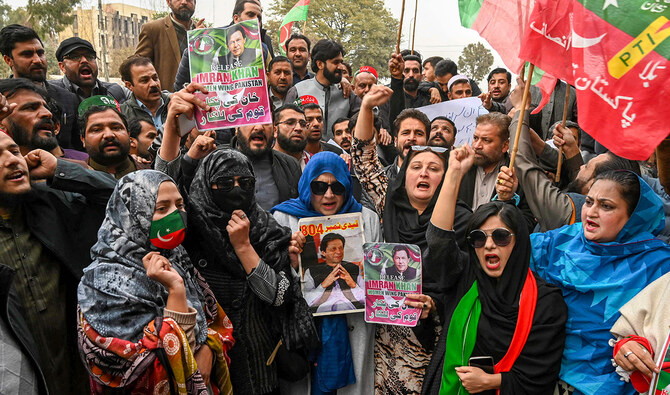
Pakistan’s imprisoned former prime minister Imran Khan’s supporters hold Khan’s portraits during a protest in Peshawar on January 17, 2025. (AFP/File)
Short Url
Updated 21 January 2025
Follow

Imran Khan party to boycott talks with Pakistan government unless truth commissions announced

  • First round of talks aimed at cooling political instability took place on Dec. 23 with follow ups on Jan. 2 and 16
  • Pakistani court last week sentenced Khan to 14 years jail in a land corruption case, a setback to nascent talks

ISLAMABAD: Salman Akram Raja, a lawyer and close aide of former Prime Minister Imran Khan, said the jailed leader had told the party not to participate in the next session of ongoing reconciliatory talks with the Pakistan government unless it announced judicial commissions into accusations Khan’s party and supporters had led violent protests. 
The first round of talks aimed at cooling political instability in the 241-million South Asian nation took place between Khan’s Pakistan Tehreek-e-Insaf and the government on Dec. 23, with follow up talks on Jan. 2 and 16. 
The PTI party’s demands to the government mainly include the release of all political prisoners including Khan, and the formation of two judicial commissions to probe into the events which led to his arrest in August 2023, and violent protest rallies, including one on May 9, when PTI supporters rampaged through military offices and installations, and a second one on Nov. 26 in which the government says four troops were killed. 
A Pakistani court last week sentenced Khan to 14 years imprisonment in a land corruption case, a setback to the nascent talks’ process. 
“He [Khan] has said we will not play committee-committee,” Raja told reporters after meeting Khan at the Rawalpindi Adiala prison on Monday.
“Our demands that judicial commissions be formed, if commissions are not announced into the events of May 9 and Nov. 26, then we will not sit in the next round [of talks].”

The talks opened last month as Khan had threatened a civil disobedience movement and amid growing concerns he could face trial by a military court for allegedly inciting attacks on sensitive security installations during the May 9 protests.
The negotiations also began two days after 25 civilians were sentenced by a military court to periods of two to 10 years of “rigorous imprisonment” in connection with attacks on military facilities on May 9, 2023. Just days later on Dec. 26, another 60 civilians were sentenced by a military court to jail time ranging from 2 to 10 years in connection with the May 9 attacks.
Khan’s first arrest in May 2023 in the land graft case in which he was sentenced last week sparked countrywide protests that saw his supporters attack and ransack military installations in an unprecedented backlash against Pakistan’s powerful army generals. Although Khan was released days later, he was rearrested in August that year after being convicted in a corruption case. He remains in prison and says all cases against him are politically motivated.
Protests demanding Khan’s release in November also turned violent, with the PTI saying 12 supporters were killed while the state said four troops had died.


Pakistan rice exports slump 40% as India’s return hits pricing power

Updated 5 sec ago
Follow

Pakistan rice exports slump 40% as India’s return hits pricing power

  • Statistics show non-Basmati shipments have fallen over 50 percent in July-January period
  • Government offers 9 percent tax drawback on premium Basmati exports to support sector

ISLAMABAD: Pakistan’s rice exports fell 40.5 percent to $1.31 billion in the first seven months of the fiscal year, official data showed on Tuesday, as India’s return to the global market squeezed Islamabad’s market share and pricing power.

According to the Pakistan Bureau of Statistics (PBS), non-Basmati exports dropped 50.8 percent to $827.8 million, with volumes falling to 2.0 million tons from 3.15 million tons a year ago. Basmati exports declined 6.62 percent to $477.7 million, with volumes easing to 436,484 tons from 487,278 tons.

The Ministry of National Food Security told a parliamentary committee in two separate meetings in December and January that India’s re-entry into the global rice market was a key factor behind the decline, saying increased Indian supplies had made Pakistani rice less competitive.

Officials told lawmakers that India benefits from free trade agreements and provides substantial support to its rice sector, putting additional pressure on Pakistani exporters.

In response, the Ministry of Commerce last month issued a notification under the “Drawback of Local Taxes and Levies for Rice Order, 2026,” allowing a rebate of 9 percent of the free-on-board (FOB) value for Basmati exports priced above $750 per metric ton.

The government said the measure, announced on January 23, aims to ease liquidity pressures on exporters and improve competitiveness.

While PBS data for July-January shows a 40.5 percent decline, figures from the Federal Board of Revenue (FBR) for July-December show an even steeper 47 percent drop to $973 million from $1.82 billion in the same period last year, reflecting a deficit of over $800 million.

Industry representatives say they are now focusing on market diversification to counter the slowdown.

“Currently Basmati is mainly exported to Middle East and EU. Non-Basmati is exported to Philippines, Indonesia, Malaysia and African countries,” Malik Faisal Jahangir, chairman of the Pakistan Rice Exporters Association, told Arab News last week.

“For the new markets for our non-basmati rice exports, we are looking to increase our volumes to China, Philippines, Indonesia and Bangladesh,” he added.