Pakistan’s Reko Diq mine to generate $74 billion in free cash flow over 37 years — Barrick CEO

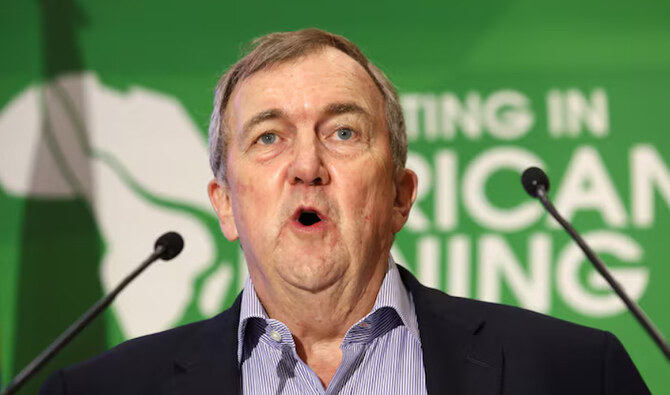
Mark Bristow, CEO of Barrick Gold Co., speaks during the Investing in African Mining Indaba 2023 conference in Cape Town, South Africa on February 8, 2023. (REUTERS/File)
Short Url
Updated 21 January 2025
Follow

Pakistan’s Reko Diq mine to generate $74 billion in free cash flow over 37 years — Barrick CEO

  • Bristow says project’s timeline on track, with fencing, accommodation, and surveys already completed
  • Saudi mining firm Manara Minerals could invest in Reko Diq in next two quarters, Pakistani petroleum minister has said

KARACHI: The Reko Diq copper and gold project in Pakistan is expected to generate approximately $74 billion in free cash flow over the next 37 years, based on consensus long-term prices, the CEO of joint owner Barrick Gold said in a media interview.
Barrick Gold owns a 50 percent stake in the Reko Diq mine and the governments of Pakistan and the province of Balochistan own the other 50 percent. Barrick considers the mine one of the world’s largest underdeveloped copper-gold areas, and its development is expected to have a significant impact on Pakistan’s struggling economy.
The project, which was delayed due to a long running dispute that ended in 2022, is expected to start production by the end of 2028. It will produce 200,000 tons of copper per year in its first phase, with an estimated cost of $5.5 billion. The first phase is expected to be completed by 2029, Barrick’s CEO Mark Bristow told Pakistani digital media outlet Dawn News English.
A second phase, estimated to cost $3.5 billion, will double production, he added.
The mine is estimated to have reserves lasting 37 years but Bristow said that through upgrades and expansions it could potentially be mined for much longer.
A free cash flow of $74 billion could generate significant dividends, royalties and taxes for Pakistan, which currently has only around $11 billion in foreign reserves.
Barrick is also in talks with railway authorities and infrastructure providers to revamp the coal terminal in Port Qasim, on the outskirts of Pakistan’s port city Karachi, to develop infrastructure to transport copper in the country and for export.
Bristow said the project’s timeline is on track, with fencing, accommodation, and surveys already completed.
Saudi Arabian mining company Manara Minerals could invest in Pakistan’s Reko Diq mine in the next two quarters, Pakistani Petroleum Minister Musadik Malik said last week.
Executives from Manara visited Pakistan in May last year for talks about buying a stake in the project. Pakistan is also in talks with other Gulf countries about mining opportunities, Malik said.


Pakistan’s president defends ongoing strikes in Afghanistan, urges Kabul to dismantle militants

Updated 02 March 2026
Follow

Pakistan’s president defends ongoing strikes in Afghanistan, urges Kabul to dismantle militants

  • Afghanistan on Thursday launched attacks in retaliation for Pakistani airstrikes the previous Sunday
  • Pakistan’s military says it is only targeting Afghan military installations to avoid civilian casualties

ISLAMABAD: Pakistan’s president on Monday defended his country’s ongoing military strikes in neighboring Afghanistan, saying Islamabad tried all forms of diplomacy before targeting militants operating from Afghan territory, and called on the Taliban government in Kabul to disarm groups responsible for attacks in Pakistan.

Pakistan earlier said it is in “open war” with Afghanistan, alarming the international community. The border area remains a stronghold for militant organizations including Al-Qaeda and the Daesh (Islamic State) group.

“(The Afghan Taliban) must choose to dismantle the terror groups that survive on conflict and its war economy,” Asif Ali Zardari said during a speech to lawmakers, adding that “no state accepts serial attacks on its soil.”

Afghanistan on Thursday launched attacks in retaliation for Pakistani airstrikes the previous Sunday. Since then, Pakistan has carried out operations along the border, with Information Minister Attaullah Tarar claiming the killing of 435 Afghan forces and the capture of 31 Afghan positions.

Kabul has denied such claims.

In Afghanistan, the deputy government spokesman Hamdullah Fitrat said Pakistan’s military fired mortar shells at a refugee camp in eastern Kunar province, killing three children and injuring three others.

Afghanistan’s defense ministry said Afghan forces carried out strikes targeting a Pakistani military facility near Paktia province, causing “substantial losses and heavy casualties.”

Pakistan’s military did not respond to questions. It has said Pakistan is only targeting Afghan military installations to avoid civilian casualties.

Pakistan has witnessed a surge of violence in recent months and blames it on the outlawed Pakistani Taliban, known as Tehreek-e-Taliban Pakistan or TTP. It operates both inside Pakistan and from Afghan territory.
Islamabad accuses Afghanistan’s Taliban government of providing safe havens for the TTP, which Kabul denies.

The latest cross-border fighting ended a ceasefire brokered by Qatar and Turkiye in October. The two sides failed to reach a permanent agreement during talks in Istanbul.

Zardari reiterated Pakistan’s call for talks, saying, “We have never walked away from dialogue.”

The Pakistani leader again accused Afghanistan of acting as a proxy for India by sheltering militant groups.

“Stop being used by another country as a battlefield for their ambitions,” he said.

Zardari cited a recent report from the United Nations Security Council’s monitoring team that described the presence of militant groups in Afghanistan as an extra-regional threat.