


DUBAI: Healthy, resilient, and productive human capital is the backbone of economic vitality, Faisal Alibrahim, the Saudi minister of economy and planning, told a panel discussion at the World Economic Forum in Davos on Monday.
“However, we see an interesting story where we invest billions in energy, education and other solutions, but the investments in healthcare seem to be taking a second priority,” he added.
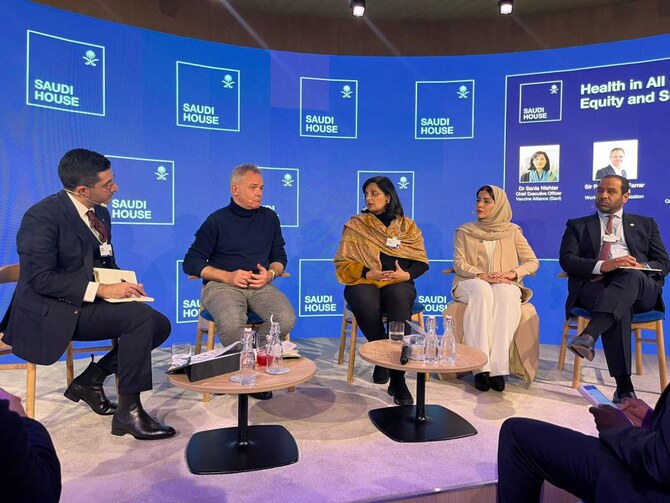
Part of Saudi House, a centralized hub serving as a meeting point for government officials, business leaders and other stakeholders at the forum, the panel was moderated by Faisal J. Abbas, editor-in-chief of Arab News.
It featured health experts such as Dr. Sania Nishtar, CEO of Gavi, the Vaccine Alliance; Sir Jeremy Farrar, chief scientist at the World Health Organization; Rayan Fayez, deputy CEO of NEOM; and Dr. Nouf Al-Numair, secretary-general of the Saudi Ministerial Committee for Health in All Policies.
Alibrahim said health was a major part of Saudi Arabia’s Vision 2030 agenda and it was “important for us to unlock the full potential of human capital in the Kingdom by making healthcare our utmost priority.”
Al-Numair said: “Saudi Arabia has taken concrete and very clear steps to adopt health in all policies.”
The initiative started “by issuing a royal decree that puts public health as a priority in all laws and regulations to prevent diseases and to increase the life expectancy of our population,” she added.
One of the committee’s policies is reducing the amount of salt and bread in foods, aimed at curbing hypertension, which affects cardiovascular health and, in turn, mortality.
“Eventually, (this) will increase the life expectancy in our population, so we have a clear understanding of what success looks like, which is linked to certain KPIs,” said Al-Numair.
A significant part of health is prevention and one of the most important tools for prevention is vaccination, Nishtar told the panel.
Although “there is a lobby of naysayers,” she added that her experience across countries has been varied with some showing a strong demand for vaccines.
“We are looking at our resource envelope, and we’re trying to raise more money, because the demand (for vaccines) from countries is so huge,” she said.
The WHO’s Sir Farrar called for a more horizontal structure with health and science built into different verticals — such as education and transport — along with a “governance structure, which ensures an inclusive voice for every ministry and every constituency.”
“Then, you have the opportunity to not have health as seen through the lens, frankly, of illness, but to have health seen through the lens of well-being,” he said.
He also asserted the need for countries to be able to adopt such a structure “either to address inequalities within the countries or inequalities between the countries.”
Health and well-being are a core part of the 15 sectors NEOM has identified as the “economic engines” of the futuristic city, said Fayez.
He said: “A lot of people hear about NEOM as this mega project or giga project, but it’s important to highlight that it is not the real estate or the infrastructure alone that makes NEOM.”
He explained that NEOM’s healthcare strategy is driven by four principles — prevention when possible, world-class treatment when needed, use of technology and sharing with the globe.


