

Saudi project clears 732 Houthi mines in Yemen

1 / 2
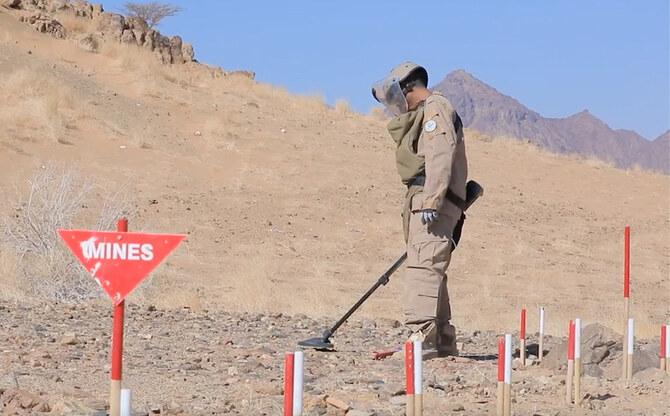
The initiative trains local demining engineers and provides them with modern equipment. (Project Masam)
2 / 2
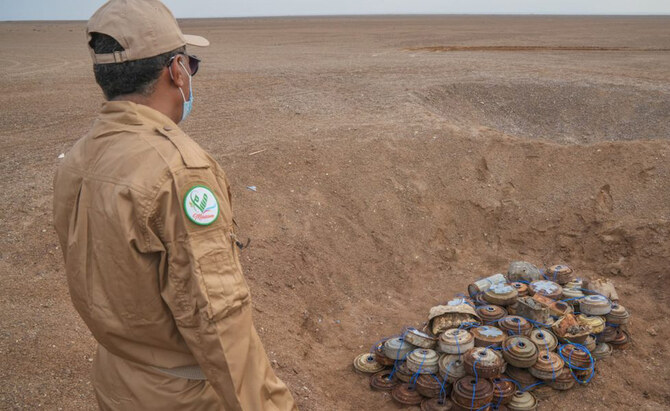
The initiative trains local demining engineers and provides them with modern equipment. (Project Masam)
Short Url
Updated 20 January 2025
Follow

Saudi project clears 732 Houthi mines in Yemen

RIYADH: Members of Saudi Arabia’s Project Masam removed 732 explosive devices from various regions of Yemen last week.

The total included eight anti-personnel mines, 51 anti-tank mines, 672 unexploded ordnances and one explosive device, according to a recent report.

Ousama Al-Gosaibi, the initiative’s managing director, said a total of 478,954 mines had been cleared since its inception in 2018.

The explosives were planted indiscriminately and posed a threat to civilians, including children, women and the elderly.

The demining operations took place in Marib, Aden, Jouf, Shabwa, Taiz, Hodeidah, Lahij, Sanaa, Al-Bayda, Al-Dhale and Saada.

The initiative trains local demining engineers and provides them with modern equipment. It also offers support to Yemenis injured by the devices.

Teams are tasked with clearing villages, roads and schools to facilitate safe movement for civilians and the delivery of humanitarian aid.

About 5 million people have been forced to flee their homes since the start of the conflict in Yemen, many of them displaced by the presence of land mines.


Saudi Arabia launches initiative to reroute Gulf cargo to Red Sea ports

Updated 13 March 2026
Follow

Saudi Arabia launches initiative to reroute Gulf cargo to Red Sea ports

  • The initiative comes as shipping through the Strait of Hormuz has been severely disrupted by the widening conflict in the region
  • Since the US and Israel struck Iran last month, Tehran has moved to restrict passage through the waterway


RIYADH: Saudi Arabia has launched an initiative to redirect shipping from ports in the Arabian Gulf to its Red Sea ports amid the ongoing US-Israel-Iran war.

Transport Minister Saleh Al-Jasser, who also chairs the Saudi Ports Authority (Mawani), launched the Logistics Corridors Initiative alongside Zakat, Tax and Customs Authority Governor Suhail Abanmi, Mawani President Suliman Al-Mazroua, and other officials, the Saudi Press Agency reported.

The initiative will establish dedicated operational corridors to receive containers and cargo redirected from ports in the Kingdom's Eastern Region and other Gulf Cooperation Council states to Jeddah Islamic Port and other Red Sea coast ports.

Al-Jasser said the Kingdom was committed to ensuring supply-chain stability and the smooth flow of goods through global trade routes. Jeddah Islamic Port and other west coast ports, he added, were already playing a key role in accommodating shipments redirected from the east, while also linking Gulf cargo to regional and international markets.

The initiative comes as shipping through the Strait of Hormuz has been severely disrupted by the widening conflict in the region. Iran has long threatened to close the strait — the world's most critical oil and gas chokepoint, through which roughly a fifth of global oil supplies pass — in the event of a war.

Since the US and Israel struck Iran last month, Tehran has moved to restrict passage through the waterway, sending freight rates soaring and forcing shipping companies to seek alternative routes.

Saudi Arabia's Red Sea ports offer a viable bypass, connecting Gulf cargo to global markets without passing through the strait.