

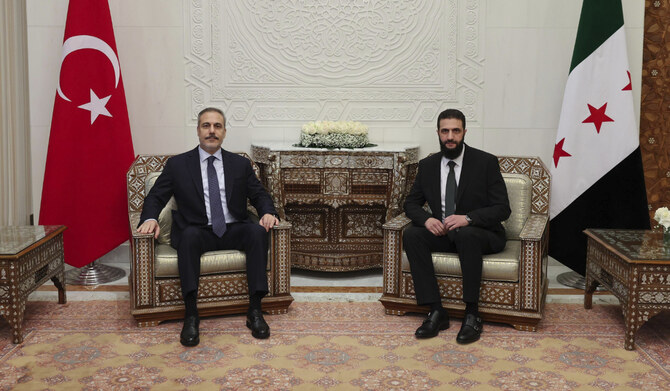

ANKARA: Turkiye has emerged as one of the most influential power brokers in Syria after rebels toppled Bashar Assad last month, ending his family’s brutal five-decade rule.
NATO member Turkiye is now in a position to influence its neighbor’s future diplomatically, economically and militarily.
Here are details of Turkiye’s connections with Syria and how it hopes to use its influence there.
WHY IS TURKEY IMPORTANT?
Turkiye, which shares a 911 km (566-mile) border with Syria, was the main backer of rebel groups fighting under the banner of the Syrian National Army during the 13-year uprising against Assad. It cut diplomatic ties with Damascus in 2012.
It is the biggest host of Syrians who fled the civil war, taking in some 3 million people, and is the main entry-point for aid.
Since 2016, Turkiye, with its Syrian allies, has mounted several cross-border military campaigns against Kurdish militants based in Syria’s northeast that it sees as a threat to its national security.
Syria’s new administration, led by Hayat Tahrir Al-Sham (HTS), a former Al-Qaeda affiliate, is friendly toward Ankara.
WHAT DOES TURKEY WANT?
With its strong ties to Syria’s new leadership, Turkiye stands to benefit from intensified trade and cooperation in areas including reconstruction, energy and defense.
Assad’s fall has presented Ankara with a window of opportunity to try to end the presence of the Kurdish People’s Protection Units (YPG) along its borders.
Ankara views the YPG as an extension of the Kurdistan Workers Party (PKK), which has been waging an insurgency against the Turkish state since 1984 and is deemed a terrorist group by Turkiye, the United States and the European Union.
The YPG militia spearheads the Syrian Democratic Forces (SDF) alliance, which is the United States’ main local partner in the fight against Daesh and controls swathes of territory in the northeast.
Washington’s longtime support of the Kurdish factions has been a source of tension with Ankara, but Turkish Foreign Minister Hakan Fidan has said he believes incoming US president Donald Trump will take a different approach.
Trump has not said publicly what his plans might be but has said that he thinks “Turkiye is going to hold the key to Syria.”
Syria’s de facto leader, Ahmed Al-Sharaa, who heads HTS, has said he does not want Syria becoming a platform for the PKK to launch attacks against Turkiye.
As rebels led by Sharaa took control of Damascus last month, fighting flared between Turkish-backed and Kurdish-led forces in the northeast.
The SDF has shown flexibility regarding some of Turkiye’s demands, telling Reuters last month that its foreign fighters, including PKK members, would leave Syria if Ankara agrees to a ceasefire.
Intensive talks are underway to try to resolve the conflict in the region.
WHAT HAS TURKEY SAID AND DONE?
Turkiye’s intelligence chief, Ibrahim Kalin, was in Damascus days after Assad was ousted, and its top diplomat, Fidan, was the first foreign minister to visit. Turkiye was also the first nation to reopen its embassy.
Fidan has said that Turkiye is proud to have been “on the right side of history” in Syria but has no desire to “dominate” it.
Turkiye has promised to support Syria’s reconstruction, offering to help rebuild infrastructure, draft a new constitution, supply electricity and resume flights.
It hopes Syrians it is hosting will start returning home but has said it will not force them to leave.
Turkiye has also called repeatedly for the YPG to be disbanded, while warning of a new military offensive if authorities in Damascus do not address the issue. Its officials have met repeatedly with US and Syrian counterparts about the issue.
The SDF has said it would be willing to integrate with Syria’s defense ministry, but only as “a military bloc.”


