

President of Iraq’s Kurdistan government meets Jordanian king, UAE president

1 / 2
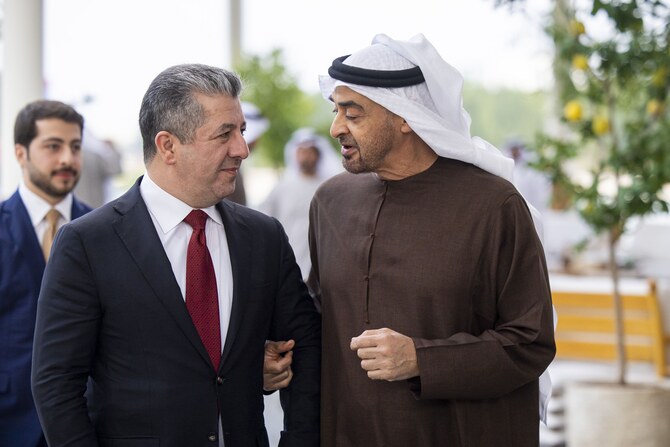
UAE President Sheikh Mohamed bin Zayed Al-Nahyan and Masrour Barzani, the president of the Kurdistan Regional Government of Iraq, in Abu Dhabi, Jan. 19 (WAM)
2 / 2
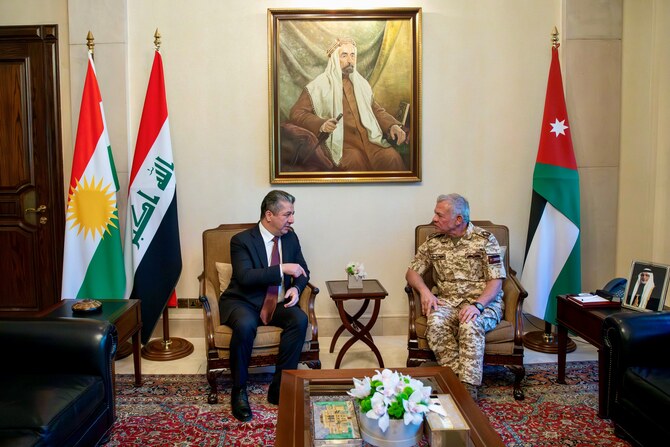
King Abdullah II of Jordan and Masrour Barzani, the president of the Kurdistan Regional Government of Iraq, in Amman, Jan. 19 (Petra)
Short Url
Updated 19 January 2025
Follow

President of Iraq’s Kurdistan government meets Jordanian king, UAE president

  • Masrour Barzani visited Amman and Abu Dhabi to discuss developments in the Middle East

LONDON: King Abdullah II of Jordan received Masrour Barzani, the president of the Kurdistan Regional Government of Iraq, at Basman Palace in Amman on Sunday.

They discussed current regional developments, particularly in the Gaza Strip and Syria, and the prospects for cooperation between Jordan and the Kurdistan Region to develop their ties.

Barzani acknowledged King Abdullah’s leadership in Jordan’s efforts for peace and stability in the Middle East, the Petra agency reported.

On Sunday, the Kurdish leader met with UAE President Sheikh Mohamed bin Zayed Al-Nahyan at Qasr Al-Shati in Abu Dhabi to discuss ways to enhance cooperation between the two nations, according to the Emirates News Agency.

Sheikh Hamdan bin Mohamed bin Zayed Al-Nahyan, deputy chairman of the Presidential Court for Special Affairs, and Sheikh Khalifa bin Tahnoon bin Mohammed Al-Nahyan, chairman of the Abu Dhabi crown prince’s court, attended the meeting along with several other sheikhs, ministers, and senior officials.


Two Palestinians killed in Gaza

Palestinians inspect a building hit by an Israeli strike on Friday, in Gaza City, February 6, 2026. (REUTERS)
Updated 11 sec ago
Follow

Two Palestinians killed in Gaza

  • Israeli occupation forces also targeted Khan Younis and Rafah during a series of attacks

GAZA: Two Palestinians were killed in Beit Lahia and Jabalia in northern Gaza by Israeli forces on Friday in breach of the ceasefire agreement, according to local sources.

A woman was also injured in gunfire east of Deir Al-Balah in central Gaza.

The Israeli army also carried out several coordinated attacks in the early hours of Friday, targeting residential buildings across several areas of the Gaza Strip as part of its policy of destroying urban blocks.

A WAFA correspondent reported that forces demolished residential buildings northeast of Gaza City and conducted additional attacks on buildings in northern Gaza.

In Khan Younis, the army attacked the southeast of the city, while eastern and southern areas of the province came under heavy artillery fire.

In Rafah, Israeli warplanes fired heavily on the city alongside shelling from military vehicles stationed there, while on Thursday night, airstrikes hit the home of the Abu Hatab family in Khan Younis refugee camp.

Meanwhile, the UN said ending the deepening humanitarian catastrophe in the Gaza Strip required the unrestricted opening of all crossings for aid delivery. It also warned that opening the Rafah crossing to individuals only, without humanitarian assistance, did not alter the deteriorating situation on the ground.

UNRWA spokesperson Jonathan Fowler said humanitarian supplies destined for Gaza remain stuck in Egypt and Jordan, adding Israel had blocked their entry since March 2025.

He stressed that allowing people to pass alone, while preventing aid deliveries, did nothing to alleviate the severe humanitarian conditions and added the continued obstruction of relief supplies was among the main reasons for ongoing suffering in Gaza.

He said that the humanitarian situation saw a very limited improvement during summer 2025 compared with the peak of the crisis but the slight increase in aid and commercial goods far from compensated
for the massive destruction caused by “a man-made humanitarian disaster.”

Fowler added children continued to suffer from hunger, medical supplies remained insufficient to meet overwhelming needs, and disease outbreaks persisted amid the collapse of water and sewage systems and an acute shortage of shelter materials.

At least 600 aid trucks per day were needed to sustain the population, he added, warning that any fewer effectively meant the crisis would continue, particularly given restrictions on the type of aid allowed in and the limited operating hours at crossings.

Fowler also said the continued ban on UNRWA’s work following the ceasefire reflected a political choice targeting the largest humanitarian organization operating in Gaza, despite the agency’s readiness, long-standing experience and extensive operational capacity.

He warned that restrictions imposed on civil society organizations were aimed at confining humanitarian work to selected actors willing to overlook violations and stressed that adherence to humanitarian principles and respect for international humanitarian law, must remain non-negotiable.