ISLAMABAD: Lt. Gen. SM Kamr-ul-Hassan, principal staff officer (PSO) of the Bangladesh armed forces division, on Sunday met senior Pakistan Navy officials and discussed with them regional maritime security cooperation, Pakistan Navy said.
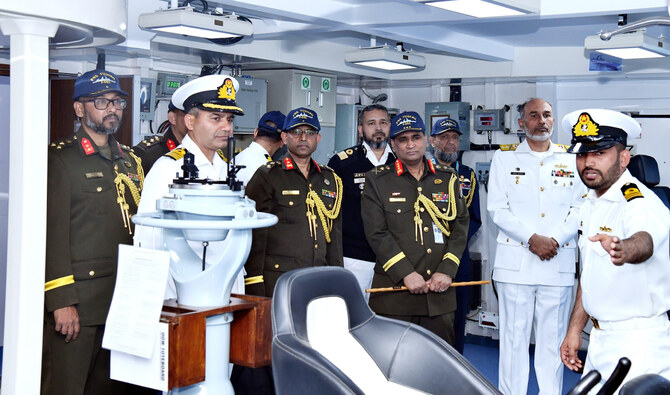
Lt. Gen. Hassan toured Pakistan Navy ships and units during his visit to the southern Pakistani port city of Karachi, according to the Directorate General Public Relations (DGPR) of Pakistan Navy.
He met Pakistan Fleet Commander Rear Admiral Abdul Munib, Coast Commander Rear Admiral Faisal Amin and Managing Director of Karachi Shipyard & Engineering Works (KS&EW) Rear Admiral Salman Ilyas.
“During these engagements, discussions focused on professional matters of mutual interests, including regional maritime security and bilateral defense collaboration,” the DGPR said in a statement.
“Various potential areas of cooperation were highlighted, such as joint military exercises, reciprocal visits, and training exchange programs between the two countries.”
Pakistan and Bangladesh were once one nation, but they split in 1971 as a result of a bloody civil war, which saw the part previously referred to as East Pakistan seceding to form the independent nation of Bangladesh.
In the years since, Bangladeshi leaders, particularly former prime minister Sheikh Hasina, chose to maintain close ties with India. Relations between Pakistan and Bangladesh have warmed up since Hasina’s ouster as a result of a student-led uprising in August, witnessing a marked improvement.
“The visit of Lt. Gen. SM Kamrul Hassan is expected to further strengthen defense ties between the two brotherly nations, enhancing cooperation and solidifying the bonds between the armed forces of Pakistan and Bangladesh,” Pakistan Navy said.
Lt. Gen. Hassan, who is currently on a visit to Pakistan, this week met Chief of Army Staff (COAS) General Asim Munir in Rawalpindi, according to the Inter-Services Public Relations (ISPR), the Pakistani military’s media wing. During the meeting, both military commanders stressed the need for an enduring partnership between the two countries to remain “resilient against external influences.”
Earlier in the day, the Trade Development Authority of Pakistan (TDAP) said it would send two trade delegations to Bangladesh on Jan. 19-20 to increase bilateral relations and economic collaboration as both countries move to repair strained ties.
“The first delegation of dates comprising 13 exporters will leave for a week-long visit on Jan. 19 while the second delegation of citrus will leave for a business-to-business (B2B) meeting on Jan. 20,” the TDAP said.
The delegations will explore more trade opportunities, promote business partnerships and Pakistan’s export potential in the Bangladeshi market, it added.
The development comes days after the signing of a landmark agreement between Pakistan and Bangladeshi businesspersons to establish a joint business council between the two countries.
Pakistan’s Deputy Prime Minister Ishaq Dar is also scheduled to visit Dhaka at the start of February to further consolidate the relations between the two countries.


Top Bangladeshi commander meets Pakistan Navy officials, discusses regional maritime security
https://arab.news/69cu7
Top Bangladeshi commander meets Pakistan Navy officials, discusses regional maritime security

- The development comes amid a thaw in relations between both nations since PM Sheikh Hasina’s ouster in August
- The two sides discussed joint military exercises, reciprocal visits and training exchange programs, Pakistan Navy says

Rating firm S&P says it won’t rush Iran war downgrades, sees risks for countries like Pakistan
- Agency says it is monitoring indebted energy importers as higher oil prices strain finances
- Gulf economies seen better placed to weather shock, though Bahrain flagged as vulnerable
LONDON: S&P Global said it would not make any knee-jerk sovereign rating cuts following the outbreak of war in the Middle East, but warned on Thursday that soaring oil and gas prices were putting a number of already cash-strapped countries at risk.
The firm’s top analysts said in a webinar that the conflict, which has involved US and Israeli strikes against Iran and Iranian strikes against Israel, US bases and Gulf states, was now moving from a low- to moderate-risk scenario.
Most Gulf countries had enough fiscal buffers, however, to weather the crisis for a while, with more lowly rated Bahrain the only clear exception.
Qatar’s banking sector could also struggle if there were significant deposit outflows in reaction to the conflict, although there was no evidence of such strains at the moment, they said.
“We don’t want to jump the gun and just say things are bad,” S&P’s head global sovereign analyst, Roberto Sifon-Arevalo, said.
The longer the crisis was prolonged, though, “the more difficult it is going to be,” he added.
Sifon-Arevalo said Asia was the second-most exposed region, due to many of its countries being significant Gulf oil and gas importers.
India, Thailand and Indonesia have relatively lower reserves of oil, while the region also had already heavily indebted countries such as Pakistan, Bangladesh and Sri Lanka whose finances would be further hurt by rising energy prices.
“We are closely monitoring these (countries) to see how the credit stories evolve,” Sifon-Arevalo said.


