


SEOUL,: South Korea’s impeached President Yoon Suk Yeol was formally arrested early on Sunday, days after being apprehended at his presidential compound in Seoul. He faces possible imprisonment over his ill-fated declaration of martial law last month.
Yoon’s arrest could mark the beginning of an extended period in custody, lasting months or more.
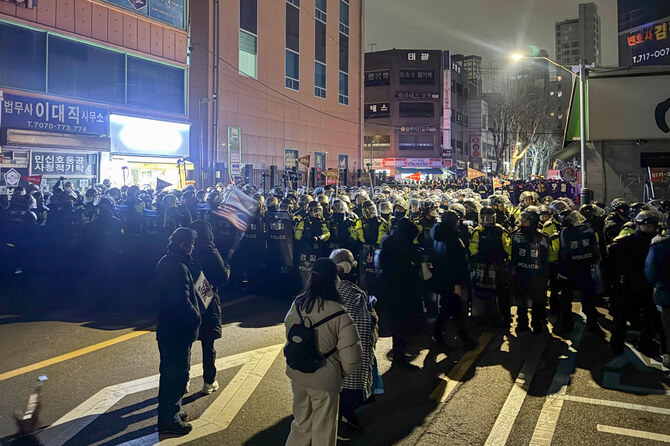
The decision to arrest Yoon triggered unrest at the Seoul Western District Court, where dozens of his supporters broke in and rioted, destroying the main door and windows. They used plastic chairs, metal beams and police shields that they managed to wrestle away from officers. Some were seen throwing objects and using fire extinguishers, destroying furniture and glass doors. They shouted demands to see the judge who had issued the warrant, but she had already left.
Hundreds of police officers were deployed and nearly 90 protesters were arrested. Some injured police officers were seen being treated at ambulance vans. The court said it was trying to confirm whether any staff members were injured and assess the damage to its facilities.
A court deliberated for 8 hours
Following eight hours of deliberation, the court granted law enforcement’s request for an arrest warrant for Yoon, saying he was a threat to destroy evidence. Yoon and his lawyers on Saturday appeared before the court and argued for his release.
Yoon, who has been in detention since he was apprehended Wednesday in a massive law enforcement operation at his residential compound, faces potential rebellion charges linked to his declaration of martial law on Dec. 3, which set off the country’s most serious political crisis since its democratization in the late 1980s.
The Corruption Investigation Office for High-Ranking Officials, which is leading a joint investigation with police and the military, can now extend Yoon’s detention to 20 days, during which they will transfer the case to public prosecutors for indictment.
Yoon’s lawyers could also file a petition to challenge the court’s arrest warrant.
Yoon’s appearance in court triggered chaotic scenes in nearby streets, where thousands of his fervent supporters rallied for hours calling for his release. Even before the court issued the warrant for Yoon’s arrest, protesters repeatedly clashed with police who detained dozens of them, including about 20 who climbed over a fence in an attempt to approach the court. At least two vehicles carrying anti-corruption investigators were damaged as they left the court after arguing for Yoon’s arrest.
Yoon’s lawyers said he spoke for about 40 minutes to the judge during the nearly five-hour closed-door hearing Saturday. His legal team and anti-corruption agencies presented opposing arguments about whether he should be held in custody.
Yoon’s defense minister, police chief and several top military commanders have already been arrested and indicted for their roles in the enforcement of martial law.
Yoon’s lawyer decries his arrest
The crisis began when Yoon, in an attempt to break through legislative gridlock, imposed military rule and sent troops to the National Assembly and election offices. The standoff lasted only hours after lawmakers who managed to get through a blockade voted to lift the measure. The opposition-dominated assembly voted to impeach him on Dec. 14.
His political fate now lies with the Constitutional Court, which is deliberating whether to formally remove him from office or reinstate him.
Seok Dong-hyeon, one of Yoon’s lawyers, called the court’s decision to issue the warrant “the epitome of anti-constitutionalism and anti-rule of law,” maintaining Yoon’s claim that his martial law decree was a legitimate act of governance. He pointed to the chaos at the Seoul Western Court and said Yoon’s arrest would inspire more anger from his supporters.
Yoon’s People Power Party regretted his arrest but also pleaded for his supporters to refrain from further violence.
The liberal opposition Democratic Party, which drove the legislative effort to impeach Yoon on Dec. 14, said his arrest would be a “cornerstone for restoring the collapsed constitutional order.” Kim Sung-hoi, a party lawmaker and spokesperson, called for stern punishment of Yoon’s supporters who stormed the court.
“I urge police to firmly enforce the law so that forces supporting rebellion will never even think of causing turmoil again,” he said.
The country’s acting leader, Deputy Prime Minister Choi Sang-mok, expressed “strong regret” about the violence at the court, saying it “directly undermines democracy and the rule of law.” He asked for heightened security at the sites related to Yoon’s case and measures to ensure order during protests.
Yoon was transported to the court from a detention center in Uiwang, near Seoul, in a blue Justice Ministry van escorted by police and the presidential security service, to attend the hearing at the court ahead of its warrant decision.
The motorcade entered the court’s basement parking space as thousands of Yoon’s supporters gathered in nearby streets amid a heavy police presence. Following the hearing, Yoon was transported back to the detention center, where he awaited the decision. He did not speak to reporters.
After its investigators were attacked by protesters later on Saturday, the anti-corruption agency asked media companies to obscure the faces of its members attending the hearing.
Yoon insists his martial law decree was legitimate
Yoon and his lawyers have claimed that the martial law declaration was intended as a temporary and “peaceful” warning to the liberal opposition, which he accuses of obstructing his agenda with its legislative majority. Yoon says the troops sent to the National Election Commission offices were to investigate election fraud allegations, which remains unsubstantiated in South Korea.
Yoon has stressed he had no intention of stopping the functioning of the legislature. He stated that the troops were sent there to maintain order, not prevent lawmakers from entering and voting to lift martial law. He denied allegations that he ordered the arrests of key politicians and election officials.
Military commanders, however, have described a deliberate attempt to seize the legislature that was thwarted by hundreds of civilians and legislative staff who helped lawmakers enter the assembly, and by the troops’ reluctance or refusal to follow Yoon’s orders.
If prosecutors indict Yoon on rebellion and abuse of power charges, which are the allegations now being examined by investigators, they could keep him in custody for up to six months before trial.
If the first court convicts him and issues a prison term, Yoon would serve that sentence as the case possibly moves up to the Seoul High Court and Supreme Court. Under South Korean law, orchestrating a rebellion is punishable by life imprisonment or the death penalty.


