

Trump rethinking next week’s planned immigration raids, report says

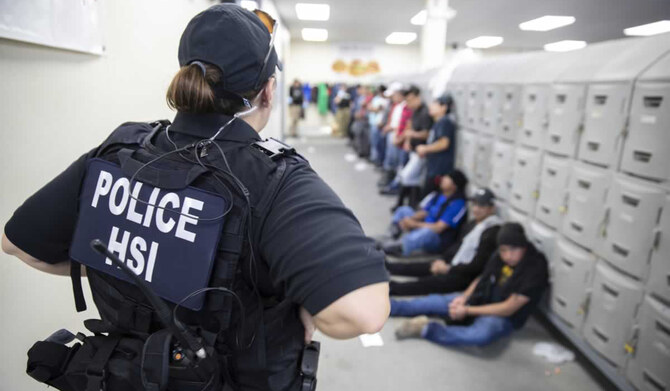
This image released by the US Immigration and Customs Enforcement (ICE) shows a Homeland Security Investigations (HSI) officer guarding suspected illegal aliens on August 7, 2019. (AFP file photo)
Short Url
Updated 19 January 2025
Follow

Trump rethinking next week’s planned immigration raids, report says

  • “President Trump has been clear from day one ... he’s going to secure the border and he’s going to have the deportation operation,” Homan told Fox News ahead of Trump’s inauguration on Monday

WASHINGTON: President-elect Donald Trump’s incoming administration is reconsidering plans for immigration raids in Chicago next week after details were leaked, Trump’s “border czar” Tom Homan told the Washington Post in an interview on Saturday.
The new administration “hasn’t made a decision yet,” said Homan, the former acting director of US Immigration and Customs Enforcement, according to the report. “We’re looking at this leak and will make decision based on this leak,” he added.
ICE did not immediately respond to a request for comment.
Officials and rights advocates had said Trump’s administration would launch sweeps in multiple US cities almost as soon as he takes office on Monday, with Chicago considered a likely first location.
Dulce Ortiz, president of the Illinois Coalition for Immigrant and Refugee Rights, told Reuters that as many as 200 ICE agents were expected to start raids in the Chicago area on Monday at 5 a.m., aiming to catch people heading into work or starting their day.
The enforcement had been expected to continue for several days, she said. An ICE spokesperson referred questions to the Trump transition team, which did not immediately respond to a request for comment.
Reuters reported Friday that agents would also conduct raids in New York and Miami. The Wall Street Journal reported on Friday that ICE would stage a week-long operation in Chicago with potentially hundreds of agents.
Trump said in an NBC News interview on Saturday that launching the mass deportations he promised in his election campaign would be a top priority. But he declined to identify the cities targeted or when deportations would start.
“It will begin very quickly,” said Trump. “We have to get the criminals out of our country.”
Homan himself had appeared to confirm the raids earlier on Saturday, telling Fox News that “targeted enforcement operations” would quickly pursue some of what he said were 700,000 migrants who are in the US illegally and under deportation orders. He indicated the efforts would occur in several cities.
“President Trump has been clear from day one ... he’s going to secure the border and he’s going to have the deportation operation,” Homan told Fox News ahead of Trump’s inauguration on Monday.
Homan said the agency had carefully planned the operation and identified specific individuals for enforcement.
“Every target for this operation is well-planned, and the whole team will be out there for officers’ safety reasons,” he said.
Asked how the detention operations would be received in so-called sanctuary cities, which have pledged not to use city resources for federal immigration raids, Homan said sanctuary city policies were “unfortunate.”
In the case of targeted individuals who are already in local jails, he said the cities’ stance creates a threat to public safety. Cities would “release that public safety threat back into the community....and force (ICE) officers into communities,” Homan said.
He urged public officials of those cities to assist in the deportation raids, but added, “We’re going to do this, with or without their help. They are not going to stop us.”


Will Afghanistan’s pledge against cross-border attacks ease tensions with Pakistan?

Updated 8 sec ago
Follow

Will Afghanistan’s pledge against cross-border attacks ease tensions with Pakistan?

  • Afghan clerics’ decree banned use of Afghan soil for cross-border attacks on Wednesday
  • Latest heavy firing between Afghanistan, Pakistan killed at least 5 people 

KABUL: As tensions flare up again between Afghanistan and Pakistan, the Afghan leadership has moved to reaffirm its commitment against cross-border militancy this week in what is seen as Kabul’s attempt to move the needle on peace negotiations, after multiple rounds of talks failed to produce a lasting truce. 

The neighboring countries have struggled to maintain a fragile ceasefire after border clashes killed dozens in October, the worst fighting since the Taliban took control of Afghanistan in 2021.

While subsequent talks toward a permanent ceasefire yielded little progress, the temporary truce brokered by Qatar and Turkiye collapsed last Friday, with heavy firing along the Spin Boldak-Chaman border that killed at least five people. 

Over the years Pakistan has put much of the blame for the border clashes on the government in Kabul allowing Tehreek-e-Taliban Pakistan — an outlawed armed group, which is separate from the Afghan Taliban — to use Afghan territory for cross-border attacks — a claim that Afghanistan has repeatedly denied.

Afghanistan again pledged to prevent its territory from being used to harm other countries on Thursday, with Taliban Foreign Minister Amir Khan Muttaqi highlighting it as a religious duty, as endorsed just a day earlier by around 1,000 Afghan clerics in a fatwa, or religious decree.

“The fatwa was more political than religious,” Kabul University lecturer Abdullah Awwab told Arab News on Friday. 

“I think it was a smooth way out of the pressure put on them by Pakistan and mediators, who were asking for a fatwa against the TTP. The emirate couldn’t issue that, so instead they had scholars issue a fatwa for ordinary Afghans, banning them from jihad abroad.

“The fatwa shows Pakistan that the Taliban can use a fatwa to stop Afghans from joining the war. It demonstrates Kabul’s power and control over its own soil and people — and, at the same time, it shows Pakistan’s weakness in needing to ask Kabul for a religious fatwa.”

Addressing new graduates at a ceremony in Kabul, Muttaqi said the Taliban had not “permitted anyone to carry out military activities in other countries” and that the government had the right to take action against anyone who violated the directive. 

“The leaders and elders of this Islamic emirate have pledged that Afghan soil will not be used to harm anyone. All the scholars and religious leaders affirmed that obeying this commitment is necessary for all Muslims,” he said. 

“Just as this nation has historically acted upon the fatwas and advice of its scholars, so too will (it) act upon them now. This is our shared duty.” 

Asif Durrani, Pakistan’s former special envoy to Afghanistan, said the decree was a “very significant” development.

“Hopefully, the TTP, which owes allegiance to the Taliban’s Supreme Leader Mullah Hibatullah Akhundzada, will now submit to the collective wisdom of the Afghan Taliban ulema and surrender arms,” he wrote on X. 

Though the decree answers one of Pakistan’s demands, Afghan political analyst Wasi Baheer said it had “no direct impact” in the conflict.

“Pakistan’s harsh words and threats to Kabul don’t mean much, because the real issue is inside Pakistan,” he told Arab News.

“They cannot simply force changes in Kabul. The main reason talks collapsed in Qatar, Istanbul, and Saudi Arabia is that Pakistan demanded the Taliban act harshly against the TTP — which makes no sense, because it is an internal Pakistani problem. Using force here in Afghanistan will not bring any relief to Pakistan’s security.”