

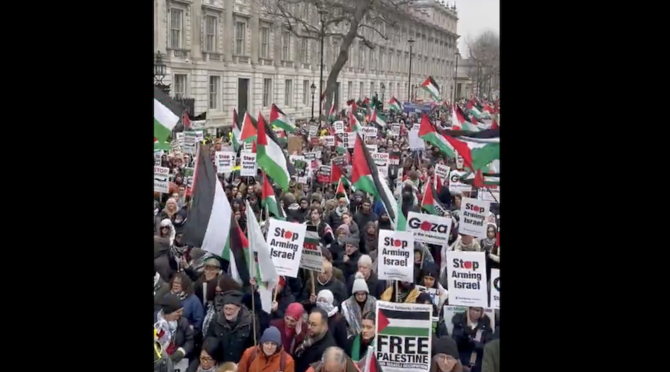

LONDON: Tensions are rising ahead of a planned pro-Palestine demonstration in London after the Palestine Solidarity Campaign and its coalition partners vowed to reject the Metropolitan Police’s proposed new route for the march.
Organizers have announced they will gather at Whitehall on Saturday to protest the police decision instead.
PSC, alongside Stop the War, the Campaign for Nuclear Disarmament, the Muslim Association of Britain, Friends of Al-Aqsa, and the Palestine Forum in Britain, made the announcement on Friday following protracted negotiations with police.
The Met had last week banned the original march, which was scheduled to start at the BBC’s headquarters, citing its proximity to a synagogue and potential security concerns.
“Despite intensive efforts to reach a compromise with the Met, it has so far refused to accept or offer a reasonable solution,” said the coalition in a statement. “However, we will assemble on Whitehall on Saturday at noon. We reiterate our call on the police to lift their repressive conditions and allow us to march. If they continue to refuse to do so and prevent us from marching, we will be rallying in Whitehall to protest.”
The controversy erupted after the police revoked the pre-approved march route, which had been announced in November, over claims it could pose a threat to the Jewish community.
Organizers described the decision as “discriminatory” and accused the authorities of bowing to political pressure from pro-Israeli groups.
“The Met has seemingly accepted and acted upon the arguments of pro-Israel groups that seek to delegitimise our protest as antisemitic or a threat to Jewish people,” said PSC Director Ben Jamal. “This is a gross distortion of the truth. There is not a single instance of our marches posing any threat to synagogues or Jewish individuals. Indeed, we count a large, self-organised Jewish bloc as some of our most indefatigable supporters.”
Organizers also said they offered to reroute the march to avoid clashing with Shabbat services at the synagogue, but claimed the police refused their proposals.
“Over the past week the Met Police have imposed a series of repressive conditions to prevent us marching and have even attempted to impose a route that the Board of Deputies of British Jews announced they had suggested to the police. This has been firmly rejected by the Palestine Coalition — it is an affront that pro-Israel groups can attempt to decide where we can or cannot march,” read the group’s statement.
On Friday, the coalition said that while they plan to defy the ban, they would gather at Whitehall instead of the BBC’s Portland Place headquarters. They also claimed the police had backed away from plans to arrest protesters assembling outside Russell Square, which the Met had suggested as a designated protest zone.
The police’s decision has drawn widespread criticism, with several cultural figures and members of the Jewish community urging the authorities to reverse the ban.
“The Met’s approach has been confrontational, heavy-handed and intransigent. Their use of powers under the Public Order Act has been based on flimsy grounds and arbitrarily applied, which erodes the right of peaceful protest that is fundamental in a democracy,” Jamal said. “Despite this, our protest tomorrow will go ahead — we call on all those who seek justice for Palestine to stand with us.”


