

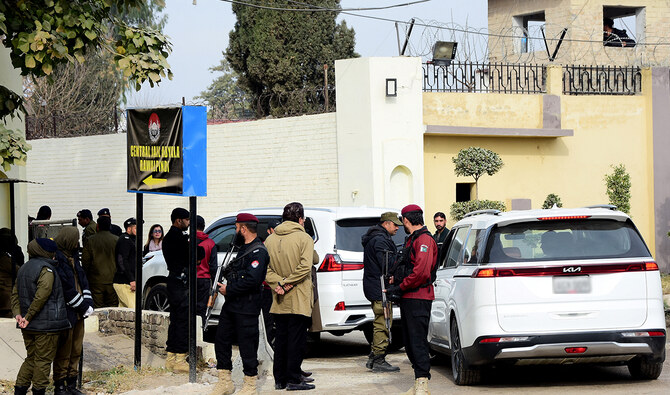

KARACHI: A government spokesperson said on Friday political negotiations with former Prime Minister Imran Khan’s opposition Pakistan Tehreek-e-Insaf (PTI) would not be affected by an accountability court verdict earlier in the day, which sentenced the ex-premier to 14 years in prison.
Khan, who has been incarcerated for well over a year, warned of civil disobedience from a high-security prison in Rawalpindi last month while calling for the release of political prisoners from his party, which has complained of a government crackdown since the downfall of the PTI administration in April 2022.
Subsequently, the government-PTI talks began as an attempt to reduce political bitterness and polarization in Pakistan. However, the accountability court’s verdict in a case involving a charitable entity, Al-Qadir Trust, set up by Khan and his third wife Bushra Khan in 2018, has raised questions about the future of the negotiations.
The court also sentenced Khan’s wife to seven years in prison in the case. Pakistani authorities allege that the trust was a front for the couple to receive valuable land as a bribe from real estate developer Malik Riaz Hussain, one of Pakistan’s richest and most powerful businessmen. Hussain, like Khan and Bushra, denies any wrongdoing.
“The talks are going on in parallel,” Barrister Aqeel Malik, government spokesperson for legal affairs, told Arab News over the phone. “These are two separate matters. The decision from the court should not be mixed with the ongoing talks with the opposition at this particular time.”
Malik argued that the case was decided in accordance with the legal provisions of the accountability laws.
“Today’s decision is in accordance with the law and justice has been served, where a huge loss had been caused to the national exchequer for private gains,” he added. “It has now been decided by the competent court that Mr. Khan stands certified to have been involved in corruption.”
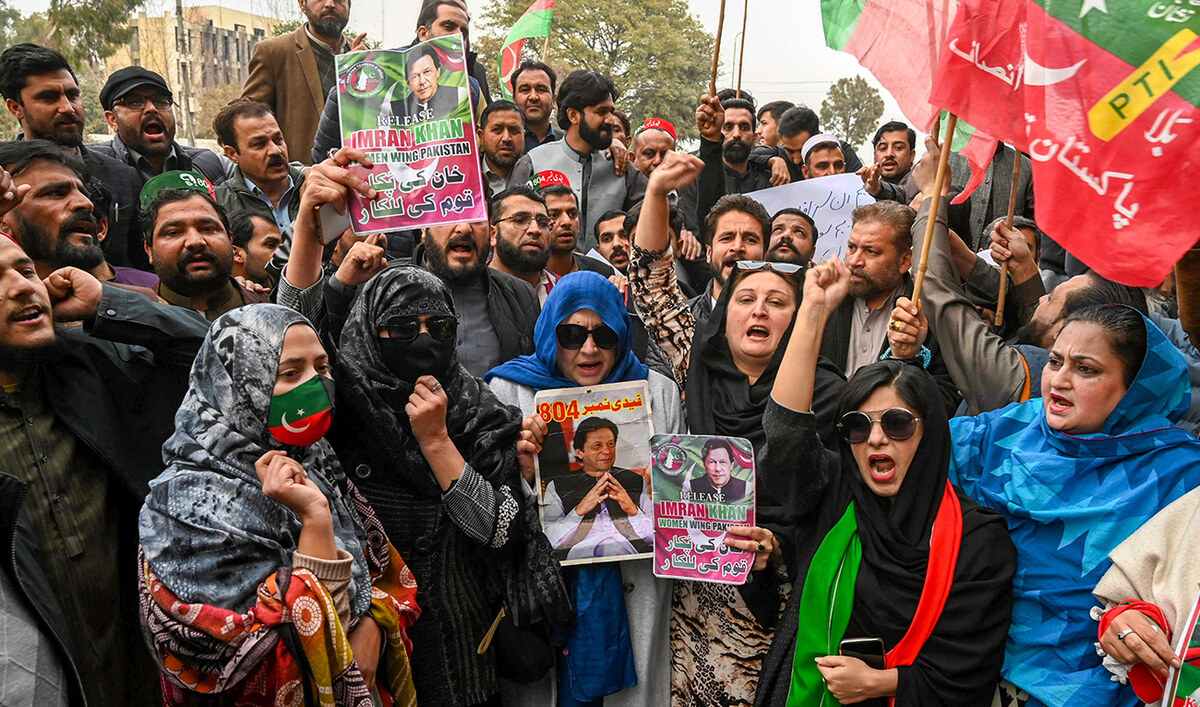
Pakistan’s imprisoned former prime minister Imran Khan’s supporters hold Khan’s portraits during a protest in Peshawar on January 17, 2025. (AFP)
The Al-Qadir Trust case, involving allegations of corruption and misuse of authority by Khan, revolved around £190 million recovered from the Pakistani real estate tycoon, who was investigated by British authorities for money laundering.
Riaz surrendered the amount as part of a settlement, which was returned to the Pakistani state under the laws of the United Kingdom. However, the Khan administration allegedly adjusted it against the real estate developer’s liability in Pakistan’s top court, where he was fined in a case for illegally acquiring land for a major project in Karachi.
The ex-premier was criticized for using the sum to reduce Riaz’s owed amount rather than depositing it in Pakistan’s national treasury. The country’s anti-graft National Accountability Bureau also accused him of approving the adjustment in return for financial benefits.
Unlike Malik, Khan’s close aide and senior PTI leader, Sayed Zulfikar Bukhari, described the talks as a political ploy by the government.
“Talks were just a bluff,” he told Arab News, adding that it was “obvious” the PTI founding leader and his wife would be sentenced in the case.
“Al-Qadir Trust is a nonprofit organization. Neither of them was a beneficiary, and the money had gone to the Supreme Court of Pakistan,” he continued, describing the verdict as another act of “political victimization and a pressure tactic to make Khan agree to talks.”
The former premier’s conviction has come at a time when the PTI confirmed meetings with Pakistan’s powerful army chief, General Asim Munir, earlier this week, although security sources denied that the interaction focused on political matters.
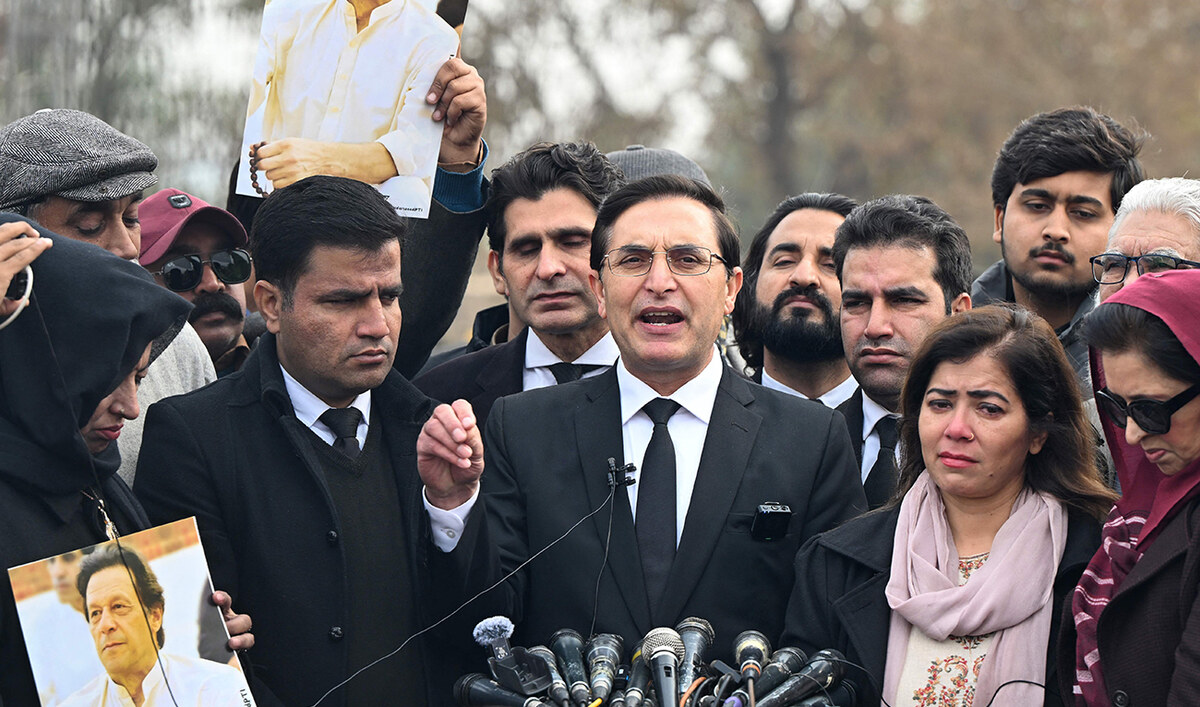
Former prime minister Imran Khan’s Pakistan Tehreek-e-Insaaf (PTI) party’s chairman and barrister Gohar Ali Khan (C) speaks to media outside the Adiala prison in Rawalpindi on January 17, 2025. (AFP)
Nadia Naqi, a talk show host and political analyst, said the verdict could pave the way for “more direct talks with the security establishment” of Pakistan, which she said was always interested in negotiating with a weaker Khan.
“Negotiations now, which have taken place within political circles, will become easier because a weak Imran Khan, a convicted Imran Khan, will be more likely to agree to the terms [offered to him] compared to a Khan who has obtained bail in various cases,” she argued.
“I believe that negotiations with the PTI will now move forward. Whether the government is involved or not, it won’t matter,” she added.
Iftikhar Ahmed, a Lahore-based analyst, said the future of the talks would depend on the reactions of both the government and the PTI.
“Until now, the PTI has not announced that they are ending the negotiations,” he noted. “The party did not offer this as a condition for negotiations that the courts should not announce their verdicts against Khan. Their demand was the release of the founder of their party.”
Meanwhile, Aitzaz Ahsan, a veteran lawyer and politician, maintained that the judgment against Khan had legal loopholes.
“This is another case in which the conviction will be converted into an acquittal by a high court,” he said, adding that the government had to show the state had suffered a financial loss due to Khan’s decision about the repatriated money, pointing out this was not adequately done.


