What are the cases against Pakistan’s former PM Imran Khan and his wife?

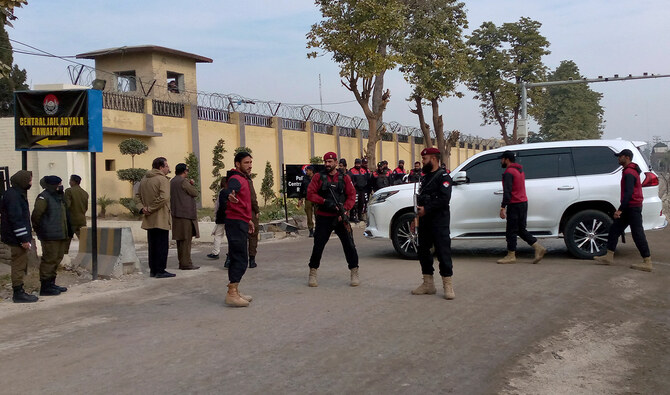
Security guards watch a vehicle carrying Bushra Bibi, wife of imprisoned former Prime Minister Imran Khan, as she arrives to hear verdict on corruption case in a court specially set up in Adiyala prison, in Rawalpindi, Pakistan, on January 17, 2025. (AP)
Short Url
Updated 17 January 2025
Follow

What are the cases against Pakistan’s former PM Imran Khan and his wife?

  • Khan, who was ousted from office in 2022, has been behind bars for more than a year
  • On Friday, ex-PM was convicted of receiving land in bribe from a real estate developer

A Pakistani court on Friday sentenced former Prime Minister Imran Khan to 14 years imprisonment and his wife Bushra Bibi to seven years in a land corruption case, his legal team said.

The verdict in the case, the largest in terms of financial wrongdoing faced by Khan, was delivered by an anti-graft court in a prison in the garrison city of Rawalpindi, where Khan has been jailed since August 2023.

Here are some of the allegations against the 72-year-old former cricket star, named in dozens of cases since he was ousted from office in 2022 that have kept him behind bars for more than a year.

GRAFT ALLEGATIONS

On Friday, Khan was convicted on charges that he and his wife were gifted land by a real estate developer during his premiership from 2018 to 2022 in exchange for illegal favors.

He was first arrested in May 2023 in this case, on allegations that the couple received land worth up to 7 billion rupees ($25.12 million) as a bribe through a trust created in 2018.

His Pakistan Tehreek-e-Insaf (PTI) party has maintained the land was donated for charitable purposes.

Bibi was taken into custody on Friday after being released on bail in October in another case.

STATE GIFTS

\Khan was arrested in August 2023 for allegedly selling gifts worth more than 140 million rupees that he received during his premiership and which belonged in state possession. Khan and Bibi were indicted on fresh charges in December after they were sentenced in two other versions of the case, although the sentences have been suspended. The couple has denied any wrongdoing.

ABETTING VIOLENCE

Khan faces anti-terrorism charges in connection with the violence that followed his arrest in May 2023, and in relation to which several of his supporters have already been sentenced.

He was indicted in December and is on trial.

STATE SECRETS

Khan was accused of making public a classified cable sent to Islamabad by Pakistan’s ambassador in Washington in 2022, while he still held office. He was acquitted in the case in June.

UNLAWFUL MARRIAGE

Khan and his wife were accused of breaking Islamic law by failing to observe the mandated waiting period between Bibi’s divorce from her previous husband and their marriage in 2018. They were acquitted of the charges in July.


Pakistan to launch AI screening in January to target fake visas, agent networks

Updated 05 December 2025
Follow

Pakistan to launch AI screening in January to target fake visas, agent networks

  • New system to flag forged-document travelers before boarding and pre-verify eligibility
  • Move comes amid increasing concern over fake visas, fraudulent agents, forged papers

ISLAMABAD: Pakistan will roll out an AI-based immigration screening system in Islamabad from January to detect forged documents and prevent illegal overseas travel, the government said on Thursday. 

The move comes amid increasing concern over fake visas, fraudulent agents and forged papers, with officials warning that such activity has contributed to deportations, human smuggling and reputational damage abroad. Pakistan has also faced scrutiny over irregular migration flows and labor-market vulnerability, particularly in the Gulf region, prompting calls for more reliable pre-departure checks and digital verification.

The reforms include plans to make the protector-stamp system — the clearance required for Pakistani citizens seeking overseas employment — “foolproof”, tighten labor-visa documentation, and cancel the passports of deportees to prevent them from securing visas again. The government has sought final recommendations within seven days, signalling a rapid enforcement timeline.

“To stop illegal immigration, an AI-based app pilot project is being launched in Islamabad from January,” Interior Minister Mohsin Naqvi said following a high-level meeting chaired by him and Minister for Overseas Pakistanis Chaudhry Salik Hussain.

Naqvi said the new screening technology is intended to determine travelers’ eligibility in advance, reducing airport off-loads and closing loopholes exploited by traffickers and unregistered agents.

The interior minister added that Pakistan remains in contact with foreign governments to improve the global perception and ranking of the green passport, while a uniform international driving license will be issued through the National Police Bureau.

The meeting also approved zero-tolerance measures against fraudulent visa brokers, while the Overseas Pakistanis Ministry pledged full cooperation to streamline the emigration workflow. Minister Hussain said transparency in the protector process has become a “basic requirement,” particularly for labor-migration cases.

Pakistan’s current immigration system has long struggled with document fraud, with repeated cases of passengers grounded at airports due to forged papers or agent-facilitated travel. The launch of an AI screening layer, if implemented effectively, could shift the burden from manual counters to pre-flight verification, allowing authorities to identify risk profiles before departure rather than after arrival abroad.

The reforms also come at a moment when labor mobility is tightening globally. Gulf states have begun demanding greater documentation assurance for imported labor, while European and Asian destinations have increased scrutiny following trafficking arrests and irregular-entry routes from South Asia. For Pakistan, preventing fraudulent departures is increasingly linked to protecting genuine workers, reducing deportation cycles and stabilizing the country’s overseas employment footprint.