Lebanese president seeks Israel’s commitment to Gaza deal, warns against violations

1 / 2
Lebanese celebrate the nomination of Prime Minister Nawaf Salam, at Martyrs’ Square in Beirut, on Jan. 13, 2025. (AFP)
2 / 2
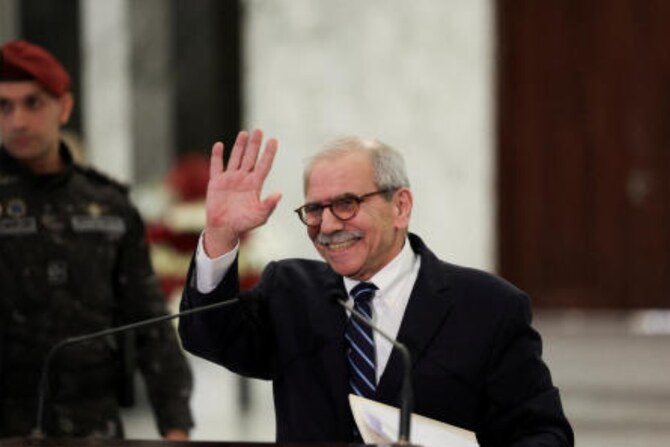
Lebanese Prime Minister-designate Nawaf Salam gestures at the presidential palace on the day he meets with Lebanese President Joseph Aoun, in Baabda, Lebanon Jan. 14, 2025. (Reuters)
Short Url
Updated 16 January 2025
Follow

Lebanese president seeks Israel’s commitment to Gaza deal, warns against violations

  • French president, UN chief set to visit Beirut as Aoun rallies support
  • PM-designate Salam calls for dialogue with Hezbollah, Amal as consultations end

BEIRUT: Lebanese President Joseph Aoun hoped on Thursday “for the ceasefire in Gaza to end the tragic reality and prompt Israel to seriously abide by the clauses of the agreement, which requires the follow-up of the sponsoring states and the UN.”
Israel had always evaded its commitments and ignored international resolutions, he said.
“The hostilities taking place in the south (of Lebanon), as well as the violations of the ceasefire agreement, prove so.”
Aoun’s comments came as Israel’s violations of Lebanese airspace reached Beirut and its forces continued to bulldoze the neighborhoods of Taybeh and Aita Al-Shaab.
Lebanese Broadcasting Corporation International said its media staff “came under Israeli fire while accompanying an ambulance team inside a house in Mays Al-Jabal, with no casualties reported.”
Aoun, who was elected president a week ago, received invitations to visit Qatar and Jordan. He also took a phone call from Saudi Crown Prince Mohammed bin Salman, who invited him to visit the Kingdom. Aoun said it would be his “first visit abroad.”
Qatar’s Ambassador to Lebanon Saud bin Abdulrahman Al-Thani delivered an official invitation from his nation’s leader, Sheikh Tamim bin Hamad Al-Thani, for Aoun to visit Doha.
In the letter, the sheikh said he hoped that Aoun’s tenure would “witness a new stage where security, stability and prosperity will prevail in the country.”
In a speech delivered from the presidential palace, the ambassador expressed his country’s “continuous support for Lebanon in all the political, economic and military fields.”
Jordan’s Foreign Minister Ayman Safadi delivered an invitation from King Abdullah II for Aoun to visit Jordan. He also expressed Jordan’s “commitment to supporting Lebanon, its security, stability and full sovereignty” and urged Israel to “honor the ceasefire agreement and stop its violations against Lebanon.”
Safadi also met Parliament Speaker Nabih Berri and Prime Minister-designate Nawaf Salam.
“We believe that the new leadership in Lebanon can go forward and we affirm that we will continue to support the Lebanese army,” he said.
“We look with our partners worldwide into providing what the army needs in terms of fundamental capabilities so it could carry out its role.”
Safadi said that the mediators announced the ceasefire in the Gaza Strip “clearly and decisively” and that “the whole world knows the importance of respecting and implementing this agreement.”
“We call for full compliance,” he said. “We also urge the opening of all crossings and an international effort to deliver sufficient humanitarian aid to Gaza.”
French President Emmanuel Macron is scheduled to make a working visit to Beirut on Friday, becoming the second head of state to visit the country, following Cyprus’ President Nikos Christodoulides.
UN Secretary-General Antonio Guterres is also expected to travel to Beirut to congratulate Aoun.
The Elysee Palace said Macron’s visit “underscores France’s unwavering commitment to Lebanon’s stability, unity and development” and that his presence would strengthen the ceasefire monitoring mechanisms, mainly focusing on UNIFIL’s peacekeeping operations.
In domestic developments, Aoun held talks with acting Central Bank Governor Wassim Mansouri, who offered his first public assessment since Lebanon’s recent period of turmoil.
He reported “improving monetary conditions and increased foreign currency reserves following the presidential election” and emphasized the central bank’s policy of maintaining the value of the Lebanese pound “without market intervention.”
Earlier on Wednesday, Aoun received Spain’s Minister of Foreign Affairs, EU and Cooperation Jose Manuel Albares Bueno.
Meanwhile, Salam entered the final day of non-binding parliamentary consultations regarding government formation and the ministerial statement that will outline his administration’s agenda.
The process has unfolded amid growing international and Arab support for Lebanon’s new leadership.
A meeting between Salam and Berri is expected to take place on Friday.
Both Berri’s parliamentary bloc and Hezbollah’s representatives have boycotted the consultations, protesting against Salam’s appointment ahead of their preferred candidate, Najib Mikati.
If it takes place, the meeting between Berri and Salam is intended to ease Hezbollah’s concerns.
It will also seek to assure the party it has not lost its internal cohesion following the speeches of the president and prime minister.
Salam is expected to present his vision for forming the next government to Berri and the president after consulting with all parliamentary blocs, including independent and Change lawmakers.
MP Jihad Al-Samad met Salam on Thursday and quoted him as saying that “given the ongoing disagreement, there are only two solutions: either an agreement or an agreement.”
Other lawmakers who attended the talks said the parliamentary consultations concluded on the second day with the “assertation that the government’s ministerial statement must be a reflection of the president’s oath speech.”
They said the consultations also emphasized the importance of “establishing a government capable of protecting Lebanon, overseeing rapid reconstruction and ensuring the return of the displaced people to the south.”
“It must be a government composed of qualified people, free from political calculations, with all its components, including new faces who aspire to trust and plan to restore depositors’ funds,” they said.
“Additionally, the government should consist of national competencies, separate parliamentary seats from ministerial posts and ensure the transparency and integrity of the judiciary to attract investments back to the country.”
At the end of the first day of the parliamentary consultations, the parliamentary blocs expressed their desire to form “a government of specialists representing all the parliamentary blocs.”


How Israel leverages planning laws to entrench control over East Jerusalem

Updated 11 sec ago
Follow

How Israel leverages planning laws to entrench control over East Jerusalem

  • Record home demolitions reveal how zoning, permits and land registration are used to systematically displace Palestinians
  • Israeli human rights groups warn planning laws have become central tools for reshaping Jerusalem’s demography

LONDON: Last month, Jews in Israel and around the world celebrated the holiday of Hannukah, which commemorates the victory of Jewish rebels who rose up against the Greek occupiers of Jerusalem in the second century B.C.E.

Each year the week-long holiday, its timing determined by the Hebrew calendar, falls on different dates. This December it began on Dec. 14 and ended at nightfall on Dec. 22 — the same day Israeli forces bulldozed an apartment building in East Jerusalem.

This act of mass eviction left about 90 Palestinians homeless and drove home the reality that it is now the Jewish state that is the occupier in Jerusalem.

The 12-hour operation, supported by soldiers and a mob of stone-throwing Jewish youths, came without warning, despite the fact that the residents’ lawyer had a meeting scheduled with Jerusalem Municipality’s legal department that very day. 

Israeli forces gather as an excavator demolishes a building built without a permit in the east Jerusalem neighbourhood of Wadi Qaddum on December 22, 2025. (AFP)

The demolition of the building, which stood on private Palestinian land, was the largest such destruction of property in 2025, but was far from an isolated case. Since the start of the year, 143 Palestinian homes had already been demolished across East Jerusalem.

But, say human rights groups in Israel, this latest demolition shows Israel is stepping up its campaign of displacement in East Jerusalem under cover of international focus on Gaza, while at the same time ramping up the development of new illegal settlements.

The day before the demolition, Israel approved the establishment of 19 new settlements in the occupied West Bank.

“The heart of the issue is the outright discrimination in urban planning policies, which has led to years of systematic and deliberate neglect of urban development for Palestinians in East Jerusalem,” said architect Sari Kronish of the Israeli nongovernmental organization Bimkom — Planners for Planning Rights.

“In practice, inadequate and restrictive zoning plans were approved until they too were halted. The Palestinian population is therefore at an extreme disadvantage; there is only a nominal amount of land designated for Palestinian residential development — roughly 15 percent of East Jerusalem. 

Palestinian protesters march in a symbolic funerary parade in the Israeli-annexed east Jerusalem's predominantly Arab neighbourhood of Silwan on June 29, 2021, during a protest over Israel's planned evictions of Palestinian families from homes in the eastern sector. (AFP)

“Without residential land designation in an approved zoning plan, it is not possible to request a building permit.”

In addition, said Kronish, “the possibility of proving land ownership is also a major obstacle along the road to a building permit and depends on the regulations in place.

“Recently, these regulations have become more strict and are basically in line with the renewed process of land registration. Most of the land in East Jerusalem is not officially registered in the land registry; until 2018 the State of Israel adopted relatively lenient protocols to allow minimal planning and building despite this reality.

“But in recent years, new land registration processes have begun, replacing expropriation as the main form of land confiscation. All planning and building processes — zoning and permits — are currently subjugated to this process, and in effect halted.”

Constructed in 2014, the apartment building in Wadi Qaddum was demolished on the pretext that it lacked a building permit. 

Israeli security forces disperse Palestinians demonstrating following the Friday prayer in the Arab neighbourhood of Silwan in Israeli-annexed east Jerusalem on February 10, 2023, to protest the Israeli authorities' plan to demolish a building housing 13 Palestinian families. (AFP)

But, as Israeli human rights groups have pointed out repeatedly, building permits are impossible for Palestinians to procure without the existence of zoning plans approved by the Jerusalem municipality — plans which the Israeli authorities systematically neglect to advance or approve for Palestinian areas.

The building was constructed on a plot of land that was subsequently designated as green space, retroactively rendering it illegal.

The first attempt to knock it down, initiated by the far-right national security minister and settler leader Itamar Ben-Gvir, came in 2022. Following legal representation and the intervention of Israeli rights groups, the government granted two stays of execution, the first of 90 days and the second of 30.

These expired in February 2023, but the office of Prime Minister Benjamin Netanyahu stepped in at the last minute and delayed the operation.

At the time, The Times of Israel, citing a Western diplomat, reported that “several Western embassies, including the American and British missions in Israel, (had) reached out to Netanyahu’s office, expressing their opposition to the demolition.” 

Israeli, Palestinian and foreign activists hold placards against Israeli occupation and house demolitions in east Jerusalem predominantly Arab neighbourhood of Silwan, on November 8, 2025 during a protest over Israel's planned evictions of Palestinian families from homes in the eastern sector's Silwan district. (AFP)

Now, say human rights groups, the world’s focus has moved away from events in the Occupied Territories, and the Israeli government is acting with increasing impunity.

Amy Cohen, director of international relations at the Israel NGO Ir Amim, or City of Nations, said that 2025 “saw the highest total number of demolitions in East Jerusalem on record, according to the available data.

“A total of 263 structures were demolished due to lacking building permits, including 148 residential units and 115 non-residential structures, placing 2025 at the top of the list in terms of total demolished structures.

“When comparing the number of residential units demolished, 2025 ranks second, after 2024, which recorded 181 demolished residential units, constituting the highest number of home demolitions on record.”

Israel’s motives, say human rights groups, are all too clear. 

Palestinian protesters clash with Israeli security forces in the Israeli-annexed east Jerusalem's predominantly Arab neighbourhood of Silwan on June 29, 2021, during a protest over Israel's planned evictions of Palestinian families from homes in the eastern sector. (AFP)

Since Israel’s occupation and illegal annexation of East Jerusalem in 1967, said Cohen, “Israeli policymaking has been driven by two main factors — the demographic and the territorial. In other words, maintaining a Jewish demographic majority and seizing as much control over land and resources as possible.

“One of the main tools used to carry out this goal is deliberate housing deprivation and the policy of selective demolitions under the guise of building-regulation enforcement.

“These in turn become mechanisms of displacement, pushing Palestinians out of the city while taking over more land for settlements and other Israeli interests.”

Bimkom says Palestinians, who constitute 40 percent of Jerusalem’s population, should be given equal rights to housing and shelter.

“The most basic way of doing this is by approving zoning plans for adequate residential development for the Palestinian population while halting land registration processes and the cruel policy of demolitions,” said Kronish. 

Israeli security forces fire tear gas to disperse Palestinian protesters amid clashes in the Israeli-annexed east Jerusalem's predominantly Arab neighbourhood of Silwan on June 29, 2021, following a protest over Israel's planned evictions of Palestinian families from homes in the eastern sector. (AFP)

“Rather than depleting the only remaining land reserves in and around Palestinian neighborhoods for Israeli settlements, which is happening at an exponential rate, these lands could be designated to meet the dire housing needs of the local residents.”

But neither Bimkom nor Ir Amin see any hope of such a change in policy.

“Given the record number of demolitions over the past two years, the near complete halt in planning processes for Palestinians, ever-increasing challenges to obtaining a building permit, and the fact that 2026 is an election year, there is reason to assume that the rate of demolitions will only increase,” said Cohen.

“Politicians will be looking to score political points, and unfortunately Palestinians often bear the brunt of this.”

Technically, the authority to demolish houses is vested in the municipality, said Daniel Seidemann, an Israeli lawyer and founder of the NGO Terrestrial Jerusalem, which monitors developments in the city that could affect the political process or spark conflict. 

Palestinians help an injured man during scuffles with Israeli police in the Arab east Jerusalem neighbourhood of Silwan as Israeli machinery demolish a Palestinian house at the site on May 10, 2022. (AFP)

“But it’s also vested in the government,” he said. “Once it was the Ministry of Interior, then the ministerial responsibility was transferred to the Finance Ministry, and then last year it was transferred to the Ministry of National Security, and that means Itamar Ben Gvir.”

Seidemann says he saw the symbolic demolition in Wadi Qaddum coming.

“They needed the approval of the Knesset, and the (Joe) Biden administration had considered this to be important enough that they interceded, and the move was not carried out back then. But then right before the summer recess, at 11 o’clock at night, they passed it.”

All the recent demolitions, he said, have been concentrated in the Palestinian neighborhood of Silwan, “and there is clear evidence that this is part of the drive to encircle the Old City with settlements and settlement-related projects.”

The international community, he believes, has lost the will to intervene. “That has been the case since the beginning of the war,” he said, referring to the conflict in Gaza that began in October 2023. 

“But with all the crises the world is currently dealing with, whether it’s climate change, Ukraine and now Venezuela, there just isn’t a lot of bandwidth left to deal with this. 

Israeli and foreign activists hold placards during a protest against Israeli occupation and house demolitions in East Jerusalem's predominantly Arab neighbourhood of Silwan, on December 19, 2025, over Israel's planned evictions of Palestinian families from homes in the eastern sector's Silwan district. (AFP)

“And it’s personal. I see the political officers in the embassies and the consulates, and they’re just overwhelmed.”

Once, he said, “in spite of all of his bluster, Netanyahu was risk-averse and engageable. He would be attentive, especially to the US, but also to European capitals. Now, he is following Ben-Gvir’s lead and he is un-engageable. He listens to nobody.”

One symptom of that is the dramatic increase in demolitions of Palestinian homes and the building of illegal settlements. But other consequences may be looming.

Given all the increased pressures on the Palestinian people since 2023, including the destruction of their homes and settler attacks, Seidemann has grave fears about what might happen in Jerusalem during Ramadan in February and March this year.

“The past couple of years, the Biden administration had senior officials sitting in Jerusalem, monitoring things, interceding, mediating, and it worked. They were able to elicit restraint from Netanyahu. But there is no guarantee that will be the case this year.

“Ben-Gvir is making no secret of his intention to radically change the status quo at Al-Aqsa, the Temple Mount. The West Bank and East Jerusalem is a tinder box, the entire region is on the brink in every imaginable front, and there is no issue more sensitive than Al-Aqsa.

“And what starts in Jerusalem doesn’t stay in Jerusalem.”