

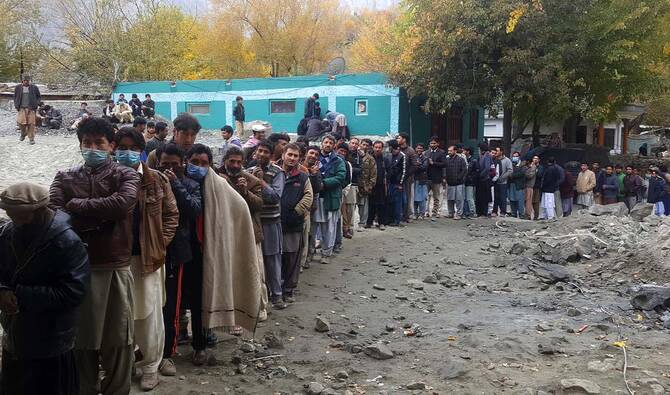

KHAPLU, Gilgit-Baltistan: Over 900,000 voters are expected to take part in polling across Pakistan’s northern Gilgit-Baltistan (GB) region today, Sunday, as the voting process begins with stringent security measures in place.
GB is a semi-autonomous region in northern Pakistan that borders China, Afghanistan and Indian-administered Kashmir. It is home to some of the world’s tallest peaks, including parts of the Karakoram mountain range, and is one of Pakistan’s most important regions for tourism, water resources and strategic connectivity.
Three hundred and ninety-six candidates are vying for 24 general seats of the Gilgit-Baltistan Assembly, which includes 266 independent candidates. Elections in the region are being held after six years to elect 33 members to its legislative assembly. The GB Assembly comprises 24 general seats, six reserved seats for women, and three reserved seats for technocrats and professionals.
Authorities have undertaken stringent security measures to prevent any untoward incidents from taking place, GB Election Commission spokesperson Bahadur Jamil told Arab News.
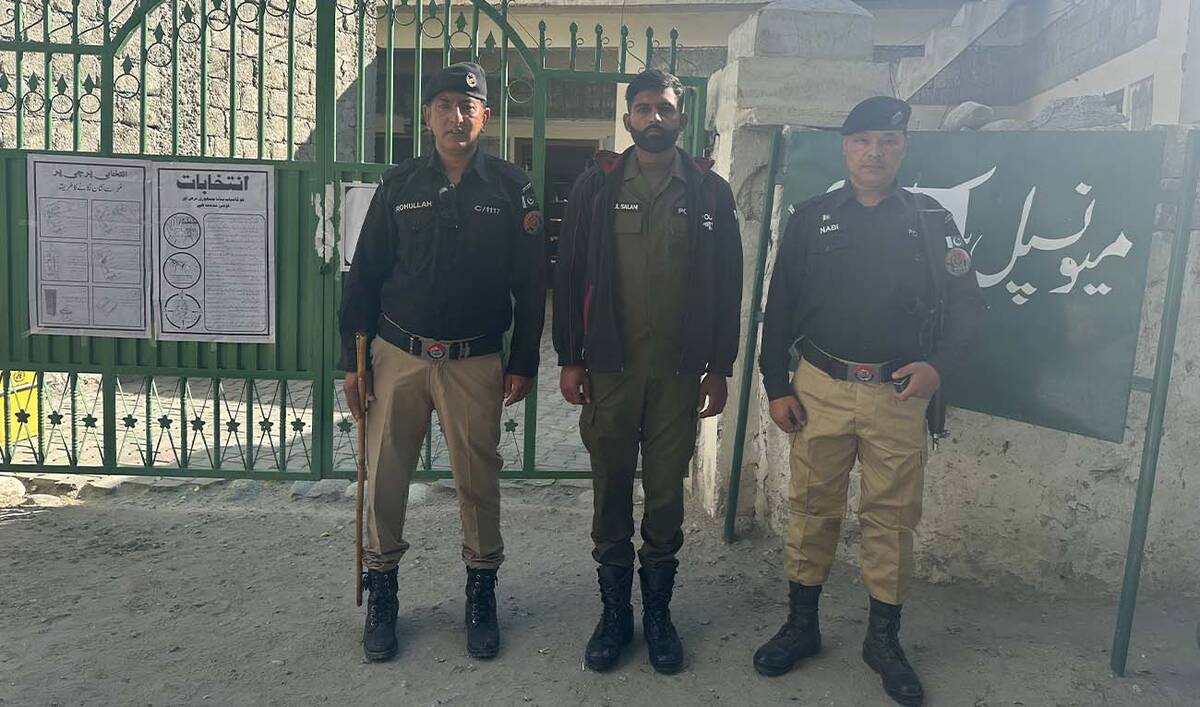
Security personell stand outside a polling station in Khaplu, Gilgit-Baltistan region of PAkistan on June 7, 2026. (AN Photo)
“All security arrangements have been finalized,” Jamil said. “At least 15,000 security forces, including the Punjab Police and Pakistan Army have been deployed across all 24 constituencies.”
Polling kicked off at 8:00 a.m. and is expected to continue without any interruption till 5:00 p.m. As per data released by the Gilgit-Baltistan Election Commission, 958,480 people have registered to vote in the region, out of which 454,708 are women.
Jamil said nearly 1,391 polling stations have been set up across 24 constituencies, of which 551 have been declared “highly sensitive.”

Polling agents count voters outside a polling station before polling starts in Khaplu, Gilgit-Baltistan region of Pakistan on June 7, 2026. (AN Photo)
The official vowed that voters would not be allowed to enter polling stations after 5:00 p.m., adding that only those voters who entered polling stations would be allowed to cast their votes.
Ghulam Abbas, the caretaker information minister for Gilgit-Baltistan, said holding free and transparent elections is the government’s topmost priority.
“All required funds and facilities have been provided to the GB Election Commission for the peaceful and fair culmination of the election process,” he added.
GB lies in the Himalayan region of Kashmir, disputed between India and Pakistan. India has always claimed that it has the right to govern all territories in the Jammu and Kashmir region.
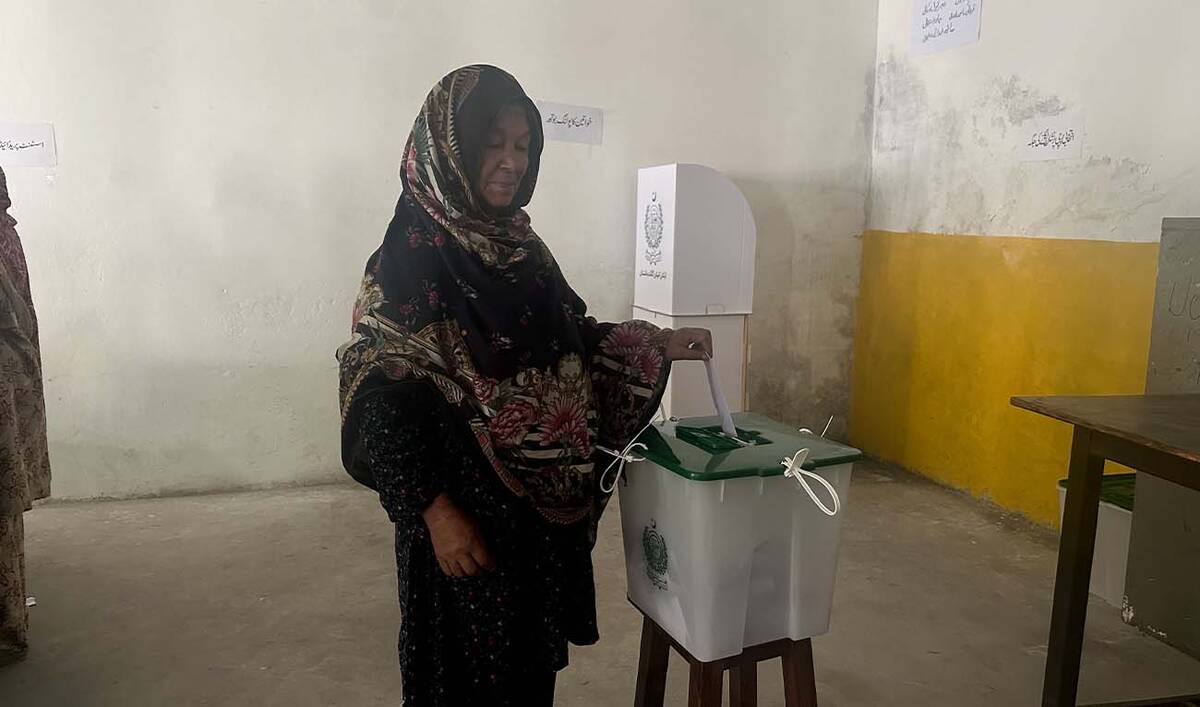
A woman casts her vote at a polling station in Khaplu, Gilgit-Baltistan region of Pakistan on June 7, 2026. (AN Photo)
Pakistan rejects these claims and accuses India of forcefully occupying the Jammu and Kashmir region since 1947. It also lays claim to all parts of Kashmir administered by India since both countries secured freedom from the British in 1947.
Mainstream Pakistani political parties, including the Pakistan Peoples Party, the Pakistan Muslim League-Nawaz and the Pakistan Tehreek-e-Insaf have campaigned for the GB elections.
Speaking to Arab News over the past couple of days, voters have cited lack of jobs, scarcity of water, absence of proper infrastructure, health and education facilities, as some of the biggest challenges that the region faces.
Historically, the party that forms its government at the center has performed well in GB. In 2009, the PPP won the GB polls while in 2015, the PML-N formed its government in the region.
In 2020, the Imran Khan-led PTI secured victory in the GB polls.
’VOICES TO BE HEARD’
Burhan Naeem, voting for the first time, told Arab News he was going to the polling station in hopes that some of the region’s issues are resolved.
“I also brought my family here because this is our responsibility,” Naeem said.

Children holding flags with pictures of electoral candiates pose for a photograph outside a polling station in Khaplu, Gilgit-Baltistan region of Pakistan on June 7, 2026. (AN Photo)
Speaking to Arab News over the past couple of days, voters have cited lack of jobs, scarcity of water, absence of proper infrastructure, health and education facilities, as some of the biggest challenges that the region faces.
Fitiambi, a 65-year-old woman who identified herself with only her first name, said she has been voting for decades in GB’s elections.
“But this time, more women are casting votes,” she said near a polling station. “Earlier, women didn’t used to take interest in voting process. Now, more women are casting their votes and this is a good omen.”
Abbas Saleem Balti, a resident of Khaplu Valley, said he wanted to be represented.
“We have come out to vote because we want our voices to be heard,” Balti said before casting his vote.
He hoped the next government would create more job opportunities and bring down inflation in the northern region.
Fatima Ali, 53, also hoped a new administration would usher in more jobs for locals.
“My expectations from the next government are simple: my son is jobless and I hope the new government will provide him opportunities,” he said.
“That’s [why] I am here to vote.”


