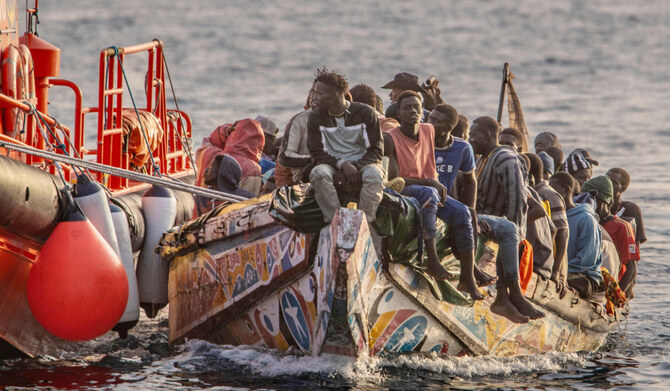
MADRID: As many as 50 migrants, many of them Pakistanis, may have drowned in the latest deadly wreck involving people trying to make the crossing from West Africa to Spain’s Canary Islands, migrant rights group Walking Borders said on Thursday.
Moroccan authorities rescued 36 people on Wednesday from a boat that had left Mauritania on Jan. 2 with 86 migrants, including 66 Pakistanis, on board, the group said.
Forty-four of those presumed to have drowned were from Pakistan, Walking Borders CEO Helena Maleno said on X.
“They spent 13 days of anguish on the crossing without anyone coming to rescue them,” she said.
The boat capsized off the coast of the disputed region of Western Sahara and several of the survivors, which included some Pakistanis, were taken to a camp near the port of Dakhla, Pakistan’s Foreign Affairs Ministry said in a post on X.
Pakistan said the boat was carrying 80 passengers.
Asked about what warnings it had received from NGOs regarding a missing boat, Spain’s maritime rescue service said it had learned on Jan. 10 about a vessel that had left Nouakchott in Mauritania and was experiencing problems but it could not confirm if it was the same boat.
The service said it had carried out air searches without success and had warned nearby ships.
Walking Borders said it had alerted authorities from all countries involved six days ago about the missing boat. Alarm Phone, an NGO that provides an emergency phone line for migrants lost at sea, also said it had alerted Spain’s maritime rescue service on Jan. 12 about a boat in distress.
A record 10,457 migrants, or 30 people a day, died trying to reach Spain in 2024, most while attempting to cross the Atlantic route from West African countries such as Mauritania and Senegal to the Canary islands, according to Walking Borders.
Citing the Walking Borders’ post on X, the Canary Islands’ regional leader Fernando Clavijo expressed his sorrow for the victims of the latest wreck and urged Spain and Europe to act to prevent further tragedies.
“The Atlantic cannot continue to be the graveyard of Africa,” Clavijo said on X. “They cannot continue to turn their backs on this humanitarian drama.”

Dozens of migrants may have drowned in attempt to cross to Spain, NGO says
Short Url
https://arab.news/8vytk
Dozens of migrants may have drowned in attempt to cross to Spain, NGO says
- Moroccan authorities rescued 36 people on Wednesday from a boat that had left Mauritania
- Forty-four of those presumed to have drowned were from Pakistan, Walking Borders CEO Helena Maleno said on X
Nepal’s rapper-turned-mayor challenges ousted PM
Katmandu: Nepal’s rapper-turned-politician Balendra Shah will go into a head-to-head election battle with the veteran prime minister he helped unseat, as he champions youth demands that toppled last year’s government.
The 35-year-old resigned last week as mayor of Katmandu to contest general elections, announcing Tuesday that he will directly challenge ousted prime minister KP Sharma Oli by running in the same constituency.
Nepal will hold general elections on March 5, the first since mass anti-corruption protests in September 2025 overthrew Oli, a 73-year-old Marxist leader and four-term prime minister.
“Contesting against a major figure... signals that I am not taking the easy way out,” Shah told AFP, ahead of his formal confirmation of candidacy.
“It demonstrates that, despite the problems or betrayals that have affected the country, we are moving toward addressing them,” he added.
Better known as Balen, the former mayor arrived for the interview at a Katmandu hotel dressed in black and wearing a traditional Nepali hat or “topi,” though he was without his trademark dark square sunglasses.
His hip-hop songs tackling corruption and inequality have drawn millions of views.
A civil engineer and rapper before joining politics, Shah stunned the political establishment in 2022 when he became the first independent candidate to be elected as Katmandu mayor.
He built a reputation as a sharp-tongued reformer, launching campaigns targeting tax evasion, traffic congestion, education and city waste.
Shah’s approach, however, drew criticism for heavy-handed enforcement and for communicating directly with his millions of social media followers rather than engaging with journalists.
“We made many processes that operated through informal arrangements transparent, through open procurement,” he said.
- ‘Ripple effect’ -
In December, Shah joined the centrist Rastriya Swatantra Party (RSP), led by television host Rabi Lamichhane, 50.
RSP, which became parliament’s fourth-largest force in the last elections in 2022, challenged parties that had dominated Nepal since the end of its civil war in 2006.
If the RSP secures a parliamentary majority, Shah would become prime minister.
“We share the same ideology,” Shah said, describing a vision of “a liberal economic system with social justice,” including free education and health care for the poor.
Rather than contesting from his Katmandu base, Shah will challenge Oli in his stronghold of Jhapa-5, a largely rural district 300 kilometers (185 miles) southeast of Katmandu.
“This should not be perceived as an egoistic decision,” Shah said. “The ripple effect would simply be greater if I contest from Jhapa.”
The September 8-9 demonstrations were initially triggered by anger over a brief government ban on major social media platforms, with protesters gathered under a loose “Gen Z” banner.
But deeper grievances — economic stagnation and entrenched corruption — fueled the unrest in the country of 30 million, in which at least 77 people were killed.
- ‘Grow our economy’ -
Shah backed the protests while urging restraint, emerging as a central figure in the movement.
“Gen Z’s number one demand is good governance, because there is a high level of corruption in the country,” he said, adding that his party had drawn on protesters for support.
“The Gen Z protest has opened a door — 40 percent of our central committee members and proportional representatives are new faces who emerged from the September protest,” he said.
Young Nepalis are looking for leaders promising economic reform. The World Bank estimates 82 percent of Nepal’s workforce is in informal employment, with GDP per capita at $1,447 in 2024.
“We need to grow our economy,” Shah said, citing tourism, trade and skilled jobs as ways to stem the mass outflow of workers.
Landlocked Nepal, wedged between regional giants India and China, faces geopolitical pressures, but Shah sees an opportunity to make Nepal a trade hub.
“My approach is to maintain a natural relationship with both neighboring nations,” he said.
And while focused on politics, he said that music remains central to his identity.
“Music is a medium to express oneself,” he said. “I will continue it, even if I am elected as prime minister.”
The 35-year-old resigned last week as mayor of Katmandu to contest general elections, announcing Tuesday that he will directly challenge ousted prime minister KP Sharma Oli by running in the same constituency.
Nepal will hold general elections on March 5, the first since mass anti-corruption protests in September 2025 overthrew Oli, a 73-year-old Marxist leader and four-term prime minister.
“Contesting against a major figure... signals that I am not taking the easy way out,” Shah told AFP, ahead of his formal confirmation of candidacy.
“It demonstrates that, despite the problems or betrayals that have affected the country, we are moving toward addressing them,” he added.
Better known as Balen, the former mayor arrived for the interview at a Katmandu hotel dressed in black and wearing a traditional Nepali hat or “topi,” though he was without his trademark dark square sunglasses.
His hip-hop songs tackling corruption and inequality have drawn millions of views.
A civil engineer and rapper before joining politics, Shah stunned the political establishment in 2022 when he became the first independent candidate to be elected as Katmandu mayor.
He built a reputation as a sharp-tongued reformer, launching campaigns targeting tax evasion, traffic congestion, education and city waste.
Shah’s approach, however, drew criticism for heavy-handed enforcement and for communicating directly with his millions of social media followers rather than engaging with journalists.
“We made many processes that operated through informal arrangements transparent, through open procurement,” he said.
- ‘Ripple effect’ -
In December, Shah joined the centrist Rastriya Swatantra Party (RSP), led by television host Rabi Lamichhane, 50.
RSP, which became parliament’s fourth-largest force in the last elections in 2022, challenged parties that had dominated Nepal since the end of its civil war in 2006.
If the RSP secures a parliamentary majority, Shah would become prime minister.
“We share the same ideology,” Shah said, describing a vision of “a liberal economic system with social justice,” including free education and health care for the poor.
Rather than contesting from his Katmandu base, Shah will challenge Oli in his stronghold of Jhapa-5, a largely rural district 300 kilometers (185 miles) southeast of Katmandu.
“This should not be perceived as an egoistic decision,” Shah said. “The ripple effect would simply be greater if I contest from Jhapa.”
The September 8-9 demonstrations were initially triggered by anger over a brief government ban on major social media platforms, with protesters gathered under a loose “Gen Z” banner.
But deeper grievances — economic stagnation and entrenched corruption — fueled the unrest in the country of 30 million, in which at least 77 people were killed.
- ‘Grow our economy’ -
Shah backed the protests while urging restraint, emerging as a central figure in the movement.
“Gen Z’s number one demand is good governance, because there is a high level of corruption in the country,” he said, adding that his party had drawn on protesters for support.
“The Gen Z protest has opened a door — 40 percent of our central committee members and proportional representatives are new faces who emerged from the September protest,” he said.
Young Nepalis are looking for leaders promising economic reform. The World Bank estimates 82 percent of Nepal’s workforce is in informal employment, with GDP per capita at $1,447 in 2024.
“We need to grow our economy,” Shah said, citing tourism, trade and skilled jobs as ways to stem the mass outflow of workers.
Landlocked Nepal, wedged between regional giants India and China, faces geopolitical pressures, but Shah sees an opportunity to make Nepal a trade hub.
“My approach is to maintain a natural relationship with both neighboring nations,” he said.
And while focused on politics, he said that music remains central to his identity.
“Music is a medium to express oneself,” he said. “I will continue it, even if I am elected as prime minister.”
© 2026 SAUDI RESEARCH & PUBLISHING COMPANY, All Rights Reserved And subject to Terms of Use Agreement.


