

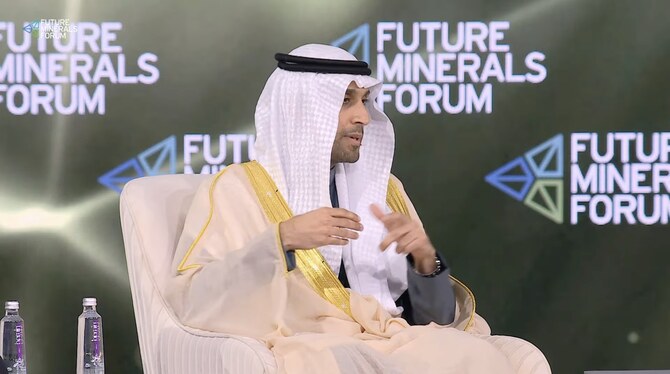

RIYADH: Saudi Arabia is poised to invest SR120 million ($32 million) this year in mining incentives aimed at supporting companies with the right technical expertise, the country’s deputy minister announced.
On the third and final day of the Future Minerals Forum, Abdulrahman Al-Belushi, deputy minister for mining development at the Ministry of Industry and Mineral Resources, said that financial support for the sector will continue to increase.
“Last year, we injected about SR70 million via the exploration enablement program for six companies, and this year we’re working on launching SR120 million worth of incentives to be distributed to companies that have the right technical expertise,” he said during a panel discussion.
This initiative is part of Saudi Arabia’s broader strategy to develop its mining sector and accelerate project timelines. “Our focus today is to accelerate the duration from the start of exploration all the way to the production of a mine,” Al-Belushi added.
He also emphasized the government’s commitment to providing essential resources for mining companies. “We’ve been busy listening to explorers and miners in the Kingdom and around the world. We gathered three components or three critical elements that are important to their success. They always want lands, they want data, and they want financing.”
To further strengthen the industry, Saudi Arabia has been heavily investing in geological research and exploration. “We’ve been working on the regional geosciences program, and that is nearing completion, and we will start off with the detailed mapping program that should be completed by 2030,” Al-Belushi explained.
He also highlighted the value of private sector contributions: “The private sector data is much more valuable, and now we’re trying to add the private sector data to the national geological database.”
Over the past five years, SR1.3 billion has been invested in exploration, generating a wealth of geological knowledge. “That’s a wealth of geological knowledge that should be in our geological database,” he added.
The Saudi government is also preparing to allocate significant land areas for future mining projects.
“We’ve been working actively on generating the data rules, availing 50,000 sq. km worth of lands for tendering in 2025 — this is the size of a small country,” Al-Belushi said.
Industry leaders expressed strong confidence in the future of the mining sector. “My confidence in the mining sector is 10 out of 10,” said Suliman Al-Othaim, chairman of Saudi Gold Refinery.
He described Saudi Arabia’s mining potential as unparalleled.
“We do have the minerals, which is a golden opportunity. We are in a world of paradise in Saudi Arabia because we have the minerals, we have the infrastructure, we have the electricity, we have the support of the government,” he said, predicting, “We will see tremendous growth within the coming five years.”
Darryl Clark, executive vice president of exploration at Ma’aden, highlighted Saudi Arabia’s unique geological features. “What I observe, and what I see here in Saudi Arabia that gets me very excited are a couple of unique geological features,” he said.
He elaborated, noting, “Saudi Arabia, geologically speaking, is broken up into two big chunks. On the western side, we have the shield, and on the eastern side, we have the platform rocks.”
Public support and sustainability were also central topics during the forum. Geoffrey McDonald Day, CEO of AMAK, stressed the importance of societal backing for the mining industry’s long-term success.
“I think how we maintain societal support for the mining industry is going to be a key thing for the sustainable success of the mining industry,” he said. He also underscored the importance of innovation, stating, “I think the ability to transform and value-add from technology is limited by our own imagination.”
Abdulaziz Al-Hamwah, vice chairman and CEO of Modern Industrial Investment Holding Group, linked the transformation of the mining sector to Saudi Vision 2030. “The mining sector today is in a better position. Why? Because of Vision 2030,” he said.
Al-Hamwah also pointed out that Saudi Arabia’s global leadership in oil, gas, and petrochemicals serves as a blueprint for its mining ambitions.
“Saudi Arabia’s transformation, as one of the global leaders in oil and gas and petrochemicals, profiles a compelling blueprint for the mining sector,” he noted.


