PESHAWAR: Four persons were injured when an aid convoy enroute to Pakistan’s northwestern Kurram district, which has been rocked by sectarian clashes in recent months, was attacked by unidentified armed men on Thursday, police and health officials confirmed, as authorities struggle to main law and order in the restive area.
Kurram, a northwestern district of around 600,000 people in Pakistan’s Khyber Pakhtunkhwa (KP) province, has been hit hard by tribal and sectarian clashes since Nov. 21, 2024, when gunmen attacked a convoy of Shia passengers, killing 52. Sporadic clashes since then have killed at least 136 people before the provincial government brokered a peace agreement among the warring tribes this month.
The attack sparked further violence and blockade of a main road connecting Kurram’s main town of Parachinar with the provincial capital of Peshawar, causing medicine, food and fuel shortages in the area.
This is the second such attack on an aid convoy enroute to the district, in the locality. Unidentified gunmen attacked an aid convoy at Bagan, a tense locality, on Jan. 4, injuring five people including a top administration official. Thursday’s attack also took place in Began.
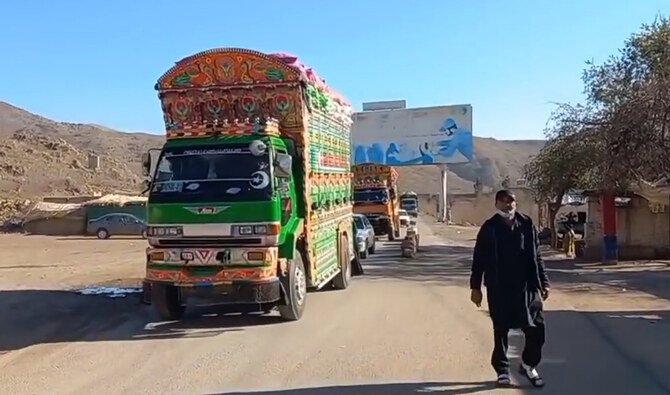
“The aid convoy of more than 30 vehicles en route to Upper Kurram was attacked with gunfire by unknown armed men in Bagan area,” a police official, who spoke on condition of anonymity as he was not authorized to speak to the media, told Arab News.
“A few of the trucks which were loaded with food items were put on fire and have been burnt,” he added.
Police and law enforcement agencies are investigating the matter, the official said.
The attack caused injuries to four persons, according to Zakir Khan, the senior medical officer at the Basic Health Unit in Manduri, Lower Kurram.
“Four injured were brought to the hospital (BHU Manduri) among whom two were serious,” he said, adding that patients critically wounded had been referred to Peshawar for treatment.
The attack takes place days after authorities started demolishing bunkers in Lower Kurram, more than a week after the peace agreement was reached.
Under the peace agreement signed on Jan. 1, both sides agreed on the demolition of bunkers and the handover of heavy weapons to authorities within two weeks.
Any party that launches an attack after the signing of the deal will be considered a “terrorist” and action will be taken against it, as per the agreement. A fine of Rs10 million ($35,933) will be imposed on those who violate the terms of the deal by using weapons against each other, it said.
The agreement called for land disputes in the volatile district to be settled on a priority basis with the cooperation of local tribes and the district administration.
It also said that opening offices of banned outfits will be prohibited in the district, while social media accounts spreading hate will be discouraged via collective efforts backed by the government.

Gunmen attack aid convoy enroute to Pakistani district hit by sectarian clashes, injuring 4
https://arab.news/8majs
Gunmen attack aid convoy enroute to Pakistani district hit by sectarian clashes, injuring 4
- At least 136 have been killed due to sectarian, land disputes in Kurram district since Nov. 21
- Five persons were injured on Jan. 4 in same locality when armed men attacked an aid convoy
Qatar, Pakistan resolve to boost strategic, economic cooperation at Doha talks
- Both countries urge dialogue on Afghanistan amid renewed border tensions between Islamabad and Kabul
- Discussions focus on bilateral trade and investment, energy, defense, manpower and labor and culture
ISLAMABAD: Pakistan and Qatar on Tuesday agreed to deepen their strategic and economic cooperation during high-level talks between Prime Minister Shehbaz Sharif and his Qatari counterpart Sheikh Mohammed bin Abdulrahman bin Jassim Al Thani, Sharif’s office said.
Sharif visited Qatar along with a high-level delegation on the invitation of Qatari emir Sheikh Tamim bin Hamad Al Thani. The Pakistani premier also held meetings with Qatar’s trade and defense ministers to discuss cooperation in various domains.
The visit came at a time when Pakistan is seeking closer economic engagement with Gulf partners amid its broader push to stabilize the economy and attract investment, while maintaining security and defense cooperation with key regional states.
During their meeting in Doha, PM Sharif and Qatar’s Sheikh Mohammed discussed bilateral relations and exchanged views on regional and international developments, according to the Pakistan prime minister’s office.
“They reaffirmed the strong brotherly relations between Pakistan and Qatar and expressed satisfaction at the growing momentum in political, economic and institutional ties,” Sharif’s office said.
“Discussions focused on enhancing cooperation in the fields of trade and investment, energy, defense, manpower and labor and culture, with both sides stressing the importance of their task force to accelerate cooperation in all these areas.”
Pakistan and Qatar maintain strong trade and investment ties. In 2022, the office of Qatar’s emir said the Qatar Investment Authority planned to invest $3 billion in Pakistan, targeting sectors including transport, aviation, education, health, media, technology and labor.
Nearly 300,000 Pakistanis live and work in Qatar, according to Pakistan’s foreign office, with many employed in health, education, engineering and public services, as well as construction and transport. The two countries engage through forums such as the Bilateral Political Consultations and the Joint Ministerial Commission.
Sharif said he had productive discussions with Qatar’s emir, Sheikh Tamim bin Hamad Al Thani, on how the two sides could transform their brotherly ties into mutually beneficial economic relationships.
“We also took stock of the regional situation,” he said on X. “Pakistan and Qatar will continue to work together for peace and stability in the region and beyond.”
DIALOGUE WITH AFGHANISTAN
Earlier, Sharif and Qatar’s Deputy PM Sheikh Saoud Al-Thani discussed the situation in Afghanistan and called for dialogue to support regional stability.
The meeting took place amid renewed tensions after Islamabad carried out airstrikes last week on what it described as Tehreek-e-Taliban Pakistan (TTP) targets inside Afghanistan. Kabul said the strikes killed civilians and vowed to respond to what it called a violation of its sovereignty.
“Regional developments were also discussed, in particular the situation in Iran and Afghanistan,” Sharif’s office said in a statement. “Both sides emphasized the importance of dialogue, de-escalation and collective efforts to promote peace and stability in the region.”
This was the second time in less than six months that Pakistan conducted airstrikes in Afghanistan. The last strikes triggered heavy, weeklong clashes between the neighbors along their border before Qatar and Turkiye mediated a ceasefire between them in Oct. last year.
Separately, Sharif held meetings with Qatar’s State Minister for Trade Dr. Ahmed bin Mohammed Al-Sayed and a delegation of the Qatar Businessmen Association (QBA), highlighting Pakistan’s investment-friendly reforms.
He invited QBA members to explore opportunities in infrastructure, logistics, energy, agriculture, technology and export-oriented manufacturing, his office said.


