

After third round of talks, Pakistan PM forms committee on demands by Imran Khan’s party

1 / 2
Pakistan's Opposition Leader National Assembly, Omar Ayub (right), hands over written demands of Pakistan Tehreek-e-Insaf to Speaker National Assembly, Sardar Ayaz Sadiq, in Islamabad, Pakistan, on January 16, 2025. (Abdul Latif)
2 / 2
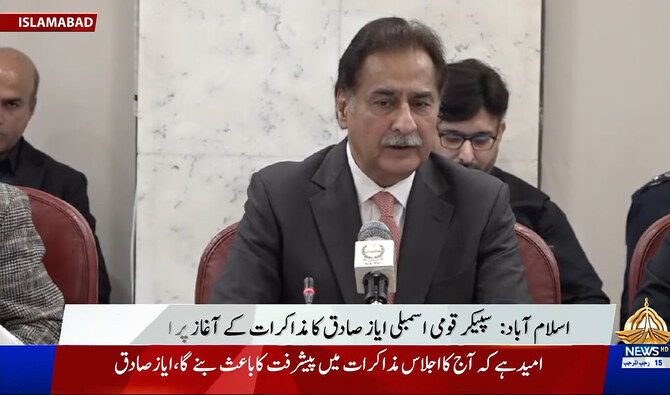
Speaker National Assembly, Sardar Ayaz Sadiq, is addressing the meeting ahead of the third round of talks between the government and Pakistan Tehreek-e-Insaf in Islamabad, Pakistan, on January 15, 2025. (PTV News/Screengrab)
Short Url
Updated 16 January 2025
Follow

After third round of talks, Pakistan PM forms committee on demands by Imran Khan’s party

  • Khan’s party is demanding release of political prisoners, judicial probe into allegations it led violent protests
  • Committee features members of government’s ally political parties, will issue “final response,” says PM’s aide

ISLAMABAD: Pakistan’s prime minister has constituted a committee comprising members of its ally political parties to respond to a “Charter of Demands” submitted by ex-PM Imran Khan’s party, Shehbaz Sharif’s aide said after a fresh round of talks between the government and the opposition to ease political tensions concluded on Thursday. 
Khan’s ouster in a parliamentary vote of no-confidence in 2022 has since plunged the country into long-term political crisis, particularly since the founder of the Pakistan Tehreek-e-Insaf (PTI) was jailed in August 2023 on corruption and other charges and remains behind bars. Khan’s party and supporters regularly hold protests calling for his release, with some of the demonstrations turning violent, including one in November last year in which the government says four troops were killed and the PTI says 12 of its supporters died. 
Khan’s brief arrest on May 9, 2023, in a land graft case had also sparked countrywide protests that saw his supporters attack and ransack military installations in an unprecedented backlash against Pakistan’s powerful army generals. Hundreds of PTI supporters and leaders were subsequently arrested and dozens remain in jail as they face trail before civilian and military courts. 
Khan last month set up a negotiating committee of top PTI leaders to open dialogue with the government on two main demands: the release of political prisoners and the establishment of judicial commissions to investigate the May 9, 2023, and Nov. 26, 2024 protests. The first round of talks took place on Dec. 23 and the second on Jan. 2, while the third was held today, Thursday. 
“The prime minister has constituted a committee which has the representation of all ally parties,” Rana Sanaullah, the prime minister’s adviser on political affairs, told reporters at a news conference. 
“This committee will prepare an effective response to this Charter of Demands, which we will present to the PTI or the opposition committee in the same manner. That will be the final response,” he added. 
Sanaullah said one of the PTI’s principal demands since the past 10-11 months was that the results of the February 2024 general election, which the party claims were manipulated, be reversed. He said the PTI has “resigned” from the demand and did not mention it in the third round of talks between the two sides. 

A PDF Embed Here

PTI Chairman Gohar Ali Khan, meanwhile, hoped on Wednesday that the government would consider the party’s demands seriously. 
“We hope that if [the government] participates with seriousness, an open mind, and sincerity, a solution can be found to all the issues,” he told reporters.
The talks opened last month as Khan had threatened a civil disobedience movement and amid growing concerns he could face trial by a military court for allegedly inciting attacks on sensitive security installations during the May 9 protests.
The negotiations also began two days after 25 civilians were sentenced by a military court to periods of two to 10 years of “rigorous imprisonment” in connection with the attacks on military facilities on May 9, 2023. Just days later on Dec. 26, another 60 civilians were sentenced by a military court to jail time ranging from 2 to 10 years.
Khan, facing a slew of legal cases from jail, says all charges against him are politically motivated to keep him and his party out of power. Khan had to sit out February 2024 general election as convicted felons cannot run for public office in Pakistan.


At ECO meeting, Pakistan proposes ‘Regional Innovation Hub’ to curb natural disasters

Updated 5 sec ago
Follow

At ECO meeting, Pakistan proposes ‘Regional Innovation Hub’ to curb natural disasters

  • Pakistan hosts high-level 10th ECO Ministerial Meeting on Disaster Risk Reduction in Islamabad
  • Innovation hub to focus on early warning technologies, risk informed infrastructure planning

ISLAMABAD: Pakistan has proposed to set up a “Regional Innovation Hub on Disaster Risk Reduction” that focuses on early warning technologies and risk informed infrastructure planning, the Press Information Department (PID) said on Wednesday, as Islamabad hosts a high-level meeting of the Economic Cooperation Organization (ECO).

The ECO’s 10th Ministerial Meeting on Disaster Risk Reduction (DRR) is being held from Jan. 21-22 at the headquarters of the National Disaster Management Authority (NDMA) in Pakistan’s capital. 

The high-level regional forum brings together ministers, and senior officials from ECO member states, representatives of the ECO Secretariat and regional and international partner organizations. The event is aimed to strengthen collective efforts toward enhancing disaster resilience across the ECO region, the PID said. 

“Key agenda items include regional cooperation on early warning systems, disaster risk information management, landslide hazard zoning, inclusive disaster preparedness initiatives, and Pakistan’s proposal to establish a Regional Innovation Hub on Disaster Risk Reduction, focusing on early warning technologies, satellite data utilization, and risk-informed infrastructure planning,” the statement said. 

The meeting was attended by delegations from ECO member states including Pakistan, Türkiye, Azerbaijan, Iran, Kyrgyzstan, Tajikistan, Turkmenistan and Uzbekistan. Representatives of regional and international organizations and development partners were also in attendance.

Discussions focused on enhancing regional coordination, harmonizing disaster risk reduction frameworks, and strengthening collective preparedness against transboundary and climate-induced hazards impacting the ECO region, the PID said. 

ECO members states such as Pakistan, Türkiye, Afghanistan and others have faced natural calamities such as floods and earthquakes in recent years that have killed tens of thousands of people. 

Heavy rains triggered catastrophic floods in Pakistan in 2022 and 2025 that killed thousands of people and caused damages to critical infrastructure, inflicting losses worth billions of dollars. 

Islamabad has since then called on regional countries to join hands to cooperate to avert future climate disasters and promote early warning systems to avoid calamities in future.