

REVIEW: ‘American Primeval’ charts the truly Wild West 

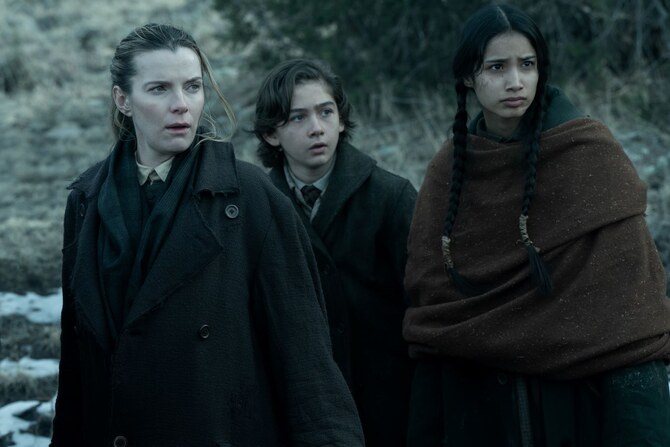
Betty Gilpin as Sara Rowell, Preston Mota as Devin Rowell, and Shawnee Pourier as Two Moons in ‘American Primeval.’ (Netflix)
Short Url
Updated 16 January 2025
Follow

REVIEW: ‘American Primeval’ charts the truly Wild West 

  • Netflix thriller is as relentless as it is unflinching

LONDON: When director Peter Berg had an idea for a project based on the Mountain Meadows Massacre — a series of attacks during the US’s 19th-century Utah War — he reached out to “The Revenant” writer Mark L. Smith to flesh out the show. As luck would have it, Smith was already working on an idea set during the same period following real-life pioneer Jim Bridger, a character he’d explored as a much younger man in that film. The result is Netflix’s “American Primeval,” set in the untamed world that predates the Wild West as audiences have come to know it. This is a brutal, savage place in which US army forces battle Mormon militias, and native tribes try to eke out a peaceful existence amid the chaos. 

Sara Rowell (Betty Gilpin) and her son Devin (Preston Mota) arrive at Fort Bridger, in search of a guide to escort them through the perilous country. Bridger (Shea Whigham) introduces them to Isaac Reed (Taylor Kitsch), a bereaved hunter and trapper who eventually agrees to go with them. The trio, later joined by runaway Shoshone Two Moons (Shawnee Pourier), set out on the dangerous trek, dodging armies, evading bounty hunters, and navigating settlers with their own (often unsavory) plans.  

At the same time, Mormon settler Jacob Pratt (Dane DeHaan) searches for his kidnapped wife Abish (Saura Lightfoot-Leon), while Mormon leader Brigham Young (Kim Coates) sets his eyes on Fort Bridger as a means to defend his followers from what he assumes to be an imminent attack by US Army forces. 

Every minute of the six episodes feels relentless. There’s little room for quieter character development — Isaac’s backstory is glossed over, Abish’s relationship with her captors doesn’t get the airtime it deserves, and Jacob’s realizations about the behavior of his Mormon brothers feels rushed.  

What Berg does cram in is certainly spectacular — “American Primeval” is brutal, bloody and gorgeous in equal measure — and the sense of constant peril is effective and exhausting. Kitsch and Gilpin are great, too, but there’s a sense that, with a little more time, Isaac and Sara’s relationship could be an even more interesting counterpoint to the savagery around them. This is a breathless series. With a beat or two more to breathe, it could have been truly epic. 


Review: ‘Relay’

Updated 21 December 2025
Follow

Review: ‘Relay’

RIYADH: “Relay” is a thriller that knows what its role is in an era of overly explained plots and predictable pacing, making it feel at once refreshing and strangely nostalgic. 

I went into the 2025 film with genuine curiosity after listening to Academy Award-winning British actor Riz Ahmed talk about it on Podcrushed, a podcast by “You” star Penn Badgley. Within the first half hour I was already texting my friends to add it to their watchlists.

There is something confident and restrained about “Relay” that pulls you in, and much of that assurance comes from the film’s lead actors. Ahmed gives a measured, deeply controlled performance as Ash, a man who operates in the shadows with precision and discipline. He excels at disappearing, slipping between identities, and staying one step ahead, yet the story is careful not to mythologize him as untouchable. 

Every pause, glance, and decision carries weight, making Ash feel intelligent and capable. It is one of those roles where presence does most of the work.

Lily James brings a vital counterbalance as Sarah, a woman caught at a moral and emotional crossroads, who is both vulnerable and resilient. The slow-burn connection between her and Ash is shaped by shared isolation and his growing desire to protect her.

The premise is deceptively simple. Ash acts as a middleman for people entangled in corporate crimes, using a relay system to communicate and extract them safely. 

The film’s most inventive choice is its use of the Telecommunications Relay Service — used by people who are deaf and hard of hearing to communicate over the phone — as a central plot device, thoughtfully integrating a vital accessibility tool into the heart of the story. 

As conversations between Ash and Sarah unfold through the relay system, the film builds a unique sense of intimacy and suspense, using its structure to shape tension in a way that feels cleverly crafted.

“Relay” plays like a retro crime thriller, echoing classic spy films in its mood and pacing while grounding itself in contemporary anxieties. 

Beneath the mechanics and thrills of the plot, it is about loneliness, the longing to be seen, and the murky ethics of survival in systems designed to crush individuals. 

If you are a life-long fan of thrillers, “Relay” might still manage to surprise you.