

UN Security Council calls on countries to stop arming Houthis as Red Sea attacks continue

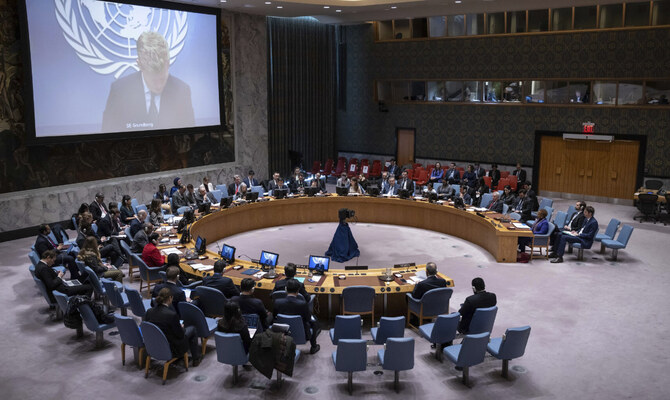
A general view shows a Security Council meeting at the United Nations headquarters, Wednesday, Jan. 15, 2025. (AP)
Short Url
Updated 16 January 2025
Follow

UN Security Council calls on countries to stop arming Houthis as Red Sea attacks continue

  • Resolution drafted by Greece and US calls for root causes of the attacks to be addressed, including ‘conflicts contributing to regional tensions’
  • Russia abstains from vote, describes draft resolution as ‘highly unbalanced and politicized’ because it fails to denounce attacks on Yemeni sovereignty by US, UK and Israel

NEW YORK CITY: The UN Security Council on Wednesday adopted a resolution that extends by six months the requirement for the secretary-general to provide monthly reports on attacks by the Houthis in Yemen against ships in the Red Sea.

The reporting obligation was established by the adoption of Resolution 2722 in January 2024, which was introduced in response to the repeated attacks on commercial shipping. The Iran-backed Houthis vowed to continue targeting vessels until Israel ended its war in Gaza.

The attacks prompted retaliatory strikes on Houthi targets in Yemen by the US, UK and Israel. Meanwhile, the EU launched Operation Aspides, a defensive mission based in Greece that aims to safeguard and escort vessels in the Red Sea but does not participate in any offensive action.

The text of the extension resolution was drafted by Greece and the US, the co-penholders on the issue of the Red Sea crisis. Twelve members of the Security Council voted in favor, while Algeria, China and Russia abstained.

A source at the Russian mission in New York told Arab News that although the safety of maritime navigation is of the utmost importance to Moscow, it considered the language of Resolution 2763 to be “highly politicized and unbalanced” because it failed to mention “the attacks on the sovereignty of Yemen” in the form of airstrikes by the US, UK and Israel.

The text of the resolution, which was seen by Arab News, demands that the Houthis immediately cease all attacks against merchant and commercial vessels and release the cargo ship Galaxy Leader and its crew. The Houthis hijacked the vessel in November 2023 and 25 crew members remain detained by the group.

The new resolution also emphasizes the need “to address the root causes of these attacks, including the conflicts contributing to regional tensions and the disruption of maritime security.”

It notes the use of advanced weaponry by the Houthis and demands that UN member states stop supplying the group with arms.

Greece’s permanent representative to the UN, Evangelos Sekeris, told fellow council members that the “Houthis’ constant attacks against vessels are still disrupting international commercial shipping. Maritime security conditions remain degraded and are expected to further deteriorate, while rerouting of shipping companies continues in favor of safer but costlier alternative maritime routes.”

Sekeris lamented that fact that “we are still witnessing the Houthis’ ongoing aggressiveness and escalatory actions through launching unjustified attacks, with the systematic use of advanced weaponry such as anti-ballistic missiles and drones, even against civil infrastructure, including oil terminals under the control of the government of Yemen.”

He added: “The humanitarian repercussions are severe. We need to put an end to this, by looking thoroughly into the origins of the use of advanced weaponry and by preserving the applicability of the targeted arms embargo.”

This year, Greece, which has a keen interest in maritime security, took over from Japan as the co-penholder on the issue of the Red Sea crisis.

Maritime security is also a key concern for Denmark, Pakistan, Panama and Somalia, who took their seats as newly elected nonpermanent members of the Security Council at the start of this year.

Ships owned or operated by companies from Denmark, Greece and Panama have been targeted by the Houthis in the Red Sea, while Pakistan has participated in maritime-security operations in the Western Indian Ocean. Somalia has been dealing with piracy off its coast for several years.


Syria’s leader set to visit Berlin with deportations in focus

Updated 58 min 15 sec ago
Follow

Syria’s leader set to visit Berlin with deportations in focus

  • Sharaa is scheduled to meet his counterpart Frank-Walter Steinmeier, the German president’s office said

BERLIN: Syrian President Ahmed Al-Sharaa is expected in Berlin on Tuesday for talks, as German officials seek to step up deportations of Syrians, despite unease about continued instability in their homeland.
Sharaa is scheduled to meet his counterpart Frank-Walter Steinmeier, the German president’s office said.
Chancellor Friedrich Merz’s office has yet to announce whether he would also hold talks with Sharaa during the visit.
Since ousting Syria’s longtime leader Bashar Assad in late 2024, Sharaa has made frequent overseas trips as the former Islamist rebel chief undergoes a rapid reinvention.
He has made official visits to the United States and France, and a series of international sanctions on Syria have been lifted.
The focus of next week’s visit for the German government will be on stepping up repatriations of Syrians, a priority for Merz’s conservative-led coalition since Assad was toppled.
Roughly one million Syrians fled to Germany in recent years, many of them arriving in 2015-16 to escape the civil war.
In November Merz, who fears being outflanked by the far-right AfD party on immigration, insisted there was “no longer any reason” for Syrians who fled the war to seek asylum in Germany.
“For those who refuse to return to their country, we can of course expel them,” he said.

- ‘Dramatic situation’ -

In December, Germany carried out its first deportation of a Syrian since the civil war erupted in 2011, flying a man convicted of crimes to Damascus.
But rights groups have criticized such efforts, citing continued instability in Syria and evidence of rights abuses.
Violence between the government and minority groups has repeatedly flared in multi-confessional Syria since Sharaa came to power, including recent clashes between the army and Kurdish forces.
Several NGOs, including those representing the Kurdish and Alawite Syrian communities in Germany, have urged Berlin to axe Sharaa’s planned visit, labelling it “totally unacceptable.”
“The situation in Syria is dramatic. Civilians are being persecuted solely on the basis of their ethnic or religious affiliation,” they said in a joint statement.
“It is incomprehensible to us and legally and morally unacceptable that the German government knowingly intends to receive a person suspected of being responsible for these acts at the chancellery.”
The Kurdish Community of Germany, among the signatories of that statement, also filed a complaint with German prosecutors in November, accusing Sharaa of war crimes, genocide and crimes against humanity.
There have also been voices urging caution within government.
On a trip to Damascus in October, Foreign Minister Johann Wadephul said that the potential for Syrians to return was “very limited” since the war had destroyed much of the country’s infrastructure.
But his comments triggered a backlash from his own conservative Christian Democratic Union party.