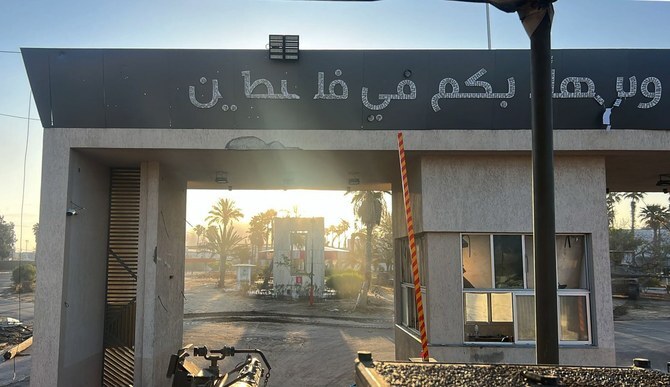
CAIRO: Egyptian state media reported Wednesday that coordination was underway to “open the Palestinian Rafah crossing to allow the entry of international aid” into Gaza, citing an Egyptian security source.
Egypt was “preparing to bring in the largest possible amount of aid to the Gaza Strip,” following news of a ceasefire deal reached between Israel and Hamas, state-owned newspaper Al-Ahram said.
It cited a report from Al-Qahera News, which is closely linked to state intelligence.
Mediators said Israel and Hamas agreed Wednesday to a ceasefire and a deal to release hostages held in Gaza, but Israel cautioned that the final sticking points needed to be ironed out.
Pressure to put an end to the fighting had ratcheted up in recent days, as mediators Qatar, Egypt and the United States intensified efforts to cement an agreement.
The Rafah border crossing has been closed since May, when the Israeli military seized the area and closed the Palestinian side of the crossing.
Egypt has repeatedly said it will only recognize Palestinian authority over the crossing.
Al-Qahera News on Wednesday said the framework agreement comprised of three interconnected phases.
The first would last 42 days and involve a temporary halt to military operations on both sides.
It would also require the withdrawal of Israeli forces away from population centers and toward Gaza’s borders, as well as the temporary cessation of flyovers by Israeli warplanes and reconnaissance aircraft for 10 hours each day.

Talks underway to open Egypt-Gaza border crossing for aid: Egypt state media
https://arab.news/cqjdk
Talks underway to open Egypt-Gaza border crossing for aid: Egypt state media
Baghdad traders protest new customs tariffs
- The demonstrators gathered outside the General Customs Directorate on Sunday, chanting slogans against corruption and rejecting the new fees
BAGHDAD: Hundreds of traders and owners of customs clearance companies protested in central Baghdad on Sunday, demanding that Iraq’s government reverse recently imposed customs tariffs they say have sharply increased their costs and disrupted trade.
The new tariffs that took effect on Jan. 1 were imposed to reduce the country’s debt and reliance on oil revenues, as oil prices have fallen.
Iraq faces a debt of more than 90 trillion Iraqi dinars ($69 billion) — and a state budget that remains reliant on oil for about 90 percent of revenues, despite attempts to diversify.
But traders say the new tariffs — in some cases as high as 30 percent — have placed an unfair burden on them. Opponents have filed a lawsuit aiming to reduce the decision, which Iraq’s Federal Supreme Court is set to rule on Wednesday.
The demonstrators gathered outside the General Customs Directorate on Sunday, chanting slogans against corruption and rejecting the new fees.
“We used to pay about 3 million dinars per container, but now in some cases they ask for up to 14 million,” said Haider Al-Safi, a transport and customs clearance company owner.
“Even infant milk fees rose from about 495,000 dinars to nearly 3 million.”
He said that the new tariffs have caused a backlog of goods at the Umm Qasr port in southern Iraq and added that electric vehicles, previously exempt from customs duties, are now subject to a 15 percent fee.
“The main victim is the citizen with limited income, and government employee whose salary barely covers his daily living, those who have to pay rent, and have children with school expenses — they all will be affected by the market,” said Mohammed Samir, a wholesale trader from Baghdad.
Protesters also accused influential groups of facilitating the release of goods in exchange for lower unofficial payments, calling it widespread corruption.
Many traders, they said, are now considering routing their imports through the Kurdistan region, where fees are lower.
The protests coincided with a nationwide strike by shop owners, who closed markets and stores in several parts of Baghdad to oppose the tariff increase.
In major commercial districts, shops remained shut and hung up banners reading “Customs fees are killing citizens.”


